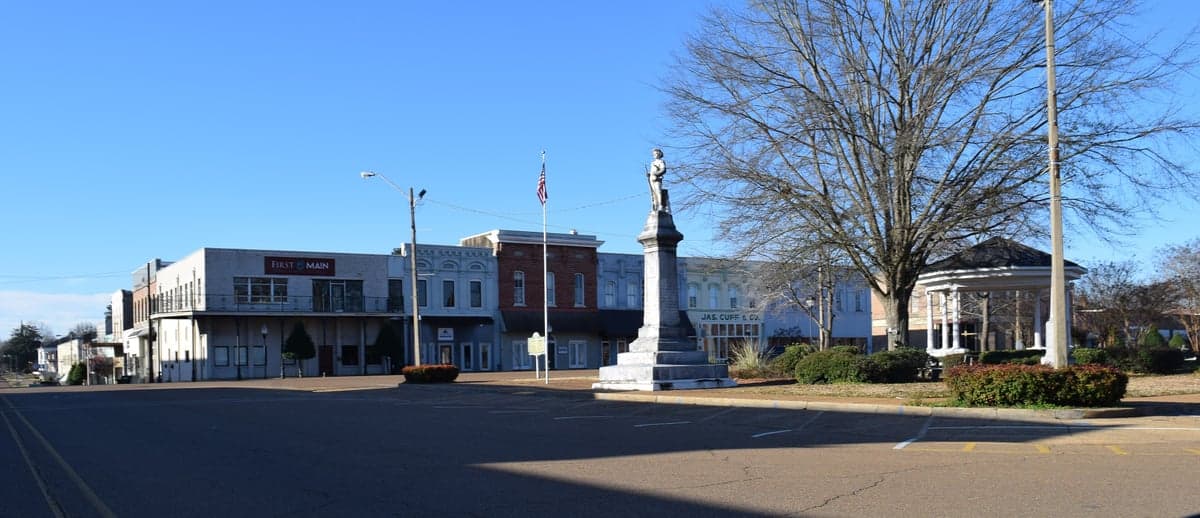
Photo: Wikipedia
Strategic Assessment of Grenada, MS
Workable tactical position. Some exposure to population density or targets, but generally defensible in a crisis.
What does the Strategic Assessment tell us?
Our Strategic Assessment grades tactical survivability of an area. Major population centers, military targets, fallout zones, natural disasters, and border exposure all drive risk — lower exposure means a more defensible position in a crisis.
This is heavily inspired by Joel Skousen's Strategic Relocation book. Highly recommended you checkout the book ($)What does this tell us?
Our Strategic Assessment grades tactical survivability of an area. Major population centers, military targets, fallout zones, natural disasters, and border exposure all drive risk — lower exposure means a more defensible position in a crisis.
This is heavily inspired by Joel Skousen's Strategic Relocation book. Highly recommended you checkout the book ($)Strategic Pillars

Key Distances
Regional Safe Places
Below is our recommended "safe zones" in Mississippi and the surrounding area based on our strategic heuristics. For most people, it's unrealistic to live in a “safe zone” full-time due to work, family or other personal reasons. They tend to be more rural. However, many of these areas are perfect for second homes and retreat properties that double as a vacation home or even a short-term rental.
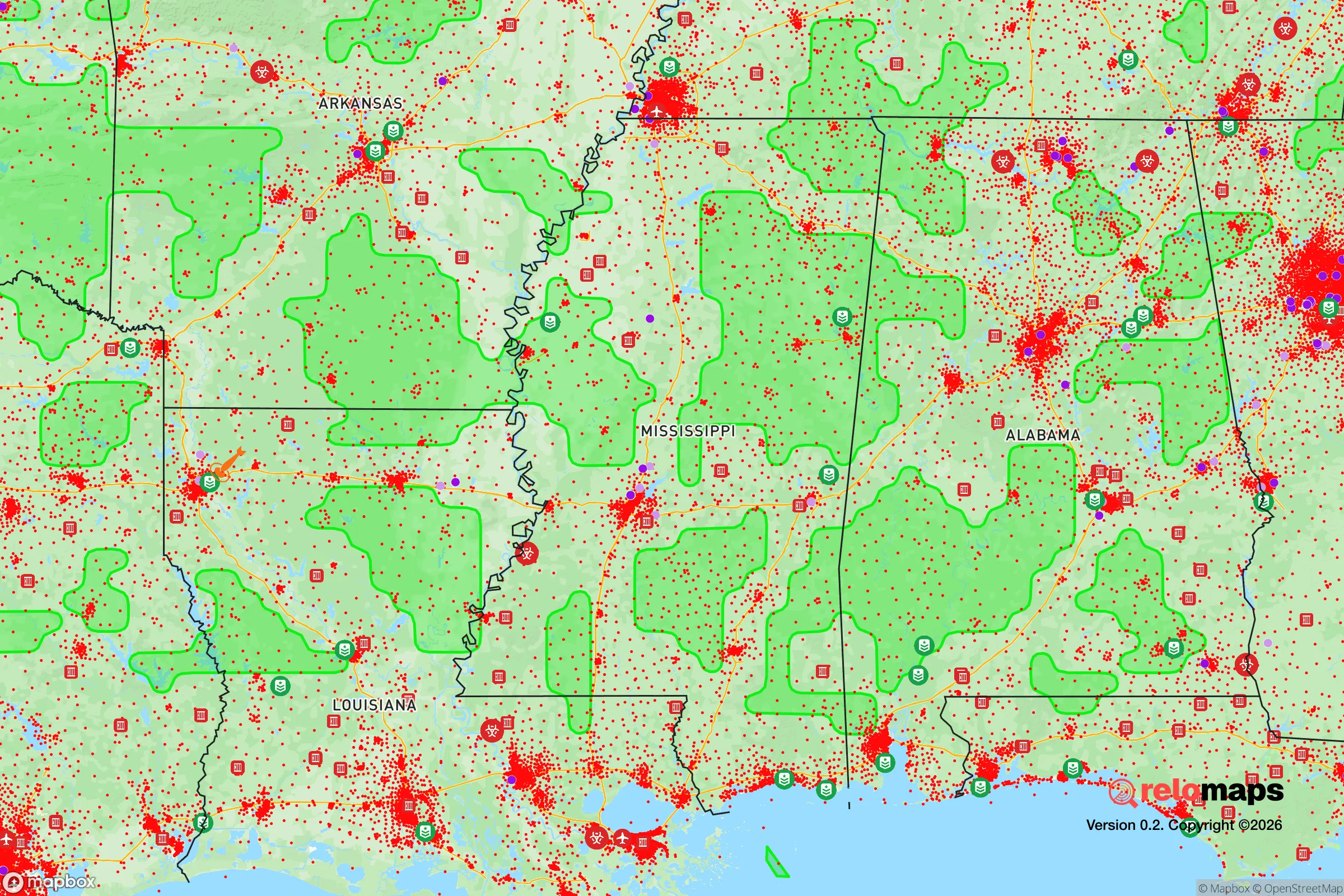
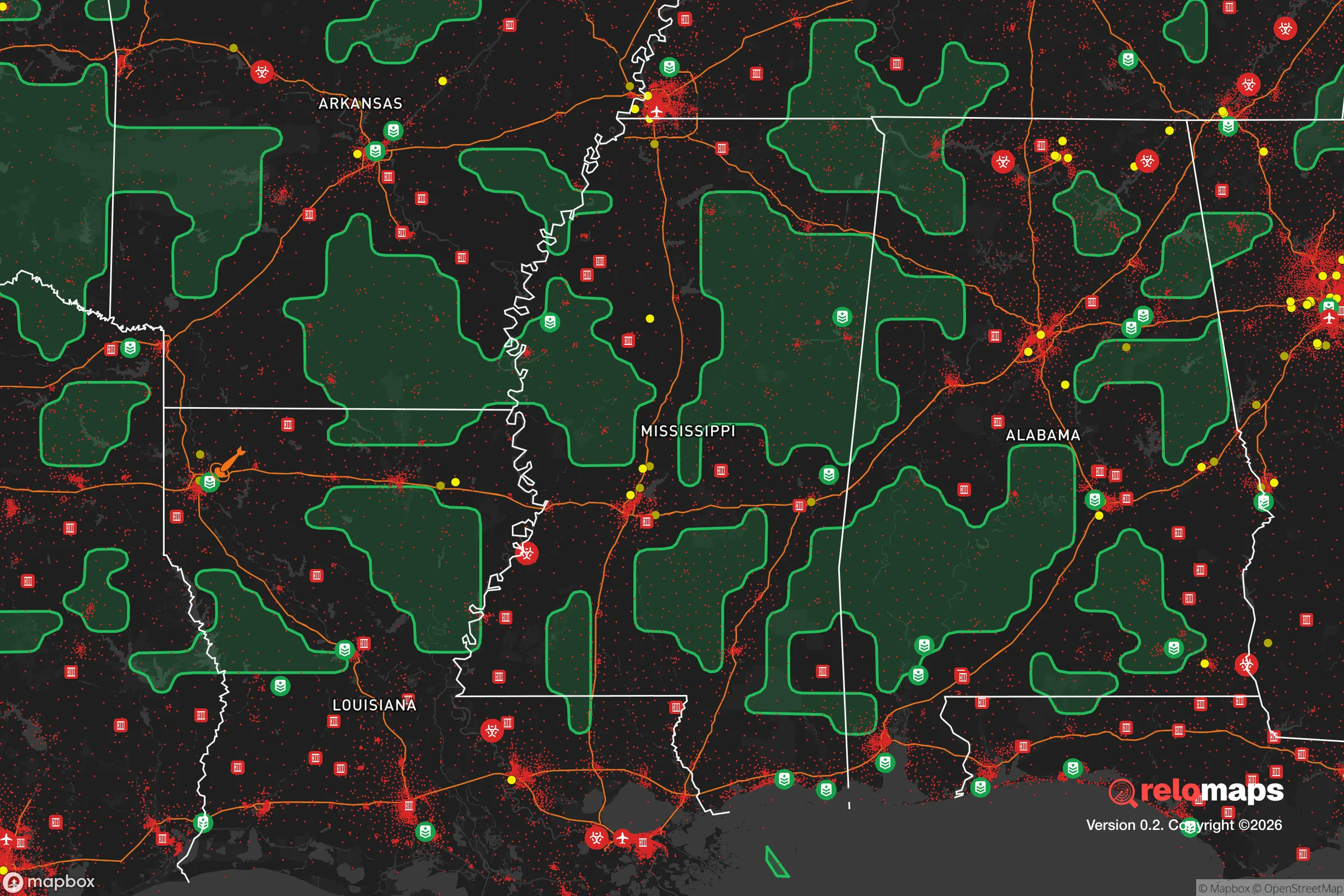


Important Note: For informational purposes only. This does not mean nothing bad ever happens in the green zones. Please use common sense. This is based on public data and modeled with AI. We tried to take a conservative approach but mistakes happen. We update this regularly as new information becomes available.
Solar Generator Recommendations
Backup power matters more here than in safer locations. We've picked three solar generators across budgets and capacity tiers — start with the budget unit if you only need a few essentials, or step up if you want to run a fridge and HVAC for days at a time.

Jackery Portable Power Station Explorer 300
Budget OptionPower on the Go: Weighing only 11 lbs, it's convenient to set up and store with book-sized foldable solar panels

BLUETTI Portable Power Station AC180
Designed for both indoor and outdoor scenarios, AC180 is highly capable as it has a robost capacity and continuous output power.

EF ECOFLOW DELTA Pro Ultra Power Station
Upgraded PickEcoFlow DELTA Pro Ultra is a whole-home energy system designed to grow with your family. Integrated with the Smart Home Panel 2, it scales to meet your evolving energy needs — keeping your home powered, intelligent, and secure through every stage of life.
We earn a commission, at no additional cost to you.
Strategic Assessment Analysis
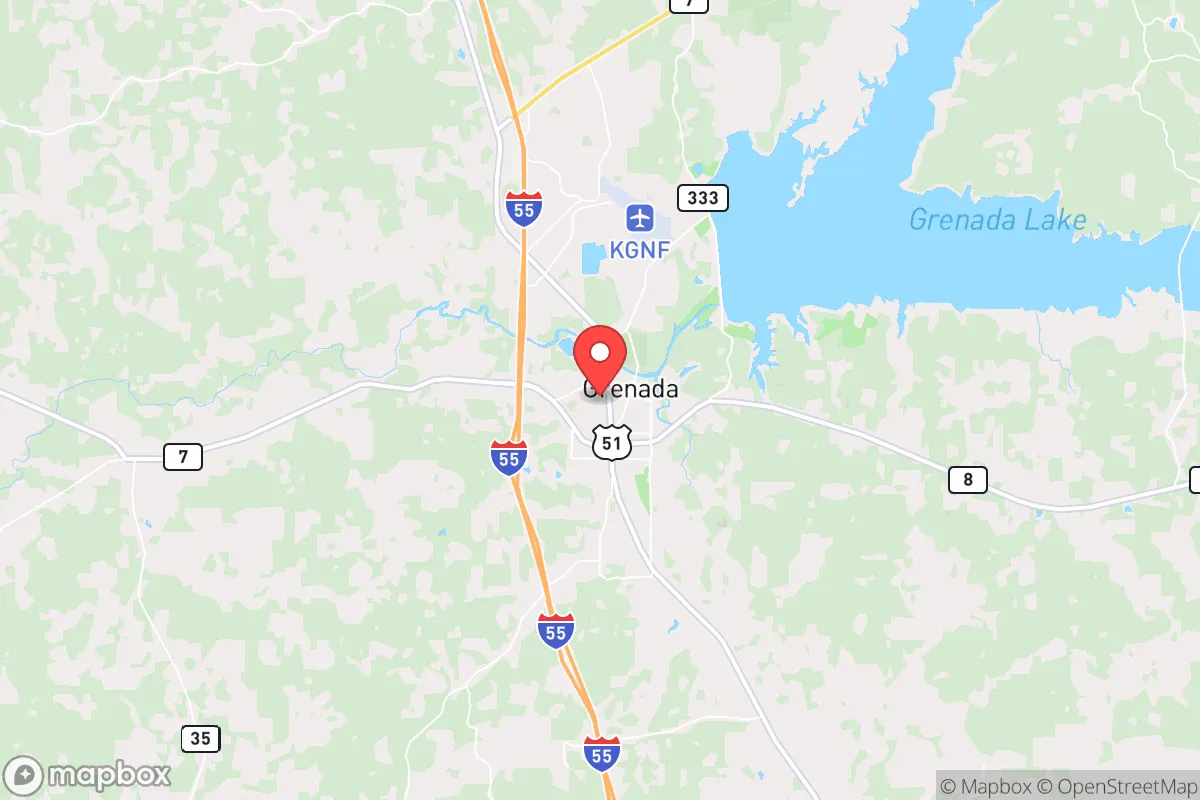
Grenada, Mississippi, sits at a strategic crossroads that offers genuine resilience advantages for those thinking long-term about security and self-sufficiency. Located roughly 90 miles south of Memphis and 100 miles north of Jackson, this town of roughly 12,000 people occupies a sweet spot—close enough to regional infrastructure for supply runs and medical access, but far enough from major population centers to avoid the worst fallout of urban collapse scenarios. The area's position along the Yalobusha River and near the massive Grenada Lake provides natural buffers and resource advantages that make it worth a hard look for anyone serious about relocation preparedness.
Geographic position and natural defensive advantages
Grenada's location in north-central Mississippi places it in the North Central Hills region, a landscape of rolling hills, mixed hardwood forests, and numerous waterways that create natural defensibility. The town sits at the intersection of Interstate 55 and Highway 51, giving residents a major north-south evacuation or supply corridor while still being far enough from interstate choke points that would become problematic during mass evacuations. The surrounding terrain offers multiple escape routes into rural areas to the east toward the Tombigbee National Forest or west into the Mississippi Delta's less populated stretches. Grenada Lake, a 35,000-acre U.S. Army Corps of Engineers reservoir, provides a massive freshwater resource that also acts as a natural barrier to approaches from the north and east. The lake's dam and spillway system, while requiring maintenance, offers hydroelectric potential for those with the technical know-how to tap into it during grid-down scenarios. The area's position roughly 150 miles from the Gulf Coast means it's far enough inland to avoid direct hurricane storm surge but close enough to benefit from Gulf maritime supply chains during normal times.
Risks, exposures, and proximity to fallout-relevant landmarks
No location is without vulnerabilities, and Grenada has several that demand honest assessment. The most significant risk is the Grenada Lake dam itself—a major earthen dam that, if compromised by earthquake, sabotage, or neglect, would send a catastrophic flood wave through the town and downstream communities. While the Corps of Engineers maintains it regularly, any dam failure scenario would be existential for the immediate area. The town lies within 60 miles of the Tennessee Valley Authority's nuclear plants and within 200 miles of multiple nuclear facilities along the Mississippi River corridor, meaning a major nuclear incident could deposit fallout across the region depending on wind patterns. Interstate 55, while an asset, also becomes a liability during crisis—it's a primary evacuation route from Memphis and points north, meaning Grenada could see waves of refugees or become a chokepoint during civil unrest. The nearby Grenada County Jail and the Mississippi State Penitentiary at Parchman (roughly 40 miles west) represent potential sources of instability during breakdown scenarios, as prison populations could be released or become unmanageable. Tornado risk is real and significant—north Mississippi sits in the heart of Dixie Alley, with violent tornadoes possible from March through May and again in November. The flat to rolling terrain offers little natural tornado protection, so below-ground shelter is non-negotiable for any serious prepper.
Practical resilience for a relocator: food, water, energy, and defensibility
For the individual or family looking to establish a resilient homestead, Grenada's practical advantages are substantial. The growing season runs roughly 220 days, from late March to early November, allowing for two full crop cycles of most vegetables and a solid harvest of grains, beans, and storage crops. The soil in the surrounding hills is primarily sandy loam over clay—workable but requiring amendment for serious agriculture. Local extension services through Mississippi State University offer soil testing and crop guidance that's invaluable for new arrivals. Water is abundant: the Yalobusha River, numerous creeks, and the lake provide surface water, while the Mississippi Embayment aquifer system offers reliable groundwater at depths of 100-300 feet. Property prices remain among the lowest in the nation for rural acreage, with 5-20 acre parcels with a house often available for $100,000-$250,000—a fraction of what similar land costs in the Rockies or Appalachia. Timber is a major local resource, with pine and hardwood forests providing building material, firewood, and potential income. The local economy is anchored by manufacturing (including a major Caterpillar facility), healthcare, and agriculture, meaning there are real jobs for those who need them while establishing a homestead. Defensibility varies by property: the rolling hills and tree cover provide natural concealment, but the lack of mountainous terrain means no high-ground advantage. Perimeter security, good neighbors, and a well-thought-out retreat plan matter more here than in more remote locations. The local gun culture is strong and supportive—Mississippi is a constitutional carry state with minimal restrictions, and the Grenada area has multiple gun shops, ranges, and a community that takes self-defense seriously.
The overall strategic picture for Grenada is one of balanced opportunity with clear-eyed trade-offs. It's not a bug-out location for those seeking total isolation—you'll have neighbors, you'll have infrastructure dependencies, and you'll have the risks that come with being in a region that's both agriculturally productive and strategically positioned along major transit corridors. But for the relocator who wants a place where you can buy affordable land, dig a well, plant a garden, and be part of a community that still values self-reliance and mutual aid, Grenada offers a realistic path. The key is to treat it as a base for building resilience, not a guaranteed safe haven—stockpile supplies, develop local networks, learn the land, and always have a secondary plan for the worst-case scenarios. In a world where urban centers are becoming increasingly fragile and the social fabric is fraying, this kind of middle-ground positioning—close enough to function, far enough to survive—is exactly what a serious strategic assessment should identify as worth your time and resources.

* Values derived from national, state, county, city and local statistics and may differ in a specific area. Last updated: 2026-04-30T19:59:28.000Z
Narrative content on this page is AI-generated and may contain mistakes. Verify any details that matter before acting on them.
ReloMaps may earn a commission from affiliate links at no extra cost to you.

