

Photo: Wikipedia
Political ClimatePolitical Climate in Grenada, MS
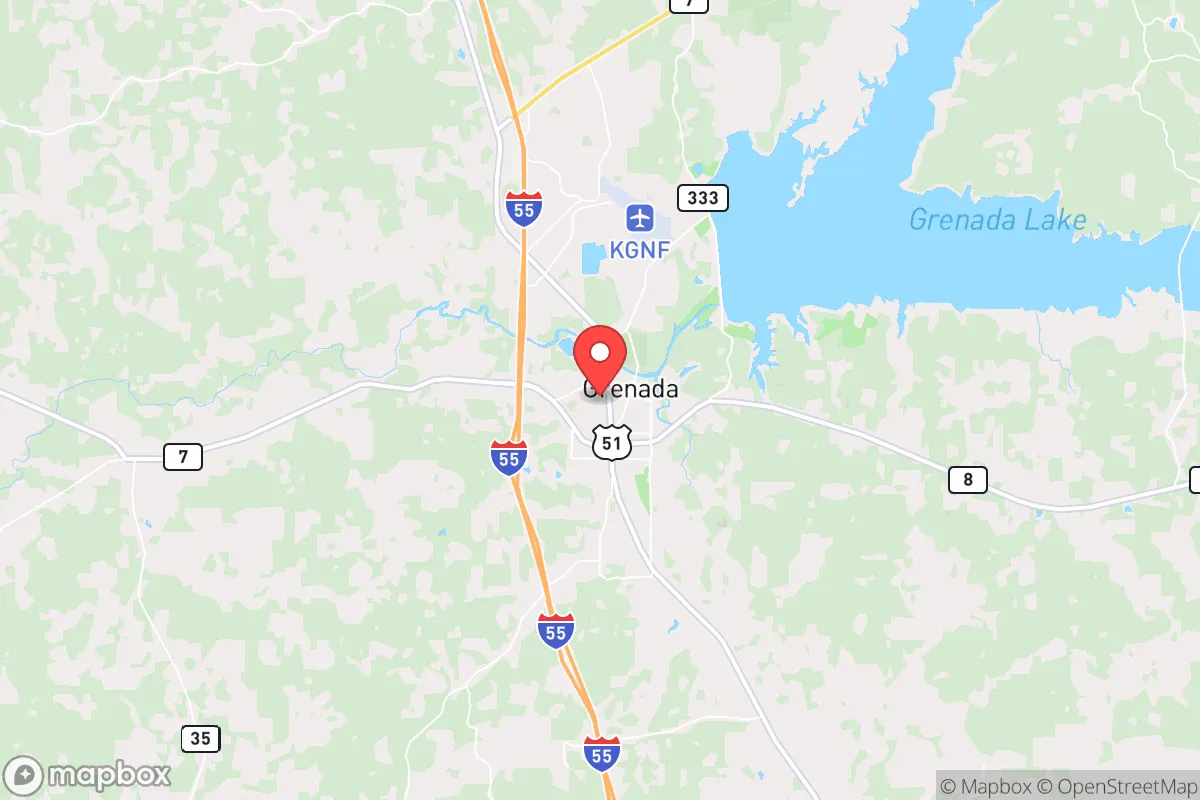
District shown is the primary district for this city’s centroid. Cities may span multiple districts.
Local Political AnalysisPolitical Analysis of Grenada, MS
Grenada, Mississippi, leans heavily Democratic on paper, with a Cook PVI of D+11, but that number doesn’t tell the whole story of what it’s actually like to live here. The area has a long history of conservative, blue-collar values, but over the last decade or so, you’ve seen a real shift as more folks from places like Oxford and Memphis move in, bringing progressive ideas with them. The local elections still tend to go Democrat, but there’s a growing undercurrent of frustration with government overreach—especially on things like property rights, school curriculum, and gun laws—that’s making the political climate feel a lot more divided than the PVI suggests. If you’re someone who values personal freedom and wants to keep the government out of your business, you’ll want to keep a close eye on how things are trending here.
How it compares
Compared to nearby towns like Oxford (home to Ole Miss) or even Batesville, Grenada is still more traditional and less influenced by the university crowd. Oxford leans left in a way that feels almost foreign to longtime Grenada residents—think more bike lanes, organic co-ops, and city council debates about diversity equity initiatives. Grenada, by contrast, has a slower pace and a “live and let live” attitude, but that’s being tested. The surrounding rural areas—like Calhoun County and Yalobusha County—vote much more Republican, and you can feel the tension when county and city policies clash. For example, the city council has pushed for more centralized planning and zoning rules that some locals see as a step toward telling you what you can do with your own land, while the county folks are fighting to keep things loose. It’s a classic urban-rural split, but here the “urban” is a small town of about 4,000 people, which makes the overreach feel even more personal.
What this means for residents
For the average resident, this political tug-of-war means you can’t take your freedoms for granted anymore. Property taxes have crept up as the city looks for more revenue, and there’s been talk of stricter rental inspections and business licensing that feel like a backdoor way to control how you run your life. The school board has also become a battleground, with some members pushing for more state-mandated curriculum changes that leave less room for local control. If you’re a gun owner or a hunter, you’ll be relieved to know that Mississippi’s constitutional carry law still stands, but there’s always chatter about “sensible” restrictions that could trickle down from Jackson. The biggest concern I hear from neighbors is that the progressive drift—even if it’s slow—is eroding the self-reliance that made this area great. You used to be able to fix your own truck, build a shed, or run a small business without a dozen permits. Now, it feels like every year there’s a new rule that makes you ask the government for permission.
Culturally, Grenada still holds onto its Southern roots—church on Sunday, hunting season is a big deal, and folks wave to each other on the square—but the policy shifts are starting to chip away at that. The biggest red flag for me is the push for more regional planning boards that could override local decisions on land use and development. If you’re thinking of moving here, just know that the political climate is in a quiet war between the old guard who want to keep things simple and the newcomers who see government as a tool to “improve” the community. My advice? Come for the low cost of living and the friendly people, but get involved in local politics fast—because if you don’t, you might wake up one day and find your rights have been voted away while you weren’t looking.

State Political ClimatePolitical Climate in Mississippi
State Political AnalysisPolitical Environment in the State
Mississippi is one of the most reliably Republican states in the nation, with a deep-red political complexion that has only deepened over the past two decades. The state hasn’t voted for a Democratic presidential candidate since 1976, and in 2024, Donald Trump carried it by over 17 points. The dominant coalition is a mix of rural and suburban conservatives, evangelical Christians, and a growing number of fiscally conservative transplants from other states. Over the last 10-20 years, the shift has been steady: Democrats held the governorship as recently as 2003, but since then, Republicans have controlled every statewide office and both chambers of the legislature, often with supermajorities. The state’s political identity is now firmly anchored in limited government, traditional values, and a skepticism of federal overreach.
Urban vs. rural divide
The political map of Mississippi is a textbook case of the urban-rural split. The state’s few urban centers—Jackson, Gulfport, and Biloxi—lean Democratic, but they are islands in a sea of red. Jackson, the capital and largest city, is overwhelmingly Democratic and has been a flashpoint for progressive policies, including a 2023 push for a local minimum wage hike that was preempted by state law. The Mississippi Gulf Coast, anchored by Gulfport and Biloxi, is more competitive but still votes Republican in most statewide races, thanks to a strong military and tourism economy. The real engine of the GOP’s dominance is the sprawling rural and small-town landscape: counties like DeSoto (just south of Memphis), Rankin (east of Jackson), and Lamar (near Hattiesburg) routinely deliver 70-80% of their votes to Republican candidates. The Delta region, once a Democratic stronghold, has been trending redder as older conservative Black voters and white rural voters align on cultural issues. The only reliably blue pockets are the majority-Black counties in the Delta and the Jackson metro area, but they lack the population to swing statewide elections.
Policy environment
Mississippi’s policy environment is aggressively conservative. The state has no income tax on wages—a flat 5% rate on corporate income was eliminated in 2022, and the personal income tax is being phased out entirely by 2026. Sales tax is 7%, among the highest in the nation, but the overall tax burden is low. The regulatory posture is business-friendly: Mississippi is a right-to-work state with weak unions and minimal zoning restrictions outside of major cities. Education policy has been a battleground: the state passed a universal school choice law in 2024, allowing any family to use public funds for private or homeschool expenses, a major win for parental rights. Healthcare is a mixed bag—Mississippi refused Medicaid expansion under Obamacare, leaving a coverage gap for about 100,000 low-income adults, but the state has also expanded telehealth and deregulated nurse practitioner scope of practice. Election laws are strict: voter ID is required, early voting is limited to in-person absentee with an excuse, and no-excuse mail voting is not allowed. The legislature has also passed laws banning private funding of election administration and restricting ballot drop boxes.
Trajectory & freedom
Mississippi is moving decisively toward more personal freedom, at least by conservative metrics. The state has become a national leader in gun rights: in 2023, it passed constitutional carry (permitless carry for anyone 18 or older who can legally possess a firearm), and it has no red flag law, no waiting period, and no magazine capacity limit. Parental rights have been strengthened: the 2024 school choice law is the biggest example, but the state also passed a Parents’ Bill of Rights in 2023, requiring schools to notify parents of any medical or mental health services offered to their children and to obtain consent before any gender-related counseling. Medical autonomy took a hit with the near-total abortion ban passed in 2019 (triggered by Dobbs), which has no exceptions for rape or incest—a position that some conservatives see as overreach, but most in the state support. Property rights are strong: Mississippi has no statewide zoning, and the legislature has repeatedly blocked efforts to impose land-use regulations. The biggest threat to freedom, from a conservative perspective, is the state’s heavy reliance on federal funding—about 40% of the budget comes from Washington—which creates a vulnerability to federal mandates. Still, the trajectory is toward less government intrusion in daily life.
Civil unrest & political movements
Mississippi has seen relatively little civil unrest compared to other states. The most visible flashpoints have been around Confederate monuments: in 2020, protests in Jackson and Oxford (home to Ole Miss) led to the removal of several statues, but the state legislature responded with a 2021 law protecting all war memorials from removal or alteration. That law has held, and most monuments remain in place. Immigration politics are muted—Mississippi has a tiny foreign-born population (about 2.5%), and there are no sanctuary cities. The state did pass a 2023 law requiring local law enforcement to cooperate with ICE detainers. Election integrity has been a hot topic: after the 2020 election, the legislature tightened absentee ballot rules and created a new election integrity unit within the Secretary of State’s office. There have been no major fraud scandals, but the issue remains a rallying point for conservative activists. The most organized political movements are on the right: the Mississippi Republican Party is dominated by the Mississippi Freedom Caucus, a hardline conservative group that has pushed for school choice, tax cuts, and anti-abortion legislation. On the left, the Mississippi Poor People’s Campaign and the NAACP remain active but have little legislative influence.
Projection
Over the next 5-10 years, Mississippi is likely to become even more conservative. In-migration is modest but growing, with retirees and remote workers from high-tax states like California and Illinois settling in the Gulf Coast and the Jackson suburbs (especially Madison and Ridgeland). These newcomers tend to be fiscally conservative and culturally traditional, reinforcing the existing political lean. The biggest demographic shift is the slow decline of the Black population in the Delta, which is losing people to other states, and the growth of the white population in the northern and coastal counties. The state’s Republican supermajority is unlikely to be challenged—the Democratic Party is weak, underfunded, and concentrated in a few urban areas. The biggest policy fights ahead will be over further tax cuts (eliminating the corporate income tax entirely), expanding school choice to include education savings accounts, and possibly a push for a state-level version of the Second Amendment Preservation Act to nullify federal gun laws. The wildcard is healthcare: if the state ever expands Medicaid, it could shift the political calculus slightly, but that seems unlikely under the current leadership. For a new resident, expect a state that is stable, predictable, and increasingly protective of individual liberties as defined by the conservative movement.
For someone moving to Mississippi, the bottom line is this: you’ll find a state that respects your right to live your life as you see fit, as long as you’re not looking for government handouts or progressive social experiments. The taxes are low and getting lower, the schools are increasingly choice-friendly, and the gun laws are among the most permissive in the country. The trade-offs are a weak safety net, limited public transportation, and a healthcare system that leaves some people behind. If you value personal responsibility and local control, Mississippi is a good bet. If you want a state that will coddle you or micromanage your decisions, look elsewhere.
* Values derived from national, state, county, city and local statistics and may differ in a specific area. Last updated: 2026-04-30T19:59:28.000Z
Narrative content on this page is AI-generated and may contain mistakes. Verify any details that matter before acting on them.
ReloMaps may earn a commission from affiliate links at no extra cost to you.

