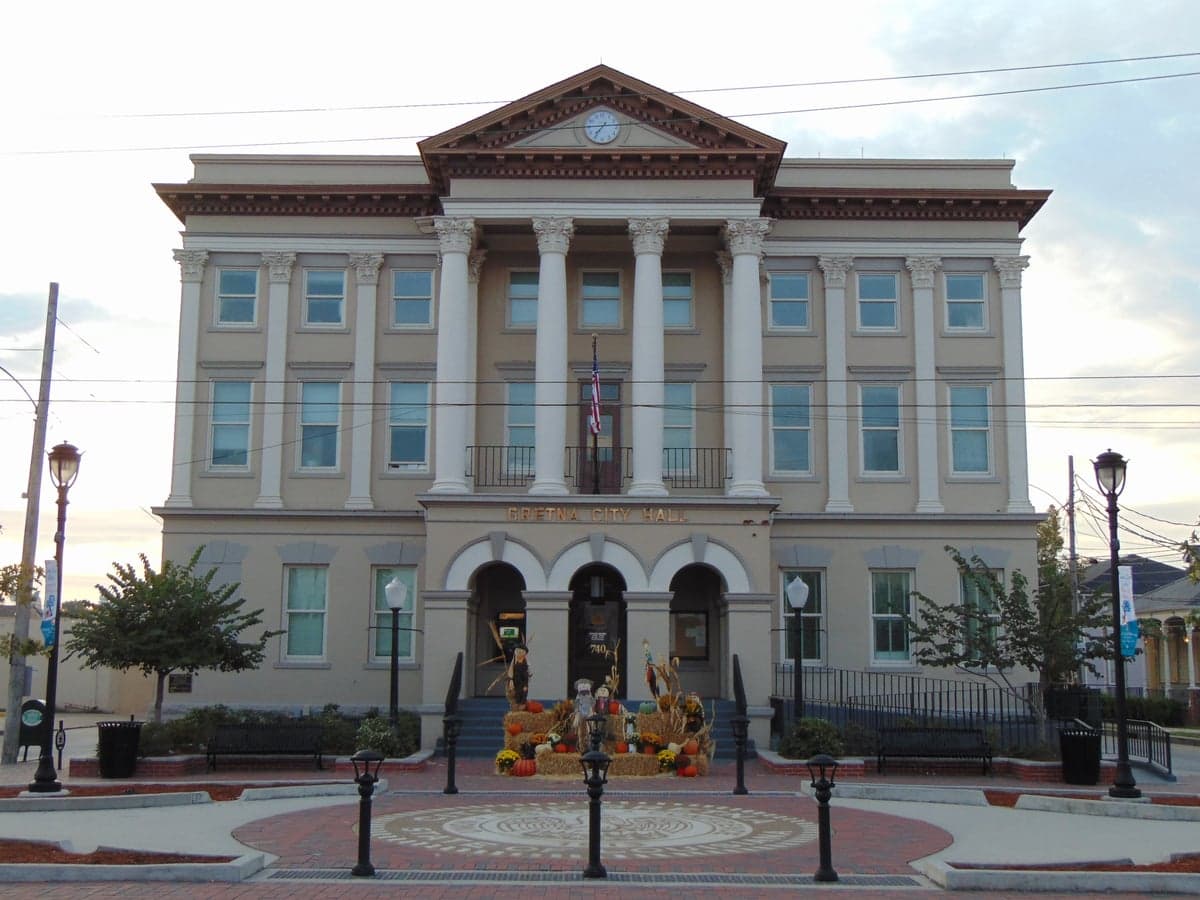
Photo: Wikipedia
Strategic Assessment of Gretna, LA
High tactical risk. This location is likely close to major population centers, strategic targets, or sits in a high-disaster corridor. A retreat property and careful exit planning is required.
What does the Strategic Assessment tell us?
Our Strategic Assessment grades tactical survivability of an area. Major population centers, military targets, fallout zones, natural disasters, and border exposure all drive risk — lower exposure means a more defensible position in a crisis.
This is heavily inspired by Joel Skousen's Strategic Relocation book. Highly recommended you checkout the book ($)What does this tell us?
Our Strategic Assessment grades tactical survivability of an area. Major population centers, military targets, fallout zones, natural disasters, and border exposure all drive risk — lower exposure means a more defensible position in a crisis.
This is heavily inspired by Joel Skousen's Strategic Relocation book. Highly recommended you checkout the book ($)Strategic Pillars

Key Distances
Regional Safe Places
Below is our recommended "safe zones" in Louisiana and the surrounding area based on our strategic heuristics. For most people, it's unrealistic to live in a “safe zone” full-time due to work, family or other personal reasons. They tend to be more rural. However, many of these areas are perfect for second homes and retreat properties that double as a vacation home or even a short-term rental.

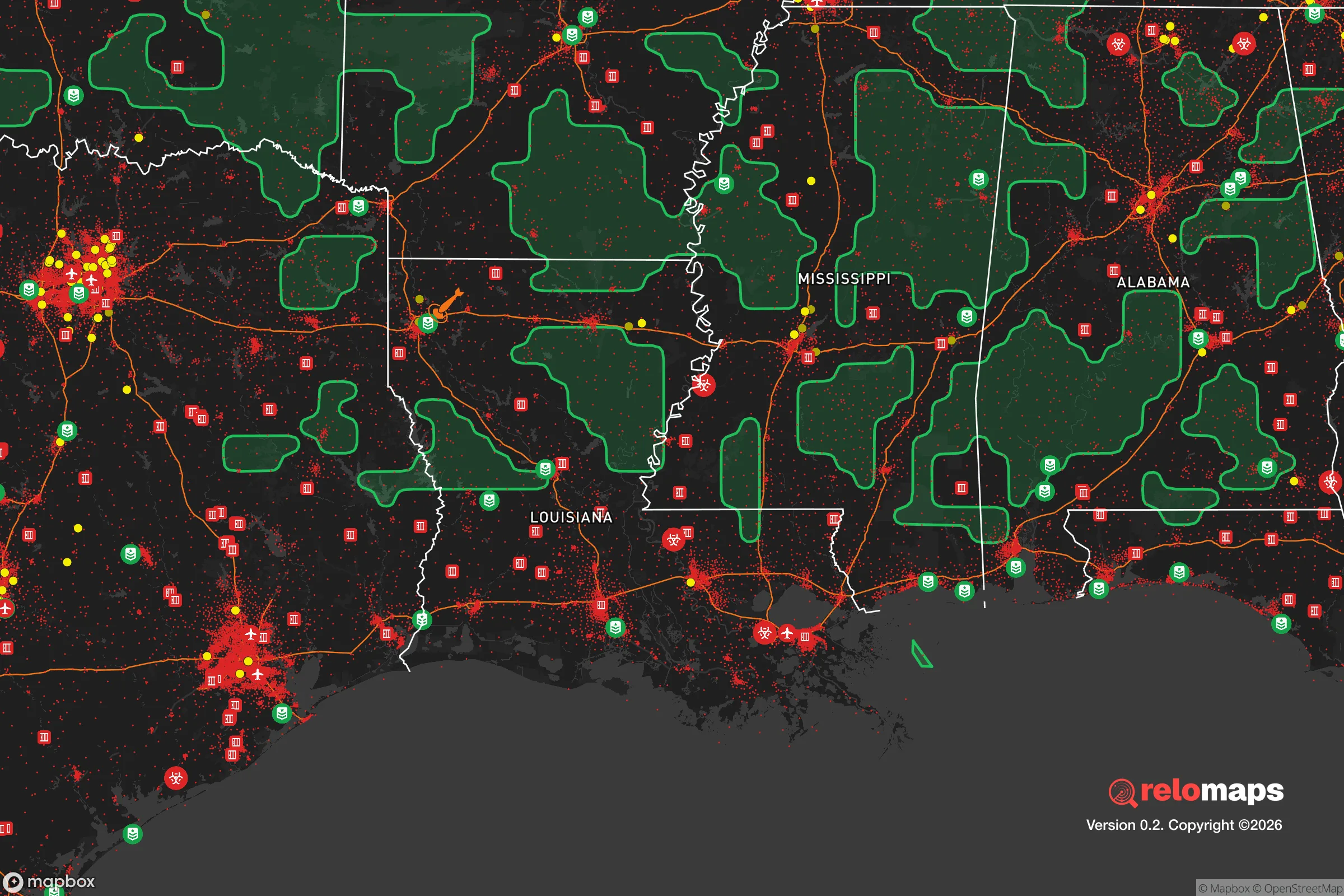


Important Note: For informational purposes only. This does not mean nothing bad ever happens in the green zones. Please use common sense. This is based on public data and modeled with AI. We tried to take a conservative approach but mistakes happen. We update this regularly as new information becomes available.
Solar Generator Recommendations
Backup power matters more here than in safer locations. We've picked three solar generators across budgets and capacity tiers — start with the budget unit if you only need a few essentials, or step up if you want to run a fridge and HVAC for days at a time.

Jackery Portable Power Station Explorer 300
Budget OptionPower on the Go: Weighing only 11 lbs, it's convenient to set up and store with book-sized foldable solar panels

BLUETTI Portable Power Station AC180
Designed for both indoor and outdoor scenarios, AC180 is highly capable as it has a robost capacity and continuous output power.

EF ECOFLOW DELTA Pro Ultra Power Station
Upgraded PickEcoFlow DELTA Pro Ultra is a whole-home energy system designed to grow with your family. Integrated with the Smart Home Panel 2, it scales to meet your evolving energy needs — keeping your home powered, intelligent, and secure through every stage of life.
We earn a commission, at no additional cost to you.
Strategic Assessment Analysis
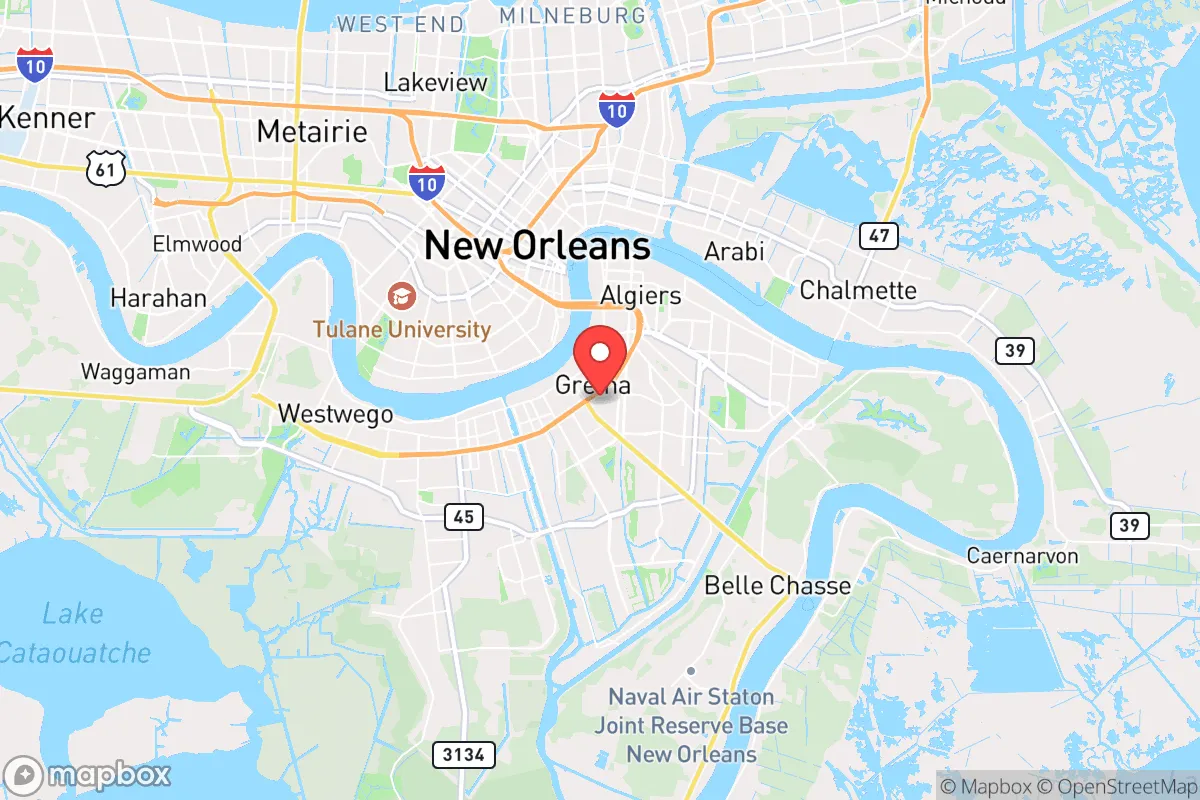
Gretna, Louisiana, positioned just across the Mississippi River from New Orleans, presents a complex strategic picture for the conservative-minded relocator focused on resilience and preparedness. While its proximity to a major urban center introduces significant vulnerabilities, the city’s location on the West Bank of the river offers distinct defensive and logistical advantages that are often overlooked. For those willing to navigate the inherent risks of being near a high-density population hub, Gretna can serve as a viable forward operating base—provided you understand the terrain, the threats, and the practical steps needed to harden your position.
Geographic position and natural advantages for a prepared relocator
Gretna sits on the natural levee of the Mississippi River, which gives it slightly higher ground than much of the surrounding metro area. This elevation advantage is not trivial in a region where flooding is a perennial concern. The city is the seat of Jefferson Parish, and its position on the West Bank means that access to and from the East Bank (New Orleans proper) is funneled through a limited number of bridges and ferries. In a grid-down or civil unrest scenario, this chokepoint can be a double-edged sword—it restricts your movement, but it also restricts the movement of potential threats from the East Bank. The Mississippi River itself is a formidable natural barrier; crossing it without functional bridges is nearly impossible for most, which effectively insulates Gretna from the worst of New Orleans’ potential chaos. The surrounding wetlands and bayous further limit approach vectors, making the area more defensible than a typical suburban sprawl. For the prepper, this means you have a natural moat on one side and limited ingress points on the other—a feature that should be factored into any relocation calculus.
Risks, exposures, and proximity to fallout-relevant landmarks
The elephant in the room is Gretna’s proximity to New Orleans, a city that is both a strategic liability and a potential flashpoint. New Orleans is a major port, a petrochemical hub, and a population center with significant socioeconomic stress. In the event of a mass casualty event, civil unrest, or a major disaster, the city could become a source of uncontrolled migration, resource competition, and security threats. The Crescent City Connection bridge, which connects Gretna to downtown New Orleans, is a critical vulnerability—it’s a single point of failure that, if compromised, could isolate the West Bank or, conversely, become a funnel for displaced populations. Additionally, the Mississippi River corridor is lined with chemical plants, refineries, and storage facilities. A catastrophic failure at one of these sites—whether from accident, sabotage, or natural disaster—could create a toxic plume that would affect Gretna depending on wind direction. The nearby NASA Michoud Assembly Facility, while not a direct threat, is a high-value target in any conflict scenario. For the survivalist, these risks mean that a robust evacuation plan and a well-stocked shelter with air filtration are non-negotiable. You are not in a remote redoubt; you are in a buffer zone, and you must plan accordingly.
Practical resilience for a relocator: food, water, energy, and defensibility
Gretna’s practical resilience is a mixed bag. On the positive side, the city has a functioning municipal water system drawing from the Mississippi, but that source is vulnerable to contamination and disruption. A prepper should assume that tap water will be unavailable or unsafe for extended periods. The good news is that the high water table means shallow wells are feasible in some areas, and rainwater collection is viable given the region’s annual rainfall of over 60 inches. For food, the surrounding agricultural areas of St. Charles and St. John the Baptist parishes provide some local produce, but Gretna itself is largely built out. You will need to establish a garden, preferably with raised beds to avoid soil contamination from historical industrial activity. The climate allows for year-round growing, which is a significant advantage. Energy reliability is a concern; the grid is prone to outages from hurricanes and heat waves. Solar with battery backup is a wise investment, but you must account for the frequent cloud cover and the risk of storm damage to panels. Natural gas is available in many parts of the city, which can be used for cooking and heating if the grid goes down. Defensibility at the household level is achievable—Gretna has a mix of older homes with solid construction and newer developments. A property with a fenced yard, reinforced doors, and a clear line of sight to approach routes is ideal. The local police presence is adequate for normal times, but in a widespread crisis, you should not rely on them. The West Bank’s relative isolation from New Orleans’ core means that you are less likely to face organized looting, but you are still within walking distance of potential trouble. A neighborhood watch or mutual assistance group is highly recommended.
The overall strategic picture for a conservative relocator
Gretna is not a bug-out location; it is a strategic compromise. It offers the economic and logistical benefits of being near a major city—access to medical facilities, supply chains, and transportation networks—while providing a degree of natural separation that many other suburbs lack. For the conservative-minded individual or family who wants to maintain a professional career in the New Orleans metro area while keeping a prepper mindset, Gretna is a defensible choice. However, it requires constant vigilance. You must have a plan for the day the bridges close, the water stops flowing, or the chemical plants release a cloud. You must be prepared to shelter in place for weeks, or to exfiltrate to a more remote secondary location if the situation deteriorates. The city’s political climate leans moderate, but the surrounding parishes are more conservative, which can be a social asset for building a like-minded network. In short, Gretna works if you treat it as a forward operating base—not a fortress. It gives you a foothold in a region with significant strategic value, but only if you are willing to do the work of hardening your position, building local alliances, and maintaining a low profile. For the serious prepper, it is a viable option, but it is not a safe harbor. It is a place to hold ground, not to hide.

* Values derived from national, state, county, city and local statistics and may differ in a specific area. Last updated: 2026-05-01T07:10:46.000Z
Narrative content on this page is AI-generated and may contain mistakes. Verify any details that matter before acting on them.
ReloMaps may earn a commission from affiliate links at no extra cost to you.

