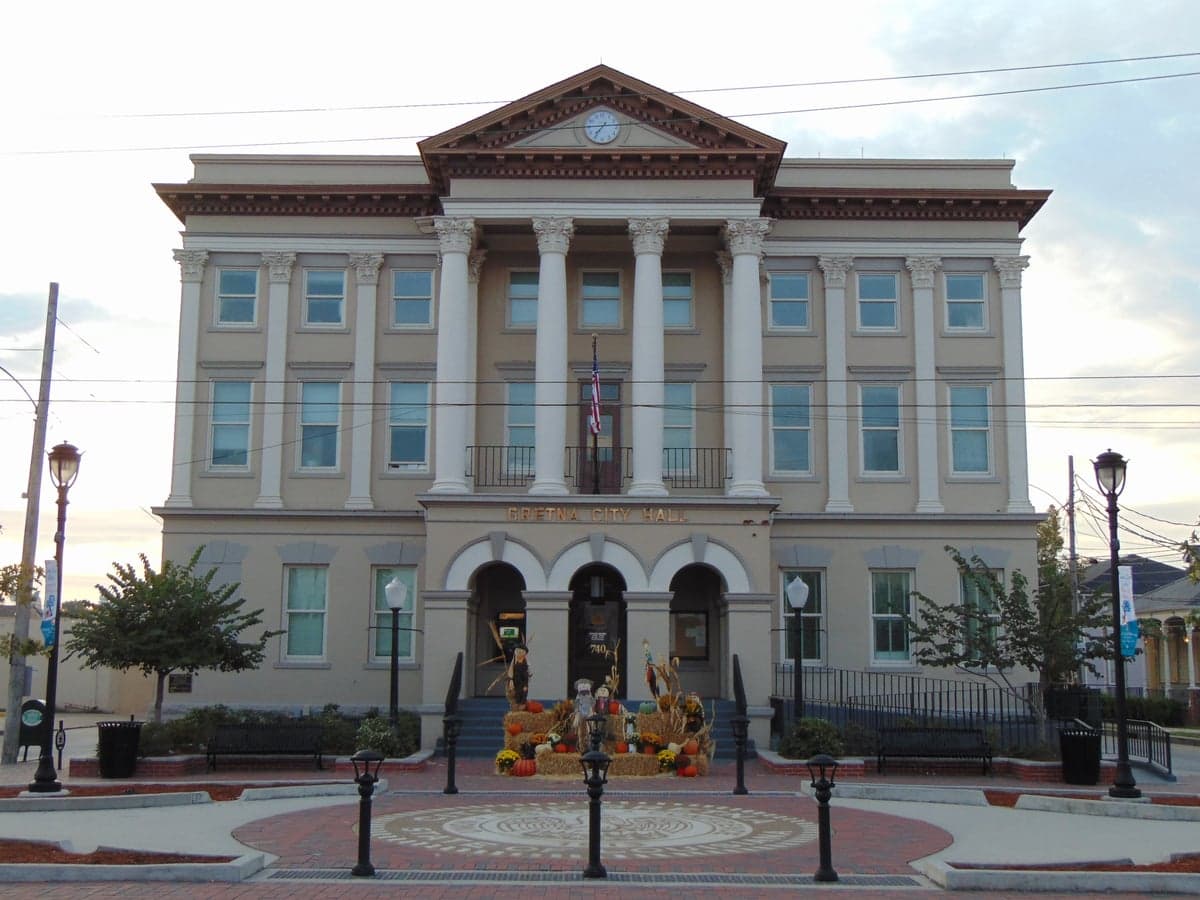
Photo: Wikipedia
Demographics of Gretna, LA
Affluence Level in Gretna, LA
A low-income area with significant economic hardship. Household wealth and educational attainment are well below national averages.
People of Gretna, LA
The people of Gretna, Louisiana, today form a dense, majority-minority city of 17,468 residents, characterized by a tri-ethnic balance of Black (32.0%), White (38.9%), and Hispanic (22.8%) populations, with a notable East/Southeast Asian community (2.4%) and a small Indian-subcontinent presence (0.1%). A significant 14.4% of residents are foreign-born, giving the city a distinctly immigrant-inflected character rare among Jefferson Parish suburbs. Despite its modest size, Gretna packs a high population density and a working-to-middle-class identity, anchored by a historic downtown and a patchwork of neighborhoods that reflect distinct settlement waves.
How the city was settled and grew
Gretna was founded in the early 19th century as a working-class counterpoint to New Orleans, directly across the Mississippi River. The city's original European settlers were German and Irish immigrants who arrived in the 1830s and 1840s, drawn by jobs in the shipyards, sugar refineries, and the railroad terminus that made Gretna a freight hub. These groups built the Historic Downtown Gretna and the adjacent McDonoghville neighborhood, a grid of shotgun houses and Creole cottages that still bears their architectural imprint. By the late 19th century, Italian immigrants joined the mix, settling in the Gretna Heights area near the levee, working as fruit vendors, fishermen, and laborers. The city remained overwhelmingly White and European-immigrant through the 1940s, with a small Black population concentrated in the Westside neighborhood, a historically African American enclave that developed along the city's western edge near the Harvey Canal.
Modern era (post-1965)
The 1965 Immigration and Nationality Act reshaped Gretna's demographics dramatically. Hispanic immigration surged from the 1970s onward, primarily from Honduras and Mexico, as workers filled construction, service, and industrial jobs in the New Orleans metro area. These newcomers concentrated in the Belle Chasse Highway corridor and the Woodmere area (a census-designated place adjacent to Gretna's southern edge), where Spanish-language businesses and Catholic parishes anchored the community. Simultaneously, East/Southeast Asian immigrants—chiefly Vietnamese and Filipino families—arrived after the Vietnam War, settling in the Lafitte-Laroussini neighborhood near the river, where they established small grocery stores and restaurants. The White population, once a supermajority, began a steady decline after 1970 as middle-class families moved to suburban Jefferson Parish communities like Metairie and Kenner, while the Black population grew through domestic migration from New Orleans and other parts of Louisiana. By 2020, Gretna had become a majority-minority city, with no single group holding a numerical majority.
The future
Gretna's population is trending toward further diversification, but not toward homogenization. The Hispanic share (22.8%) is the fastest-growing segment, driven by both immigration and higher birth rates, and is likely to approach 30% by 2035. The White share (38.9%) continues a slow decline as older residents age out and younger families choose suburbs farther from the river. The Black population (32.0%) is stable but aging, with younger Black residents increasingly moving to newer subdivisions in Terrytown and Harvey. The East/Southeast Asian community (2.4%) is plateauing, with second-generation Vietnamese and Filipino families assimilating into broader metro-area patterns. The Indian-subcontinent population (0.1%) remains negligible. The city is not tribalizing into hostile enclaves, but distinct neighborhood identities persist: Historic Downtown is becoming more White and affluent through gentrification, Westside remains predominantly Black, and the Belle Chasse Highway corridor is solidifying as a Hispanic commercial and residential hub. The foreign-born share (14.4%) is likely to hold steady or rise slightly as new immigrant families replace aging European-ancestry residents.
For someone moving in now, Gretna is becoming a denser, more polyglot city—a working-class river town where no single ethnic group dominates, and where neighborhood choice increasingly signals lifestyle and community preference. The city offers affordable housing and proximity to New Orleans, but its demographic trajectory means new arrivals should expect a place where Spanish, Vietnamese, and English mix on the streets, and where the historic European character is giving way to a more layered, immigrant-inflected identity. This is not a homogenizing suburb; it is a city of distinct, stable enclaves that are likely to persist for another generation.

* Values derived from national, state, county, city and local statistics and may differ in a specific area. Last updated: 2026-05-01T07:10:46.000Z
Narrative content on this page is AI-generated and may contain mistakes. Verify any details that matter before acting on them.
ReloMaps may earn a commission from affiliate links at no extra cost to you.

