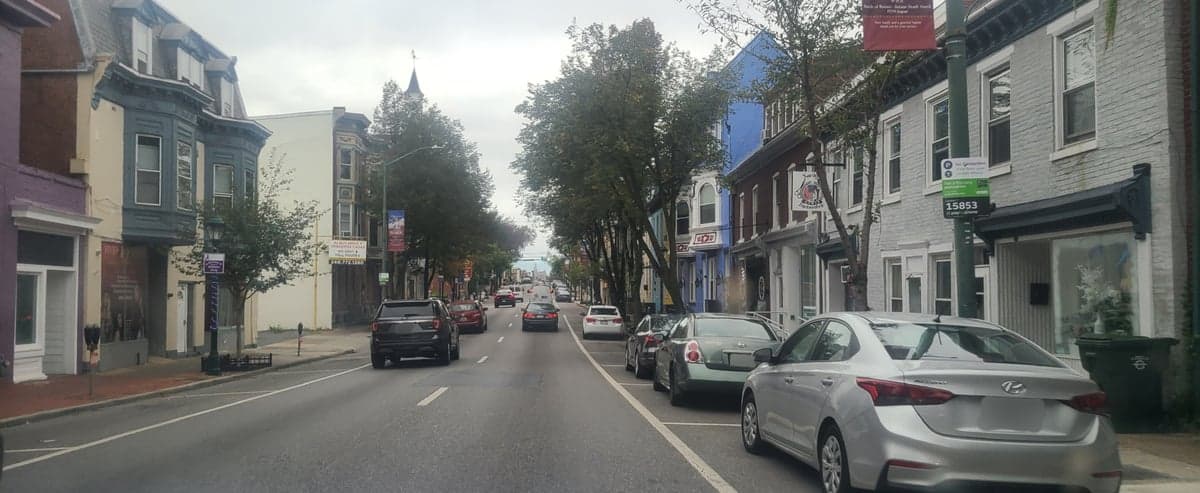
Photo: Wikipedia
Demographics of Hagerstown, MD
Affluence Level in Hagerstown, MD
A below-average socioeconomic profile. Incomes, home values, and educational attainment trail the U.S., with higher poverty and unemployment.
People of Hagerstown, MD
The people of Hagerstown, Maryland today number 43,490, forming a community that is 57.6% White, 22.5% Black, 10.6% Hispanic, and 0.7% East/Southeast Asian, with a separate 0.6% Indian-subcontinent population. The city is notably less diverse than the national average, with a foreign-born share of just 3.8% and a college-educated rate of 19.7%, reflecting a working-class, native-born character. Hagerstown’s identity is rooted in its history as a transportation and manufacturing hub, where distinct waves of settlement have left lasting imprints on neighborhoods like the West End, South End, and the historic downtown core.
How the city was settled and grew
Hagerstown was founded in 1762 by German immigrant Jonathan Hager, who purchased a 200-acre tract along the Great Wagon Road, a major colonial migration route. The original settlers were primarily German and Scots-Irish farmers, drawn by fertile land and the promise of religious freedom. The city’s early growth centered on the Downtown Historic District, where German craftsmen built stone houses and taverns, and the West End, where prosperous merchants erected Federal-style homes. The arrival of the Baltimore and Ohio Railroad in the 1830s transformed Hagerstown into a rail hub, attracting Irish laborers who settled in the South End near the rail yards. By the late 19th century, the city’s industrial base—including the Hagerstown Shoe Company and Pangborn Corporation—drew waves of Italian and Eastern European immigrants, who clustered in the North End around the factories. The Great Migration (1910–1970) brought Black families from the rural South to work in the rail yards and mills, establishing a community in the Jonathan Street corridor, a historically Black neighborhood that remains a cultural anchor today.
Modern era (post-1965)
After the 1965 Hart-Cellar Act, Hagerstown’s foreign-born population grew only modestly, unlike many East Coast cities. The city’s manufacturing decline in the 1970s and 1980s—with the loss of jobs at Mack Trucks and other plants—slowed immigration and spurred White flight to surrounding Washington County suburbs. The West End and South End saw significant depopulation, while the Jonathan Street area retained a stable Black population. Hispanic growth began in the 1990s, driven by Mexican and Central American immigrants seeking work in agriculture and poultry processing; they concentrated in the East End and along the Dual Highway corridor. The Indian-subcontinent population (0.6%) is a recent, small-scale arrival, primarily professionals in healthcare and IT, with no distinct neighborhood enclave. East/Southeast Asian residents (0.7%) are similarly dispersed, often living in newer subdivisions on the city’s fringe. The city’s overall foreign-born share remains low at 3.8%, reflecting limited international migration compared to regional peers like Frederick or Baltimore.
The future
Hagerstown’s population is trending toward modest diversification, but the pace is slow. The White share has declined from roughly 70% in 2000 to 57.6% today, while the Hispanic share has grown from 3% to 10.6% over the same period. The Black population has remained stable at around 22%, with little new in-migration. The city is not homogenizing; instead, it is developing distinct ethnic enclaves, with the East End becoming increasingly Hispanic and the Jonathan Street area remaining predominantly Black. The West End and North End are aging and losing population, while newer subdivisions on the city’s outskirts attract younger White families. Over the next 10–20 years, Hagerstown is likely to see continued Hispanic growth, a plateauing Black population, and a slow increase in Asian and Indian residents as the city’s healthcare sector expands. The low college-educated rate (19.7%) and limited foreign-born share suggest the city will remain a working-class, native-born community, with demographic change driven more by domestic migration from nearby counties than by international arrivals.
For someone moving in now, Hagerstown offers a stable, affordable community with a clear sense of its industrial past. The city is becoming more Hispanic and slightly more diverse, but it remains predominantly White and Black, with a strong native-born character. New residents should expect a place where neighborhoods retain distinct identities, and where the pace of change is gradual rather than transformative.

* Values derived from national, state, county, city and local statistics and may differ in a specific area. Last updated: 2026-04-22T01:48:30.000Z
Narrative content on this page is AI-generated and may contain mistakes. Verify any details that matter before acting on them.
ReloMaps may earn a commission from affiliate links at no extra cost to you.

