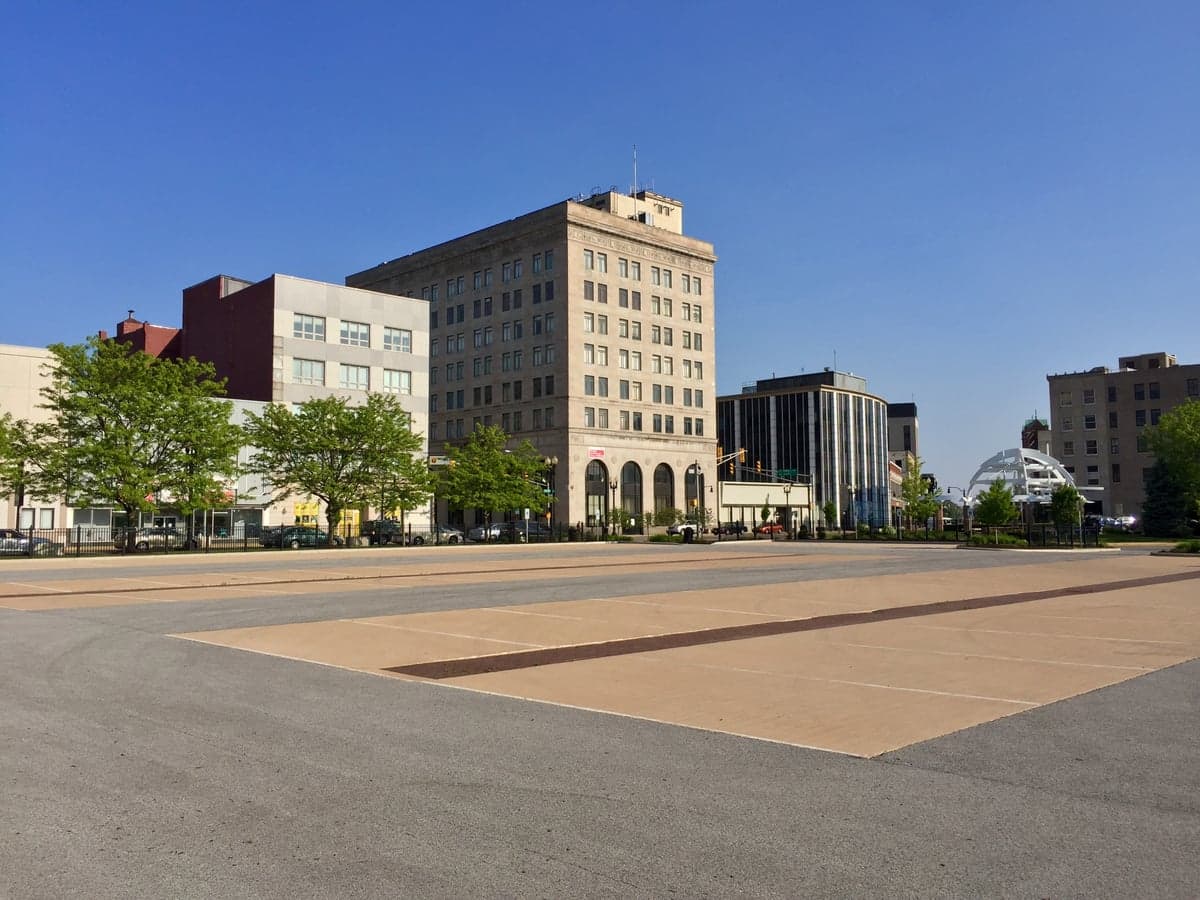
Photo: Wikipedia
Demographics of Hammond, IN
Affluence Level in Hammond, IN
A below-average socioeconomic profile. Incomes, home values, and educational attainment trail the U.S., with higher poverty and unemployment.
People of Hammond, IN
The people of Hammond, Indiana, today form a dense, working-class, and majority-minority city of 77,098 residents, characterized by a distinct Hispanic plurality (40.9%) alongside a significant Black population (22.9%) and a shrinking White share (32.3%). The city is one of the most ethnically diverse in Northwest Indiana, yet it remains economically strained, with only 15.4% of adults holding a bachelor’s degree and a foreign-born population of 6.3% that is notably lower than the national average. This is a community forged by industrial labor, shaped by waves of European immigration and later domestic migration, and now navigating a transition toward a younger, more Hispanic identity while grappling with population decline and suburban flight.
How the city was settled and grew
Hammond’s population history begins not with colonial settlement but with the industrial revolution. Founded in 1851 as a slaughterhouse and meatpacking hub along the Grand Calumet River, the city was named after George H. Hammond, a Detroit meatpacker who built the region’s first major beef-packing plant. The original workforce was overwhelmingly German and Irish immigrants, who settled in the Hohman Avenue corridor and the State Line neighborhood along the Illinois border. By the 1880s, the expansion of the Lake Shore and Michigan Southern Railway and the opening of the Standard Oil refinery in neighboring Whiting drew a second wave of Polish, Croatian, and Serbian immigrants. These groups built dense, ethnic enclaves in Robertsdale (the city’s oldest intact neighborhood, near the Illinois line) and North Hammond, where Catholic parishes and fraternal halls anchored community life. The 1910s and 1920s saw a third wave of Hungarian and Slovak immigrants, who clustered in the Hessville neighborhood, named after a local landowner. By 1930, Hammond’s population had surged past 64,000, making it the second-largest city in Lake County. The steel mills of Inland Steel and Youngstown Sheet and Tube, located just east in East Chicago, provided the economic backbone that kept these ethnic neighborhoods stable through the Great Depression and World War II.
Modern era (post-1965)
The post-1965 era brought profound demographic change. The Hart-Cellar Immigration Act of 1965 had a limited direct effect on Hammond’s foreign-born share (still only 6.3% today), but the domestic migration patterns it triggered reshaped the city. The Great Migration of Black Americans from the South, which had begun in the 1940s, accelerated through the 1970s as steel mills continued to hire. Black families settled primarily in the Woodmar neighborhood and the central area around 165th Street, where they replaced departing White ethnic families. By 1980, Hammond’s Black population had risen to roughly 18%, and White flight to suburban communities like Munster, Schererville, and St. John was well underway. The Hispanic population began growing in the 1990s, driven by Mexican and Puerto Rican families moving from Chicago’s South Side and from the declining steel towns of East Chicago and Gary. They concentrated in Hessville and the South Hammond corridor along Calumet Avenue, where Spanish-language stores and churches now dot the commercial strips. The White population, which was over 90% in 1960, fell to 32.3% by 2024. The East/Southeast Asian population remains tiny at 1.0%, mostly Vietnamese and Filipino families who arrived in the 1980s and 1990s and settled in the Hohman Avenue area near Purdue University Northwest. The Indian-subcontinent population is negligible at 0.2%.
The future
Hammond’s population is heading toward a more homogenized Hispanic majority, but the pace is slowing. The city lost roughly 10% of its population between 2000 and 2024, dropping from 83,000 to 77,098, as middle-class families of all races continue to leave for safer, better-funded suburbs. The Hispanic share is projected to rise to 45-48% by 2040, driven by higher birth rates and continued migration from Chicago, while the Black share is likely to plateau near 22-24% as younger Black families also exit. The White share will continue to decline, possibly falling below 25% by 2040, as the remaining older ethnic European residents age in place in Robertsdale and North Hammond. The foreign-born share is unlikely to rise dramatically because Hammond lacks the entry-level job growth and affordable housing stock that attract new immigrants to cities like Chicago or Elgin. The city is not tribalizing into distinct enclaves so much as it is becoming a predominantly Hispanic working-class city with a large Black minority and a shrinking White remnant. The biggest wildcard is economic: if the planned redevelopment of the former State Line power plant site and the expansion of the Purdue University Northwest campus attract new residents, the decline could stabilize. If not, the population may fall below 70,000 by 2040.
For someone moving in now, Hammond is a place of affordability and convenience—15 minutes from downtown Chicago—but also of limited upward mobility. The city is becoming younger and more Hispanic, with a strong blue-collar identity that still values the Catholic parishes, union halls, and ethnic festivals of its past. The schools are underperforming, and property crime rates are above the national average, but the housing stock is cheap and the commute to Chicago is short. It is not a gentrifying frontier; it is a stable, modest, majority-minority city that has absorbed decades of industrial decline and demographic change without losing its character.

* Values derived from national, state, county, city and local statistics and may differ in a specific area. Last updated: 2026-04-22T10:39:14.000Z
Narrative content on this page is AI-generated and may contain mistakes. Verify any details that matter before acting on them.
ReloMaps may earn a commission from affiliate links at no extra cost to you.

