Photo: Wikipedia
Demographics of Hampstead, MD
Affluence Level in Hampstead, MD
An upper-middle-class area. Household wealth, education levels, and homeownership run ahead of national benchmarks.
People of Hampstead, MD
Hampstead, Maryland, is a small, predominantly white town of 6,311 residents where 89.8% of the population identifies as white, and the foreign-born share stands at 0.0%. The town is notably more college-educated than the national average at 44.1%, and its demographic profile reflects a stable, long-settled community with minimal recent international immigration. Hampstead’s identity is rooted in its agricultural and railroad history, with a population that has remained overwhelmingly white and native-born through successive generations.
How the city was settled and grew
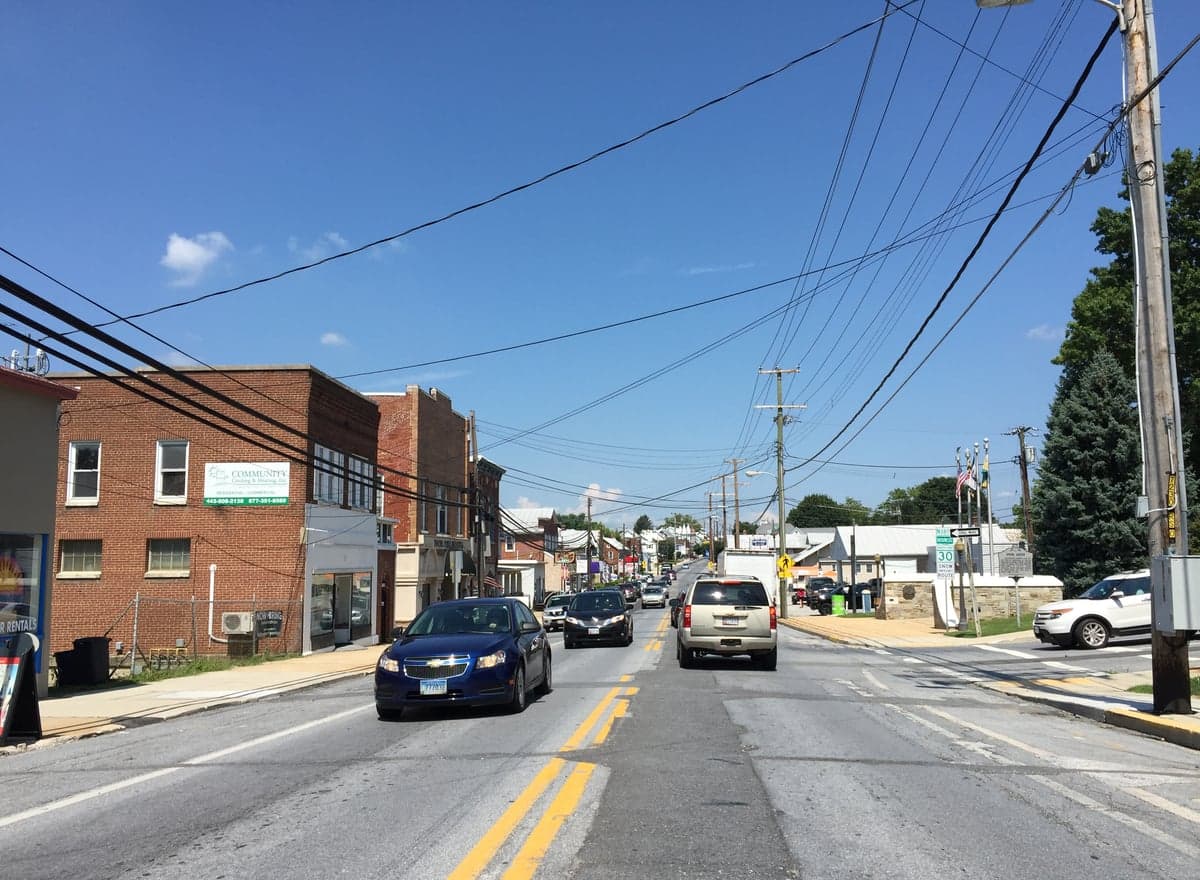
Hampstead’s original population arrived in the mid-18th century, drawn by the fertile farmland of the Piedmont region and the promise of land grants from the Calvert family, the proprietors of the Maryland colony. The town was officially laid out in 1787, and its early settlers were primarily English and German farmers who established homesteads along what is now Main Street and the surrounding rural roads. The arrival of the Western Maryland Railroad in the 1870s spurred a second wave of growth, bringing Irish and German laborers who built the rail line and settled in the Railroad District near the depot, where modest worker cottages still stand. By the early 20th century, Hampstead’s population was a mix of farmers, railroad workers, and small business owners, with the Historic Downtown area serving as the commercial and social hub. The town remained a quiet agricultural community through the mid-20th century, with little in-migration beyond the natural growth of existing families.
Modern era (post-1965)
After the 1965 Hart-Cellar Act, Hampstead saw virtually no increase in foreign-born residents—the foreign-born share remains 0.0% today. Instead, the town’s modern growth came from domestic in-migration, primarily white families from Baltimore and the surrounding Baltimore County suburbs seeking lower taxes, larger lots, and a small-town atmosphere. This wave began in the 1980s and accelerated through the 2000s, with new subdivisions like Springfield Estates and Carrolltowne absorbing the influx. These neighborhoods, built on former farmland, feature single-family homes on half-acre to one-acre lots, attracting families with children and commuters working in Baltimore or Westminster. The town’s racial composition shifted only slightly during this period: the white share dropped from near 100% in 1970 to 89.8% today, with small increases in Black (2.6%), Indian subcontinent (2.3%), and East/Southeast Asian (1.5%) populations. These minority groups are concentrated in newer subdivisions like Hampstead Heights and Willow Pond, where professional families—often employed in healthcare, education, or technology—have moved in since 2010. The Hispanic share remains negligible at 0.9%, and there is no significant Arab population.
The future
Hampstead’s population is likely to remain predominantly white and native-born, with slow, steady growth driven by domestic in-migration from the Baltimore metro area. The town’s 0.0% foreign-born share and low Hispanic and Asian percentages suggest that international immigration will not be a major factor in the foreseeable future. Instead, the demographic trend is toward a slight diversification through domestic moves: the Indian subcontinent and East/Southeast Asian populations, while small, are growing as professionals are attracted to the town’s schools and housing values. The white population is aging, with a median age of 42.3, and younger families moving in are slightly more diverse. The town is not tribalizing into distinct ethnic enclaves; rather, minority residents are dispersed across newer subdivisions like Carrolltowne and Willow Pond, while older neighborhoods like the Railroad District and Historic Downtown remain overwhelmingly white and long-established. Over the next 10–20 years, Hampstead will likely see continued modest growth, with the white share declining slowly to around 85–87% as the town becomes a more diverse, but still majority-white, bedroom community.
For someone moving in now, Hampstead offers a stable, low-crime environment with strong schools and a tight-knit community feel, but it is not a place of rapid demographic change or cultural diversity. The population is becoming slightly more varied in ethnic background, but the town remains fundamentally a white, native-born, college-educated enclave where new residents—especially those from the Baltimore region—will find a familiar, suburban-rural lifestyle with minimal disruption from broader national migration trends.

* Values derived from national, state, county, city and local statistics and may differ in a specific area. Last updated: 2026-10-10T16:27:38.000Z
Narrative content on this page is AI-generated and may contain mistakes. Verify any details that matter before acting on them.
ReloMaps may earn a commission from affiliate links at no extra cost to you.

