
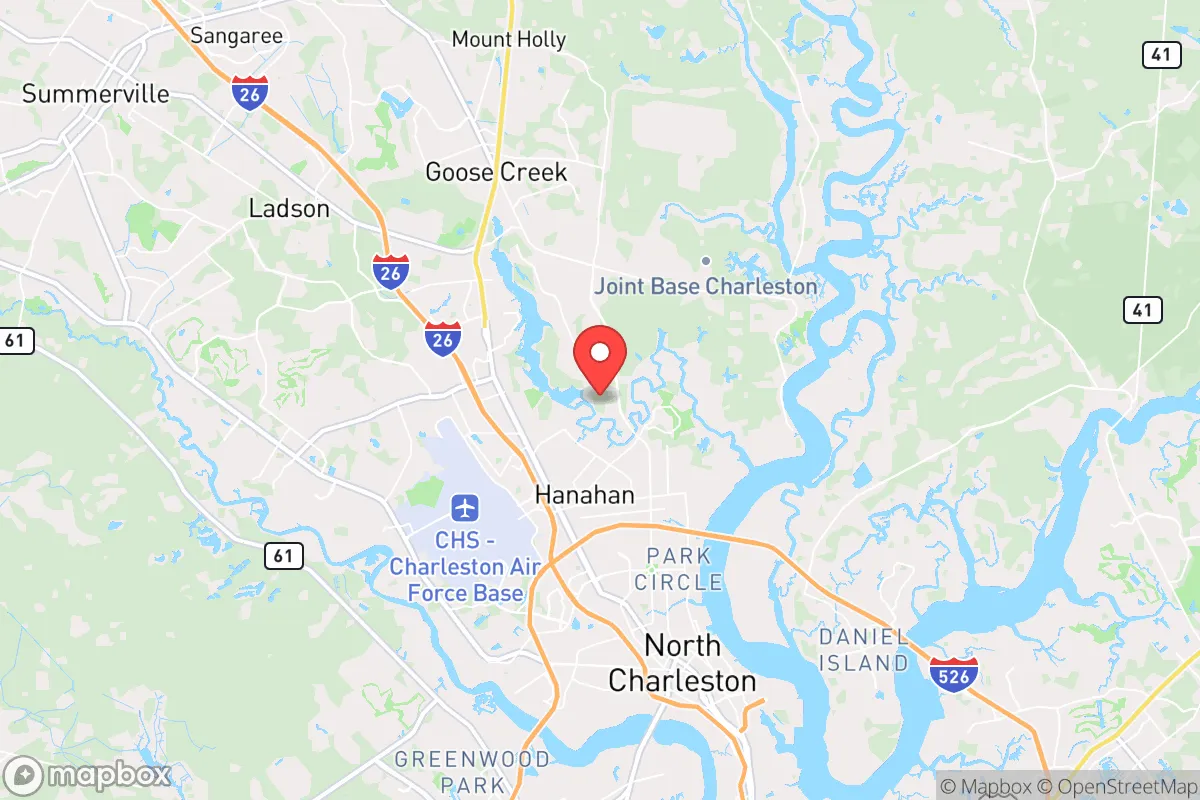
Photo by Leo Heisenberg on Unsplash
Demographics of Hanahan, SC
Affluence Level in Hanahan, SC
A middle-class area roughly in line with national averages across income, home values, education, and employment.
People of Hanahan, SC
The people of Hanahan, South Carolina, today form a predominantly white (71.9%), family-oriented suburban community of 21,119 residents, with a notable and growing Hispanic minority (11.6%) and smaller Black (8.7%), East/Southeast Asian (3.1%), and Indian-subcontinent (1.3%) populations. The city is characterized by a higher-than-national college attainment rate (38.0%) and a relatively low foreign-born share (5.9%), reflecting its roots as a post-war bedroom community for the Charleston Naval Base and nearby industrial employers. Hanahan’s identity is distinctly middle-class, suburban, and military-adjacent, with a strong sense of local boosterism centered on its schools and parks. The population is denser and more diverse than surrounding rural Berkeley County, but remains less cosmopolitan than neighboring North Charleston or Mount Pleasant.
How the city was settled and grew
Hanahan did not exist as a settlement before the 20th century. The land was originally part of low-country plantations, but the city’s founding is directly tied to the expansion of the U.S. Navy. In 1901, the Charleston Naval Base opened across the Cooper River, and the area that would become Hanahan began attracting workers and their families. The city was officially incorporated in 1970, but its growth had been underway for decades. The first major wave of residents were white Southerners and Appalachian migrants who moved to the area for shipyard and railroad jobs during World War I and World War II. These early families settled in what are now the Yeamans Park and Bowen neighborhoods, where modest single-family homes on large lots still dominate. A second wave in the 1950s and 1960s brought more Navy personnel and civilian defense contractors, who filled the ranch-style homes of Hanahan Plantation and the Tanner Plantation subdivisions. These areas remain the historic core of the city’s white, military-connected population.
Modern era (post-1965)
The post-1965 immigration reforms had a modest direct effect on Hanahan compared to coastal gateway cities, but the city’s demographics shifted significantly through domestic migration. The closure of the Charleston Naval Base in 1996 was a turning point: many military families left, and the resulting housing vacancies attracted new residents from other parts of the South and the Rust Belt. The Hispanic population began growing noticeably in the 2000s, drawn by construction and service jobs in the booming Charleston metro area. Today, Hispanic residents are concentrated in the Otranto area and the newer apartment complexes along Hanahan Road, where rental housing is more available. The Black population, at 8.7%, is smaller than in neighboring North Charleston (where it exceeds 40%), and is dispersed across the city with no single majority-Black neighborhood. East/Southeast Asian residents (3.1%) and Indian-subcontinent residents (1.3%) are relatively recent arrivals, many employed in the region’s growing tech, healthcare, and logistics sectors; they are most visible in the Foxbank Plantation and Berkely Hills subdivisions, which feature newer, larger homes. The foreign-born share of 5.9% is below the national average of 13.7%, indicating that Hanahan remains primarily a destination for domestic movers rather than international immigrants.
The future
Hanahan’s population is likely to continue growing moderately, driven by spillover from the Charleston region’s economic expansion. The city is not homogenizing into a single demographic bloc; rather, it is slowly diversifying along income and housing type lines. The older, established white population in Yeamans Park and Bowen is aging in place, while younger families—both white and Hispanic—are moving into newer developments like Foxbank Plantation and the apartments near Otranto. The Hispanic share is expected to rise, possibly reaching 15-18% by 2035, as second-generation families form households and new arrivals continue to seek affordable housing within commuting distance of Charleston. The East/Southeast Asian and Indian-subcontinent communities are small but growing, likely plateauing at 4-5% combined as the region’s tech sector matures. The Black population has been stable for a decade and is unlikely to increase significantly without a major shift in housing affordability. The city is not tribalizing into distinct ethnic enclaves; instead, it is becoming a moderately diverse, mostly middle-class suburb where income, rather than ethnicity, is the primary sorting mechanism.
For someone moving to Hanahan now, the city offers a stable, family-oriented environment with improving diversity and a strong local identity. It is not a melting pot in the classic sense, but a place where different groups coexist in separate but overlapping residential zones, united by shared priorities of good schools, low crime, and access to Charleston’s job market. The population trajectory points toward gradual diversification and continued suburban growth, making Hanahan a solid choice for conservative-leaning families who value community stability and are comfortable with incremental change.

* Values derived from national, state, county, city and local statistics and may differ in a specific area. Last updated: 2026-04-29T20:04:29.000Z
Narrative content on this page is AI-generated and may contain mistakes. Verify any details that matter before acting on them.
ReloMaps may earn a commission from affiliate links at no extra cost to you.

