 Popular
Demographics of Harpers Ferry, WV
Affluence Level in Harpers Ferry, WV
An upper-middle-class area. Household wealth, education levels, and homeownership run ahead of national benchmarks.
People of Harpers Ferry, WV
Today, Harpers Ferry, West Virginia is a remarkably small and homogeneous community of 342 residents, where 98.0% of the population identifies as White and 60.9% hold a college degree, a figure that far exceeds state and national averages. The town’s character is defined less by its current population size and more by its outsized role in American history, functioning now as a historic tourism destination and a bedroom community for commuters to Washington, D.C. and Baltimore. With only 2.0% foreign-born residents and negligible racial diversity—0.6% Black, 1.2% East/Southeast Asian, and 0.3% Hispanic—Harpers Ferry remains one of the least ethnically diverse incorporated places in the Eastern Panhandle. Its identity is deeply tied to preservation, outdoor recreation, and a quiet, educated populace that values the town’s 19th-century character over modern suburban expansion.
How the city was settled and grew
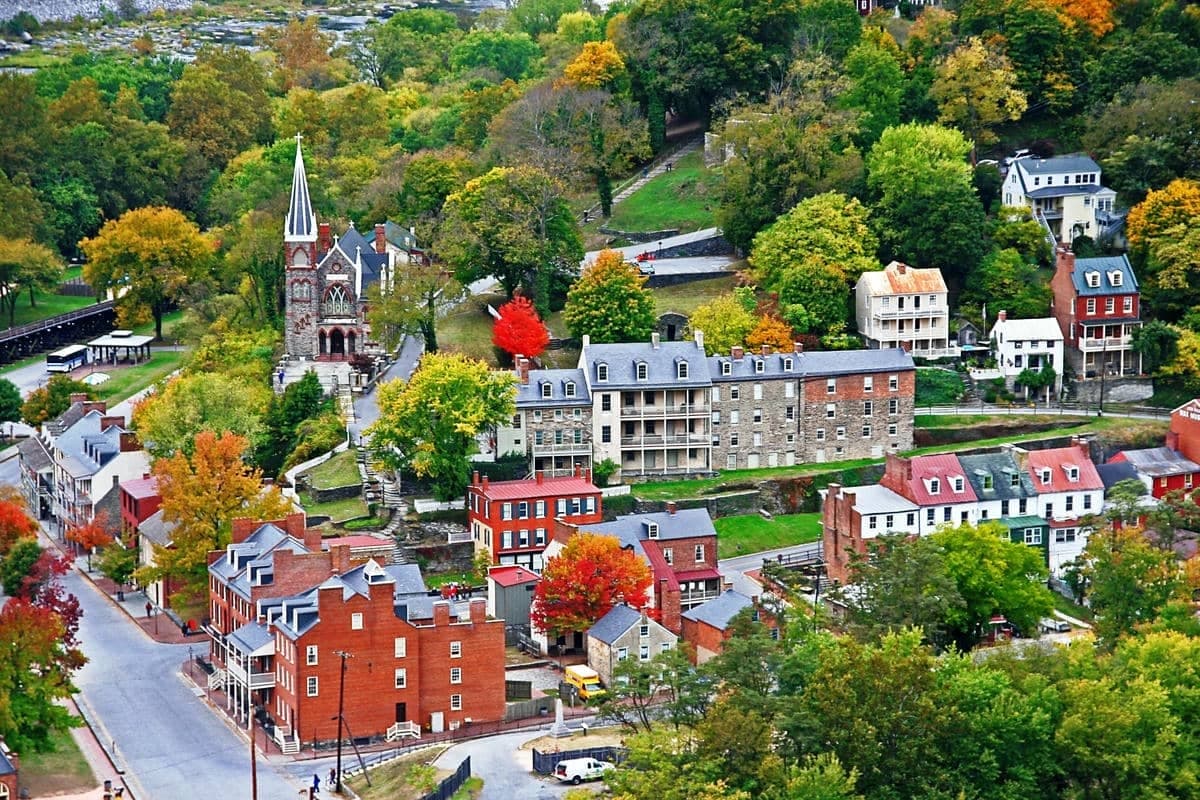
Harpers Ferry was founded in 1763 by Robert Harper, who established a ferry across the Potomac and Shenandoah rivers, drawing the first permanent settlers as farmers and mill operators. The U.S. Armory and Arsenal, established in 1799, transformed the village into a major industrial center, attracting skilled mechanics, ironworkers, and laborers from Pennsylvania, Maryland, and Virginia. These early workers settled in the Lower Town district, the historic core along the rivers, where tightly packed stone and brick rowhouses still stand. The arrival of the Baltimore and Ohio Railroad in the 1830s and the Chesapeake and Ohio Canal in the 1830s brought a wave of Irish immigrant laborers, who built the rail lines and locks, many living in the Camp Hill neighborhood above the flood-prone Lower Town. The 1859 raid by John Brown and the subsequent Civil War devastated the town’s industrial base; the armory was destroyed, and the population, which had peaked at roughly 3,000 in the 1850s, began a long decline. By the early 20th century, Harpers Ferry had shifted from a manufacturing hub to a small service and tourism town, with African American families—descendants of enslaved and free Black workers from the armory era—concentrated in the Fillmore Street area, a historically Black neighborhood that persisted through the Jim Crow era.
Modern era (post-1965)
After the 1965 Hart-Cellar Act, Harpers Ferry saw virtually no new immigration; the foreign-born share remains at just 2.0%, and the town’s racial composition has changed little since the 1970s. The most significant demographic shift has been domestic in-migration of educated professionals and retirees from the Washington, D.C. and Baltimore metropolitan areas, drawn by the town’s historic ambiance, low crime, and proximity to the MARC train line. These newcomers have largely settled in the Bolivar Heights and Ripley’s Overlook neighborhoods, where newer single-family homes and townhouses have been built on the ridges above the historic district. The historic Lower Town has become almost entirely commercial and tourist-oriented, with very few year-round residents. The Black population, which was around 15% in 1950, has dwindled to 0.6% today, as younger generations left for larger cities and the Fillmore Street neighborhood lost its residential character. The East/Southeast Asian population (1.2%) is almost entirely composed of professionals employed at the National Park Service’s Harpers Ferry Center or at nearby federal facilities, and they are dispersed rather than concentrated in any single neighborhood.
The future
The population of Harpers Ferry is likely to remain very small and predominantly White for the foreseeable future, constrained by the town’s strict historic preservation zoning, limited developable land, and lack of new housing construction. The 342-person population has been stable within a narrow range for decades, and no major demographic shifts are anticipated. The town’s cultural identity is becoming more oriented toward heritage tourism and second-home ownership, with an increasing share of homes owned by non-residents. The small number of new families moving in are almost entirely White, college-educated, and politically moderate to conservative, reinforcing the existing character. The Bolivar Heights and Ripley’s Overlook areas may see modest infill development, but the historic core will remain a museum-like setting. Harpers Ferry is not becoming more diverse; it is becoming more uniformly affluent, educated, and preservation-minded, with little room for the kind of growth that would alter its demographic profile.
For someone moving to Harpers Ferry today, the town offers a stable, safe, and historically rich environment with an exceptionally well-educated population and strong ties to federal and tourism employment. The trade-off is clear: residents accept very low diversity, minimal nightlife, and a small-town scale in exchange for stunning natural scenery, top-tier schools in Jefferson County, and a commute to the D.C. metro area that is feasible via MARC train. This is not a place of demographic change or cultural flux—it is a place that has deliberately preserved its 19th-century character, and its population reflects that choice.

* Values derived from national, state, county, city and local statistics and may differ in a specific area. Last updated: 2026-07-21T20:00:45.000Z
Narrative content on this page is AI-generated and may contain mistakes. Verify any details that matter before acting on them.
ReloMaps may earn a commission from affiliate links at no extra cost to you.

