
Photo by Anthony Chiado on Unsplash
Demographics of Harrisonburg, VA
Affluence Level in Harrisonburg, VA
A middle-class area roughly in line with national averages across income, home values, education, and employment.
People of Harrisonburg, VA
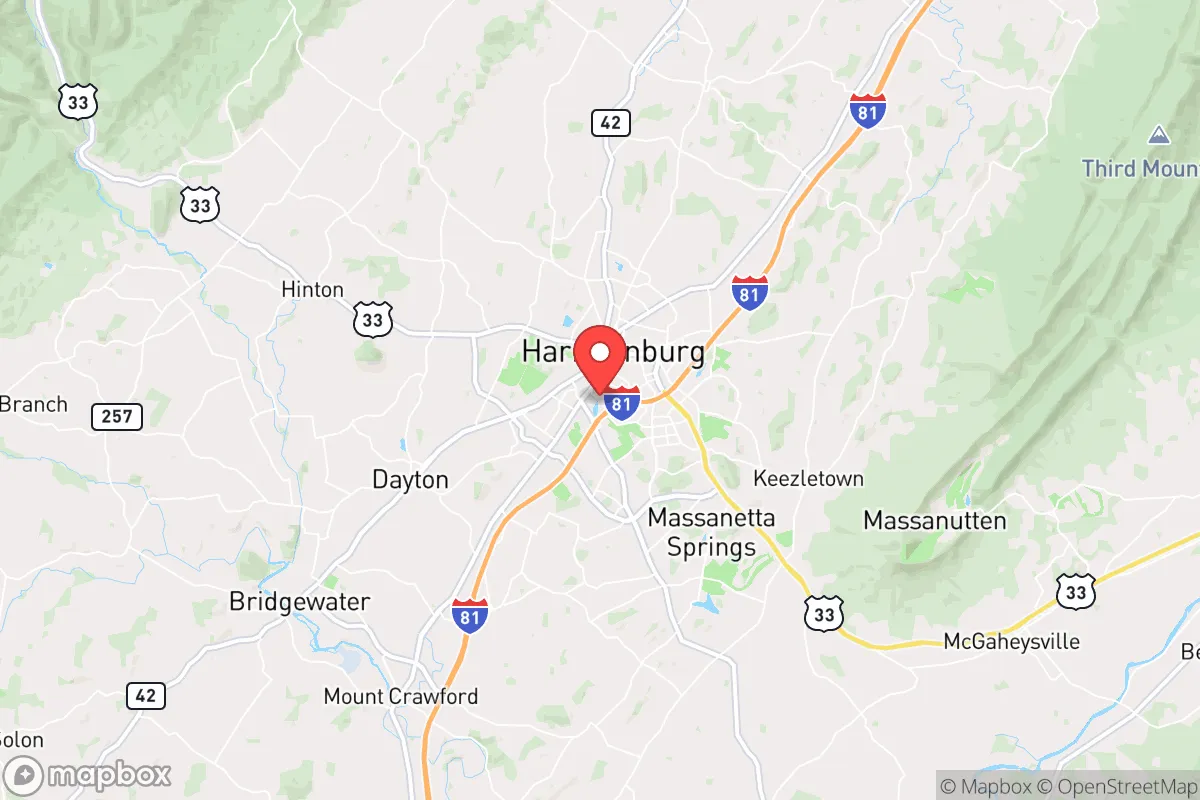
Harrisonburg, Virginia, is a city of 51,492 residents that blends a historic Mennonite and German-rooted population with a rapidly growing Hispanic community, creating a distinctive cultural and economic dynamic. The city is denser than its rural Shenandoah Valley surroundings, with a population that is 61.4% white, 23.1% Hispanic, 7.0% Black, 2.4% East/Southeast Asian, and 0.8% Indian (subcontinent). Its identity is shaped by a tension between long-established conservative agricultural traditions and a younger, more diverse influx driven by the city’s role as a regional hub for manufacturing, education, and immigrant labor.
How the city was settled and grew
Harrisonburg was founded in 1779 on land granted to Thomas Harrison, a Pennsylvania Quaker, and the earliest settlers were primarily of German and Scots-Irish descent moving south along the Great Wagon Road. These groups established small farms and mills, with the Old Town district—centered around Court Square—becoming the commercial and civic core. The arrival of the railroad in the 1850s spurred growth, attracting more Anglo-American families and a small number of free Black residents who settled in the Northeast Neighborhood, an area that later became a historic African American enclave. By the early 20th century, Mennonite and Brethren communities from Pennsylvania and Switzerland had established a strong presence, founding institutions like Eastern Mennonite University (1917) and shaping the city’s conservative, pacifist character. The mid-20th century saw limited growth, with the population remaining predominantly white and rural in orientation through the 1960s.
Modern era (post-1965)
The 1965 Immigration and Nationality Act opened the door for new arrivals, but Harrisonburg’s modern demographic shift began in earnest in the 1980s and 1990s, driven by the poultry and meatpacking industries. Companies like Cargill and Pilgrim’s Pride recruited heavily from Central America, particularly Guatemala and El Salvador, drawing a wave of Hispanic laborers who settled in the Northeast Neighborhood and the Westover Park area. These neighborhoods now have the highest concentration of Hispanic residents, with many families living in older single-family homes and apartment complexes near industrial zones. The Hispanic share of the population rose from under 5% in 1990 to 23.1% today, making it the fastest-growing demographic. Meanwhile, the city’s role as a regional education hub—home to James Madison University (JMU) and Eastern Mennonite University—attracted a smaller but notable influx of East/Southeast Asian students and faculty, who tend to cluster near the JMU campus in the Port Republic corridor. The Black population, at 7.0%, includes both long-standing families in the Northeast Neighborhood and newer arrivals from other parts of Virginia. The Indian subcontinent community (0.8%) is small and largely tied to professional roles at JMU and the local hospital, with no single concentrated neighborhood.
The future
Harrisonburg’s population is heading toward greater ethnic diversity, but the trajectory is one of tribalization into distinct enclaves rather than wholesale assimilation. The Hispanic community is growing rapidly through both immigration and higher birth rates, and its concentration in the Northeast Neighborhood and Westover Park is likely to intensify as new arrivals join established family networks. The white population, while still the majority, is aging and slowly declining in share, with younger white residents often leaving for larger cities after college. The East/Southeast Asian and Indian communities are expected to remain small and stable, tied to university and medical employment. The city’s overall growth rate is moderate—about 1-2% annually—and is projected to continue as long as manufacturing and education sectors remain strong. However, the city shows little sign of homogenizing; instead, it is becoming a patchwork of ethnic and economic zones, with Old Town and the JMU area remaining predominantly white and affluent, while the northeast and west sides become increasingly Hispanic and working-class.
For someone moving in now, Harrisonburg offers a city where conservative, family-oriented values coexist with a growing immigrant presence, creating a community that is both stable and in flux. The key decision is which neighborhood aligns with your priorities: Old Town for historic charm and walkability, the Northeast Neighborhood for a tight-knit Hispanic community, or the Port Republic corridor for proximity to JMU’s amenities. The city is not becoming a melting pot, but rather a collection of distinct, self-reinforcing enclaves—a reality that rewards careful neighborhood selection.

* Values derived from national, state, county, city and local statistics and may differ in a specific area. Last updated: 2026-05-01T18:37:16.000Z
Narrative content on this page is AI-generated and may contain mistakes. Verify any details that matter before acting on them.
ReloMaps may earn a commission from affiliate links at no extra cost to you.

