

Photo by Anthony Chiado on Unsplash
Political ClimatePolitical Climate in Harrisonburg, VA
District shown is the primary district for this city’s centroid. Cities may span multiple districts.
Inherited from parent state — no local data available.
Local Political AnalysisPolitical Analysis of Harrisonburg, VA
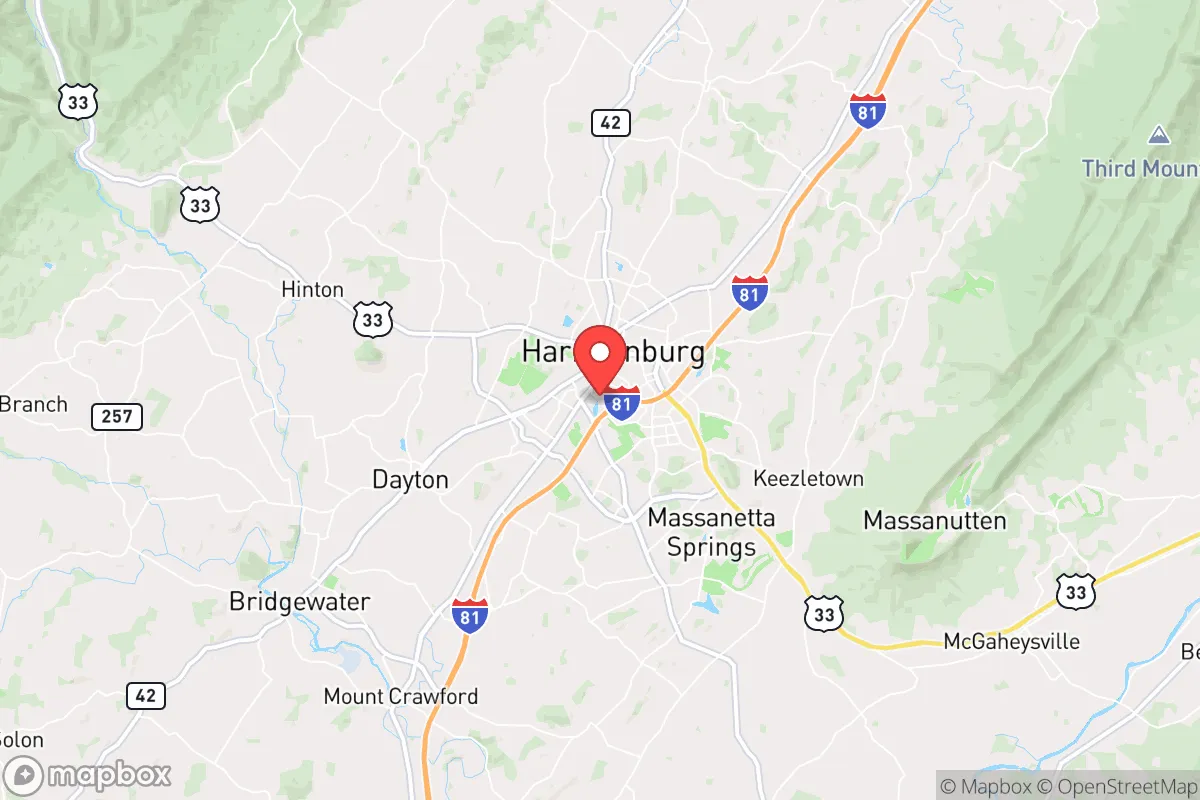
Harrisonburg sits in the heart of the Shenandoah Valley, and for a long time, this town was a reliably conservative stronghold where folks minded their own business and the government stayed out of your backyard. The official Cook PVI for the area is R+12, which tells you the underlying DNA of the district is still solidly red, but if you’ve been here more than a decade, you’ve watched the political center of gravity shift. The influx of James Madison University students and faculty, along with a growing refugee and immigrant population, has nudged the city itself leftward, while the surrounding Rockingham County remains deeply conservative. The result is a split personality: the city council and school board have taken on a noticeably progressive tone in recent years, but the county supervisors and state legislative seats still lean heavily Republican.
How it compares
Drive 20 minutes north to Broadway or 15 minutes south to Dayton, and you’re back in territory where the Second Amendment is a given and property taxes are kept low. Those towns haven’t seen the same demographic churn Harrisonburg has. Even Staunton, about 25 miles west, feels more traditionally conservative in its local governance than Harrisonburg proper does today. The real contrast, though, is with Charlottesville, about 45 minutes east—that place has gone full progressive, with rent control debates and defund-the-police rhetoric that would never fly here. Harrisonburg is still a place where most people wave at you on the street, but the city council has started pushing things like sanctuary city policies and equity audits that would have been unthinkable 15 years ago. The county, meanwhile, passed a Second Amendment sanctuary resolution in 2019 and hasn’t looked back.
What this means for residents
If you value personal freedom and want the government to keep its nose out of your business, the split is something you have to navigate. The city has gotten aggressive with zoning ordinances and short-term rental restrictions that feel like overreach—telling you what you can do with your own property. There’s also been a push for higher local taxes to fund social programs that many longtime residents see as unnecessary expansion of government. On the flip side, the county still respects the idea that you know what’s best for your family and your wallet. The school board has seen heated battles over curriculum transparency and parental rights, with conservative parents pushing back hard against any hint of critical race theory or gender ideology being taught without consent. For now, the balance is holding, but the trajectory is concerning if you believe in limited government and local control.
Culturally, Harrisonburg still has a strong Mennonite and Old Order presence that keeps the area grounded in traditional values—you’ll see horse-drawn buggies on the back roads, and the farmers market is full of folks who don’t want a single government handout. But the university’s influence is growing, and with it comes a push for sanctuary city status and diversity, equity, and inclusion mandates that feel like top-down social engineering. The long-term worry among conservatives here is that if the city keeps tilting left, you’ll see more regulations on everything from firearm carry to land use, and the freedom that made this valley a great place to raise a family will slowly get chipped away. For now, the county provides a buffer, but keep an eye on the next few election cycles—that R+12 rating might not hold forever if the trend continues.

State Political ClimatePolitical Climate in Virginia
State Political AnalysisPolitical Environment in the State
Virginia is a deeply purple state that has lurched leftward over the past 20 years, shifting from a reliably Republican stronghold to a state where Democrats control the governorship, both chambers of the legislature, and both U.S. Senate seats. The 2021 gubernatorial race saw Republican Glenn Youngkin win by a narrow 1.6 points, but the 2023 legislative elections handed Democrats full control of the General Assembly, and the 2024 presidential race saw the state go blue by roughly 5 points. The dominant coalition is now an alliance of Northern Virginia suburbanites, Richmond-area professionals, and Hampton Roads voters, while rural and exurban areas remain deeply red but are losing population share. For a conservative considering relocation, the state’s trajectory is concerning, but there are still pockets of freedom and a fighting chance to push back.
Urban vs. rural divide
The political map of Virginia is a tale of two states. The urban crescent—Northern Virginia (Fairfax, Loudoun, Prince William counties), Richmond, and Hampton Roads (Virginia Beach, Norfolk, Chesapeake)—drives the blue vote. Fairfax County alone cast over 300,000 votes for Biden in 2020, more than the entire population of many rural counties. The Richmond metro area, anchored by the state capital, has become reliably Democratic as the city gentrifies and Henrico County shifts left. Meanwhile, Virginia Beach remains a purple battleground within the region, with military families and retirees splitting tickets. The rural south and west—places like Roanoke, Lynchburg, and the Shenandoah Valley—vote heavily Republican. Lynchburg, home to Liberty University, is a conservative stronghold, while Roanoke County and the surrounding areas have held the line. The divide is stark: the 10 most populous counties (all in the urban crescent) voted for Biden by an average of 20 points, while the 50 least populous counties voted for Trump by an average of 35 points. The problem for conservatives is that population growth is concentrated in the blue areas, with Northern Virginia adding 200,000 residents between 2010 and 2020 while rural counties stagnated or shrank.
Policy environment
Virginia’s policy environment has shifted dramatically left since Democrats took full control in 2020. The state income tax is a flat 5.75%, but property taxes are set locally and can be high—Fairfax County has an effective rate of 1.1%, while Lynchburg sits at 0.8%. The regulatory posture is increasingly burdensome: the Virginia Clean Economy Act mandates a 100% carbon-free grid by 2050, driving up electricity costs. Education policy is a flashpoint: Governor Youngkin pushed for parental rights and banned critical race theory in schools, but the Democratic legislature has blocked most of his agenda and restored funding for diversity, equity, and inclusion programs. Healthcare is heavily regulated, with the state expanding Medicaid under the Affordable Care Act in 2019, adding 400,000 enrollees. Election laws have been loosened: no-excuse absentee voting and same-day registration are now permanent, and the state has automatic voter registration through the DMV. Gun laws have tightened significantly: in 2020, Democrats passed a red flag law, a one-handgun-a-month purchase limit, and universal background checks for private sales. The state also banned assault weapons in 2023, though enforcement is spotty. For a conservative, the policy environment is a mixed bag—taxes are moderate, but the regulatory and cultural direction is clearly leftward.
Trajectory & freedom
Virginia is becoming less free by any objective measure. The most concerning trend is the erosion of Second Amendment rights: the 2020 red flag law allows police to seize firearms based on a complaint without a criminal conviction, and the 2023 assault weapons ban criminalizes possession of commonly owned rifles. On parental rights, Youngkin’s executive orders on transparency in school curricula were a win, but the legislature has refused to codify them, and school boards in Loudoun County and Fairfax County continue to push gender ideology policies that keep parents in the dark. Medical autonomy took a hit with the 2021 repeal of the state’s parental notification law for minors seeking abortions, and the 2024 law expanding taxpayer-funded abortion coverage through the state employee health plan. Property rights are under pressure from the Virginia Housing Commission’s push for upzoning and rent control in Arlington and Alexandria. On the positive side, the state has no income tax on military pensions, which helps retirees in Virginia Beach and Norfolk. But the overall trajectory is clear: the legislature is actively expanding government control over guns, healthcare, and education, while the courts have been friendly to progressive causes.
Civil unrest & political movements
Virginia has been a flashpoint for political violence and protest. The 2017 Unite the Right rally in Charlottesville left one counterprotester dead and sparked a national reckoning, and the city remains a symbol of racial tension. More recently, the 2020 Black Lives Matter protests in Richmond led to the toppling of Confederate statues and a year-long occupation of the Capitol grounds. On the right, the Virginia Citizens Defense League has organized massive Second Amendment rallies at the Capitol, drawing 20,000+ attendees in 2020. Immigration politics are heated: Fairfax County and Arlington are sanctuary jurisdictions that limit cooperation with ICE, and the state has a “Dreamer” tuition law that grants in-state rates to undocumented students. Election integrity remains a sore spot: the 2020 election saw widespread use of drop boxes and mail-in ballots, and the 2021 gubernatorial race was decided by just 66,000 votes out of 3.3 million cast, with no audit of the results. The state’s new voter ID law, passed in 2023, is weaker than the pre-2020 version, allowing utility bills as proof of identity. A new resident in Lynchburg or Roanoke will see a different world than someone in Arlington—the former are quiet and conservative, the latter are activist and progressive.
Projection
Over the next 5-10 years, Virginia will likely continue its leftward drift. The demographic trends are inexorable: Northern Virginia is growing at 1.5% annually, while rural areas are losing population. The 2024 election results showed that even Loudoun County, once a swing county, is now solidly blue. The state’s economy is increasingly tied to the federal government and defense contractors in Arlington and McLean, which insulates it from conservative economic policies. The Republican Party is struggling to compete in the suburbs, and the 2025 gubernatorial election will be a test: if a Democrat wins, expect further gun control, a state-level public option for healthcare, and more progressive education mandates. The best-case scenario for conservatives is a split government that blocks the worst legislation, but the long-term trend is toward a California-style model of high regulation and progressive social policy. Someone moving to Lynchburg or Roanoke today will find a conservative community, but they will be fighting a losing battle at the state level.
For a conservative considering relocation, Virginia offers a mixed bag. The rural and exurban areas—Lynchburg, Roanoke, the Shenandoah Valley—still have strong communities, low crime, and a traditional way of life. But the state government is actively hostile to gun rights, parental control, and fiscal conservatism. If you’re looking for a place where your vote will matter and your values are reflected in state law, Virginia is a tough sell. The bottom line: move here for the mountains, the history, and the job market, but be prepared to fight for your freedoms at the ballot box and in the courts. The state is not lost yet, but it’s on a trajectory that should concern anyone who values limited government and personal liberty.
* Values derived from national, state, county, city and local statistics and may differ in a specific area. Last updated: 2026-05-01T18:37:16.000Z
Narrative content on this page is AI-generated and may contain mistakes. Verify any details that matter before acting on them.
ReloMaps may earn a commission from affiliate links at no extra cost to you.

