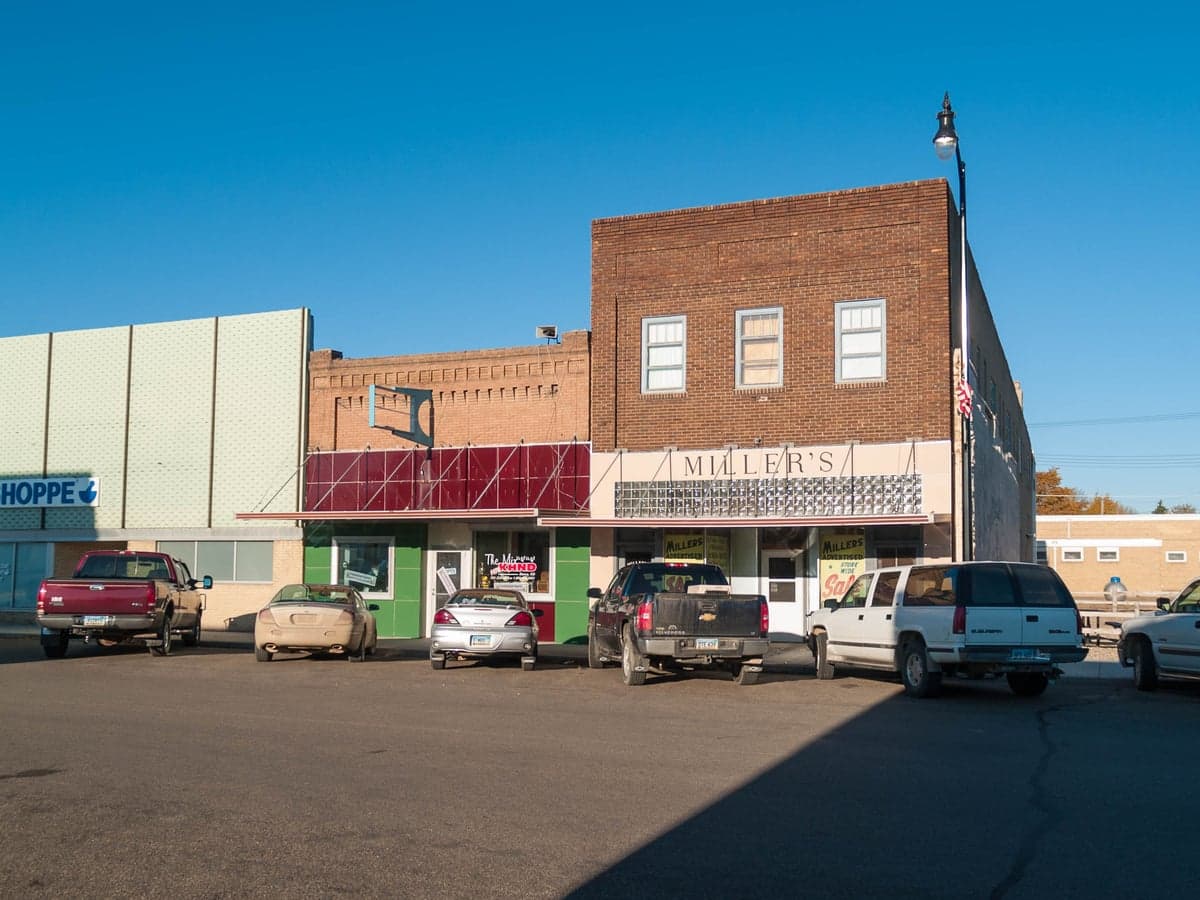
Photo: Wikipedia
Demographics of Harvey, ND
Affluence Level in Harvey, ND
A below-average socioeconomic profile. Incomes, home values, and educational attainment trail the U.S., with higher poverty and unemployment.
People of Harvey, ND
The people of Harvey, North Dakota, today form a tight-knit, predominantly white community of 1,720 residents, characterized by a strong agricultural and energy-sector work ethic and a low population density that preserves a small-town, family-oriented atmosphere. With 91.8% of the population identifying as white and a foreign-born share of just 0.2%, the city remains one of the most ethnically homogeneous in the state, a direct reflection of its settlement history and limited recent in-migration. Distinctive markers include a high rate of homeownership, a median age slightly above the national average, and a civic identity rooted in Lutheran and Catholic church communities, local sports, and the annual Harvey Harvest Festival. The city’s population has been slowly declining from a peak of roughly 2,200 in the 1980s, but those who remain are deeply invested in the area’s stability and heritage.
How the city was settled and grew
Harvey was founded in 1884 as a railroad town on the Soo Line, with the first wave of settlers being German-Russian immigrants fleeing religious persecution and land scarcity in the Russian Empire. These families, primarily from the Black Sea region, were drawn by the promise of cheap, fertile land under the Homestead Act and the railroad’s need for laborers and suppliers. They established the German-Russian enclave in the original town plat, centered around the railroad depot and the grain elevators that still dominate the skyline. A second wave, arriving between 1900 and 1920, consisted of Norwegian and Swedish immigrants who settled the North Side district, building the Scandinavian Lutheran churches and the first brick commercial buildings along Main Street. The city’s growth peaked during the 1950s oil boom, when domestic migrants from the Upper Midwest—many of them second-generation Scandinavian farmers—moved into the South Hill neighborhood, a post-war subdivision of ranch-style homes built for oilfield workers and their families. No significant non-white or foreign-born populations settled in Harvey during this period, as the city’s economy and social structures were built around ethnic European enclaves that remained largely closed to outsiders.
Modern era (post-1965)
After the 1965 Hart-Cellar Act, Harvey saw virtually no immigration from Asia, Latin America, or Africa, a pattern that continues today with a foreign-born share of just 0.2%. The city’s demographic story in the modern era is one of domestic out-migration and aging, not diversification. Young adults born in the 1970s and 1980s left for college and jobs in Bismarck, Fargo, and the oil fields of the Bakken region, leaving behind an older, more stable population. The West End, a neighborhood of 1970s-era split-level homes near the hospital, became the preferred location for retiring farmers and empty-nesters, while the East Side, closer to the grain elevators and industrial park, saw a slight influx of families from the surrounding rural towns seeking better schools. The Hispanic population, now 2.7%, is a very recent development, consisting of a handful of families who moved in during the 2010s to work at the local turkey processing plant and the nearby wind farm; they are concentrated in rental properties along Railroad Avenue, but have not formed a distinct ethnic neighborhood. The Asian population (0.2%) and Indian subcontinent population (0.0%) are statistically negligible, represented by a single professional family or temporary worker at any given time. The black population remains at 0.0%.
The future
The population of Harvey is likely to continue its slow decline over the next 10–20 years, driven by an aging demographic and limited economic opportunities for young adults. The city is not homogenizing further—it is already as homogeneous as a North Dakota town can be—but it is also not tribalizing into distinct enclaves, as the small Hispanic population is assimilating into the broader community through intermarriage and church attendance. The 0.2% foreign-born share is unlikely to rise significantly, as the city lacks the industrial base or refugee resettlement programs that drive immigration to larger regional centers. The South Hill and West End neighborhoods will see the most turnover as older residents pass away or move to assisted living, with homes likely purchased by families from the surrounding farm country rather than by out-of-state migrants. The North Side historic district may see some reinvestment from local preservation efforts, but new construction will remain rare. The city’s future is one of stability through shrinkage—a smaller, older, but still deeply connected community.
For someone moving in now, Harvey offers a predictable, safe, and culturally cohesive environment where neighbors know each other by name and community institutions remain strong. The trade-off is clear: you gain a low-crime, family-friendly town with a strong sense of place, but you join a population that is slowly contracting and largely closed to demographic change. This is a place for those who value continuity over growth, and who are comfortable living in a community where nearly everyone shares a similar background and worldview.

* Values derived from national, state, county, city and local statistics and may differ in a specific area. Last updated: 2026-04-19T08:01:05.000Z
Narrative content on this page is AI-generated and may contain mistakes. Verify any details that matter before acting on them.
ReloMaps may earn a commission from affiliate links at no extra cost to you.

