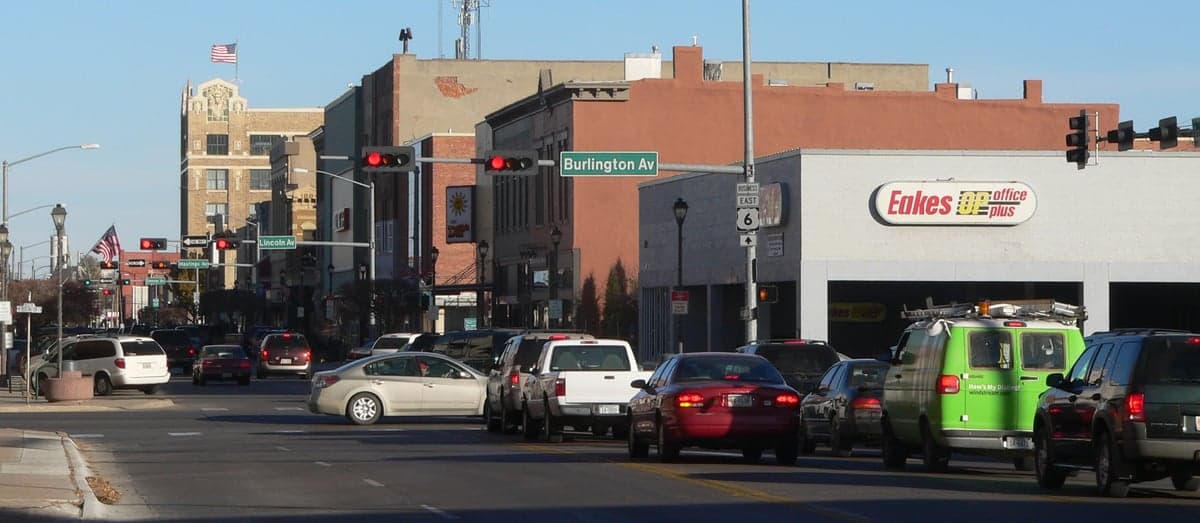
Photo: Wikipedia
Demographics of Hastings, NE
Affluence Level in Hastings, NE
A middle-class area roughly in line with national averages across income, home values, education, and employment.
People of Hastings, NE
The people of Hastings, Nebraska, today form a stable, predominantly white community of 25,005 residents, characterized by a strong sense of local identity rooted in agricultural and manufacturing heritage. With 80.4% of the population identifying as white and a Hispanic community of 14.5% that is the city’s fastest-growing demographic, Hastings is a place where traditional Midwestern values meet gradual diversification. The city’s foreign-born population sits at 4.7%, and its college-educated share of 28.0% reflects a workforce oriented toward practical trades and local industry rather than a large professional class. Distinctive markers include a tight-knit civic culture, a reliance on manufacturing and healthcare employers, and a demographic profile that is whiter and less diverse than Nebraska as a whole.
How the city was settled and grew
Hastings was founded in 1872 as a railroad town on the open prairie, its original population drawn by the promise of land and the junction of the Burlington and Missouri River Railroad and the St. Joseph and Denver City Railroad. The city’s early growth was fueled by homesteaders from the eastern United States, particularly German, Czech, and Swedish immigrants who arrived in the 1870s and 1880s to farm the surrounding fertile loess soil. These groups built the city’s first residential districts: the West Side neighborhood, centered around the railroad depot, became home to German and Czech laborers and small business owners, while the South Central area near the original town square housed Swedish and Danish families who worked in grain milling and retail. The arrival of the Hastings College of the Law (later Hastings College) in 1882 attracted a small professional class, and the city’s population grew steadily through the early 20th century, reaching 15,000 by 1920. The North Park neighborhood, developed in the 1910s and 1920s, became a middle-class enclave for second-generation German and Swedish families who had moved up from manual labor into white-collar roles at the city’s growing manufacturing plants, including the Hastings Manufacturing Company (piston rings) and the Campbell Soup Company’s local plant.
Modern era (post-1965)
After the 1965 Hart-Cellar Act, Hastings saw only modest immigration, with the foreign-born share remaining below 5% through the 2020s. The most significant demographic shift has been the growth of the Hispanic population, which rose from roughly 3% in 1990 to 14.5% today, driven by domestic in-migration from Texas and the Southwest rather than direct immigration. These families have concentrated in the East Side neighborhood, particularly along Baltimore Avenue and near the Hastings Regional Center campus, where affordable housing stock and proximity to meatpacking and food-processing jobs at the JBS Swift plant and the local Cargill facility created a natural landing zone. The Southwest neighborhood, developed in the 1970s and 1980s, absorbed the city’s growing white professional class—engineers, healthcare workers at Mary Lanning Healthcare, and faculty at Hastings College—while the Northwest area, with newer subdivisions built after 2000, became a destination for families seeking larger lots and newer schools. The Black population remains small at 1.3%, concentrated in the South Central area near the original downtown, while East/Southeast Asian residents (1.2%) are scattered across the city, with no single enclave. The Indian-subcontinent population is effectively zero, and Arab communities are negligible.
The future
Hastings is not homogenizing into a single demographic block but is instead tribalizing into distinct enclaves along income and ethnic lines. The Hispanic population is projected to continue growing, likely reaching 18-20% by 2040, driven by natural increase and continued domestic migration from the Southwest, with the East Side solidifying as a predominantly Hispanic corridor. The white population is aging—the median age for whites is 42, compared to 28 for Hispanics—and the city’s overall population has been flat since 2010, suggesting that Hispanic growth is offsetting white out-migration and natural decline. The Northwest subdivisions will likely remain overwhelmingly white and middle-class, while the West Side and South Central neighborhoods are seeing gradual white flight to newer areas, leaving older housing stock for lower-income renters. The foreign-born share is unlikely to rise significantly, as Hastings lacks the refugee resettlement programs or large immigrant-employing industries that drive growth in other Nebraska cities like Lexington or Grand Island. The next 10-20 years will likely see a Hastings that is slightly more Hispanic, slightly older in its white population, and more economically stratified by neighborhood, with the East Side becoming a distinct cultural and commercial hub for the Hispanic community.
For someone moving in now, Hastings is becoming a city where neighborhood choice increasingly determines social experience: the Northwest offers a traditional, predominantly white suburban lifestyle, while the East Side provides a more diverse, working-class environment with growing Hispanic cultural institutions. The city’s overall stability—low crime, strong schools, and a steady manufacturing base—makes it a safe bet for families and retirees, but those seeking a rapidly diversifying or cosmopolitan environment will find Hastings’ pace of change slow and its demographic boundaries relatively fixed.

* Values derived from national, state, county, city and local statistics and may differ in a specific area. Last updated: 2026-05-03T20:30:14.000Z
Narrative content on this page is AI-generated and may contain mistakes. Verify any details that matter before acting on them.
ReloMaps may earn a commission from affiliate links at no extra cost to you.

