 Popular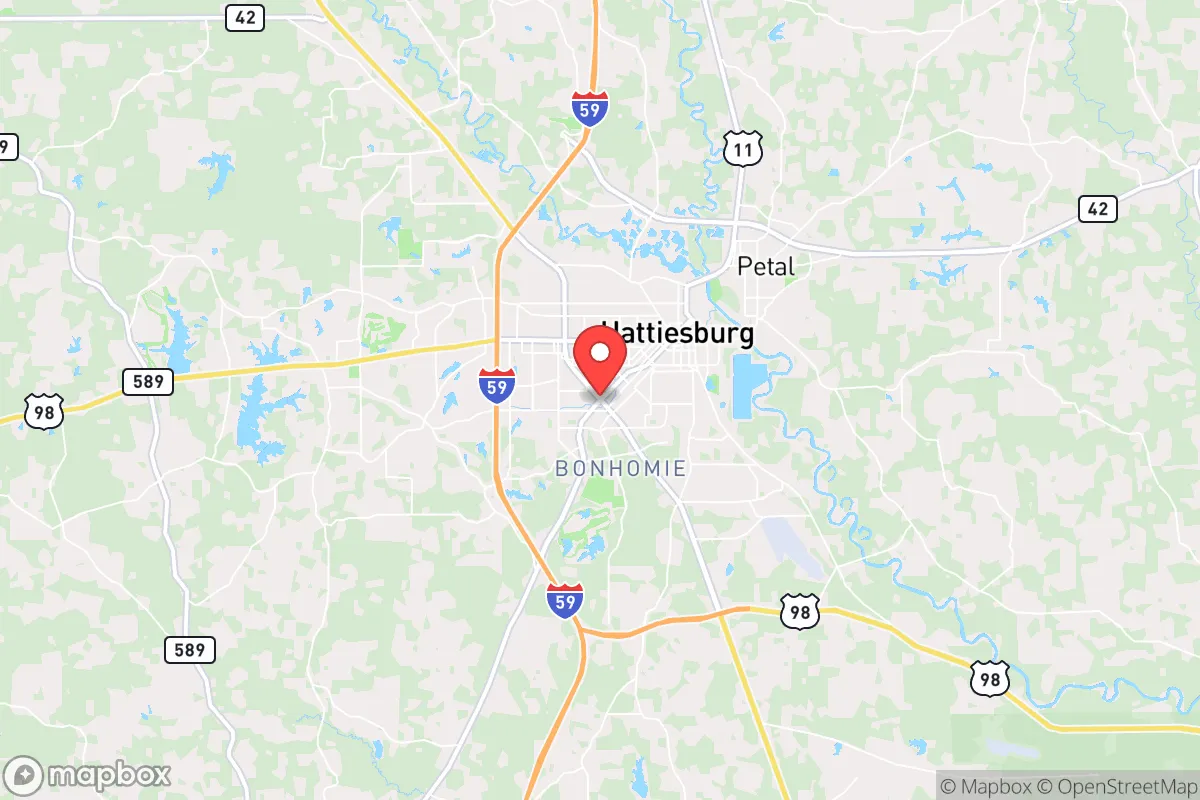
Photo: Wikipedia
Personal Sovereignty in Hattiesburg, MS
Viable for self-reliance. Generally workable, though some barriers may limit total independence.
What does Personal Sovereignty tell us?
Personal Sovereignty measures your capacity for self-reliance and independence with minimal government friction. Higher scores mean fewer barriers between you and the way you want to live... but it assumes you have the space you need and good neighbors.
What does this tell us?
Personal Sovereignty measures your capacity for self-reliance and independence with minimal government friction. Higher scores mean fewer barriers between you and the way you want to live... but it assumes you have the space you need and good neighbors.
State Policy
Energy independence: Importer (50% of energy produced in-state)
Personal Liberty
Homesteading

Personal Liberty Analysis
Hattiesburg, Mississippi, offers a notably high degree of personal sovereignty compared to much of the coastal and urban Northeast or West Coast, making it a serious consideration for those prioritizing autonomy. The city sits within a state that consistently ranks among the most liberty-oriented in the nation, with a legal and cultural environment that generally resists federal overreach and encourages self-reliance. For the survivalist or prepper, the key question isn't whether the government will leave you alone—it's whether the local infrastructure and community norms support the kind of independent, prepared lifestyle you're aiming for. The answer is largely yes, but with specific nuances around local zoning and the practical realities of Mississippi's regulatory climate that deserve a closer look.
Tax burden and regulatory posture in Mississippi
Mississippi's state-level tax structure is a clear win for personal sovereignty. There is no state income tax on Social Security benefits, and the state's personal income tax is being phased out entirely, with a flat 4.0% rate in 2026 and scheduled elimination by 2028. Property taxes are among the lowest in the nation—the effective rate in Forrest County (where Hattiesburg sits) is roughly 0.72% of assessed value, meaning a $200,000 home carries an annual tax bill around $1,440. Sales tax in Hattiesburg is 7%, which is moderate, but the absence of state-level inventory taxes and a relatively light business regulatory burden means that starting a side hustle or small-scale trade (essential for prepper income diversification) is straightforward. The state's "right-to-work" status and lack of burdensome occupational licensing for many trades further reduce government friction. However, be aware that Mississippi's state government, while philosophically conservative, is not always operationally efficient—permitting for larger projects can be slow, but for day-to-day life, the regulatory footprint is light. The state also has no personal property tax on vehicles or boats, which is a direct savings for anyone maintaining a fleet of trucks, trailers, or off-grid equipment.
Self-defense and gun law specifics in Hattiesburg
Mississippi is a constitutional carry state, meaning that as of 2026, no permit is required to carry a concealed firearm for any law-abiding adult 18 or older. Hattiesburg itself is in Forrest County, which has a sheriff's office that is generally supportive of Second Amendment rights. The state preempts local gun ordinances, so Hattiesburg cannot enact its own bans on magazine capacity, firearm types, or carry locations beyond what state law allows. Stand-your-ground and castle doctrine laws are fully in effect, with no duty to retreat in any place you have a legal right to be. For the prepper, this means you can legally keep a loaded firearm in your vehicle, on your person, and in your home without bureaucratic hurdles. The state also has strong firearm preemption laws that prevent local governments from creating a patchwork of restrictions. One practical consideration: while the legal framework is excellent, Hattiesburg's crime rate—particularly property crime—is higher than the national average, so actually exercising your self-defense rights is a realistic daily concern, not a theoretical one. The city's violent crime rate is roughly 50% above the national average, concentrated in specific areas, so situational awareness and a defensive mindset are warranted.
Self-reliance and homesteading viability in the Pine Belt
Hattiesburg's location in the Pine Belt of Mississippi offers strong potential for self-reliance, but with caveats. The growing season is long—roughly 230 days—and the soil in the surrounding rural areas is sandy loam, workable for gardens and small orchards. Within the Hattiesburg city limits, lot sizes vary widely; older neighborhoods near downtown have lots as small as 0.25 acres, while newer subdivisions on the outskirts (like the Oak Grove area) offer 0.5 to 1-acre lots. For serious homesteading, you'll want to look outside city limits in Lamar or Forrest County, where 5- to 20-acre parcels are common and affordable, often under $5,000 per acre. Zoning in unincorporated areas is minimal—no county-level building codes in many rural parts of Forrest County, and no restrictions on keeping chickens, goats, or even a few head of cattle. Off-grid feasibility is high: the region gets ample rainfall (about 55 inches annually), so rainwater catchment is viable, and solar insolation is adequate for a modest off-grid system. However, the city of Hattiesburg does have building codes and permit requirements for structural additions, so if you're buying inside city limits, expect to navigate the local permitting office. The biggest practical challenge for off-grid living is the humidity and heat—passive cooling design and mold-resistant construction are essential. Also, note that Mississippi has no state-level ban on rainwater harvesting, and the state's water rights laws are favorable to landowners for well drilling.
Personal liberties: parental rights, medical autonomy, speech, and property
On parental rights, Mississippi is one of the strongest states in the nation. The state has a "Parents' Bill of Rights" law that affirms parents' fundamental right to direct the upbringing, education, and healthcare of their children. This means no government-mandated vaccine requirements for school attendance beyond the standard childhood schedule, and parents can opt out of any curriculum materials they find objectionable. Medical autonomy is similarly robust: Mississippi does not have a state-level vaccine passport mandate, and the state's response to federal health emergencies has been consistently resistant to lockdowns and mask mandates. During the COVID-19 pandemic, Hattiesburg's local government did not impose business closures or capacity limits beyond the state's minimal guidance. For speech, Mississippi has no hate speech laws that criminalize political or religious expression, and the state's public universities (including the University of Southern Mississippi in Hattiesburg) are generally considered tolerant of conservative viewpoints, though like any campus, there are pockets of progressive activism. Property rights are protected by a strong eminent domain law that limits takings to public use (not economic development), and the state has a "right to farm" law that shields agricultural operations from nuisance lawsuits—useful if you plan to homestead near suburban edges. One notable gap: Mississippi does not have a state-level Religious Freedom Restoration Act (RFRA) as strong as some other states, though federal protections still apply.
Overall, Hattiesburg represents a solid middle-ground option for those seeking personal sovereignty in the current American landscape. It is not a libertarian utopia—you will still deal with property taxes, sales tax, and some local permitting—but the state-level legal framework is deliberately designed to maximize individual freedom in the areas that matter most to preppers and conservatives: self-defense, parental control, medical choice, and property use. The city's relatively low cost of living (about 15% below the national average) and affordable land prices mean you can achieve a degree of self-reliance that would be financially impossible in high-tax, high-regulation states. The trade-off is that Hattiesburg is in a region with real crime concerns and a climate that demands resilience, but for those willing to adapt, the sovereignty-to-cost ratio here is among the best in the Southeast. If your priority is minimizing government interference in your daily life while maintaining access to a mid-sized city's infrastructure, Hattiesburg deserves a serious look.

* Values derived from national, state, county, city and local statistics and may differ in a specific area. Last updated: 2026-04-30T03:01:58.000Z
Narrative content on this page is AI-generated and may contain mistakes. Verify any details that matter before acting on them.
ReloMaps may earn a commission from affiliate links at no extra cost to you.

