 Popular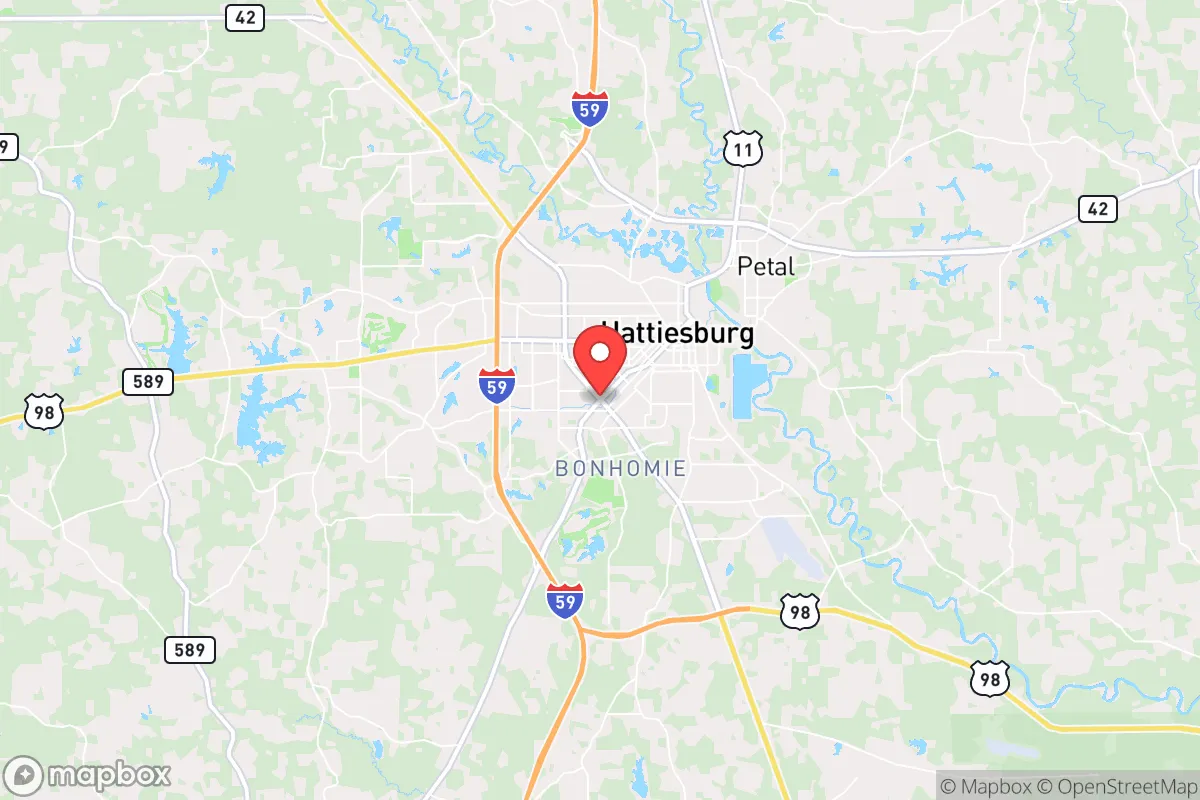
Photo: Wikipedia
Political ClimatePolitical Climate in Hattiesburg, MS
District shown is the primary district for this city’s centroid. Cities may span multiple districts.
Local Political AnalysisPolitical Analysis of Hattiesburg, MS
Hattiesburg sits in a reliably conservative corner of Mississippi, anchored by a Cook PVI of R+21 that reflects the broader region’s deep-rooted preference for limited government and traditional values. But if you’ve lived here as long as I have, you’ve watched the political winds shift in subtle ways—especially around the university and downtown areas, where a younger, more progressive crowd has started to make noise. The county itself, Forrest County, has voted Republican in every presidential election since 2000, but the margins have tightened a bit in recent cycles, and that’s something worth keeping an eye on.
How it compares
Drive 20 miles south to Petal or 30 miles west to Columbia, and you’ll find communities that lean even harder into the conservative mold—places where the R+21 number feels almost moderate by comparison. Those towns haven’t seen the same influx of college students and out-of-state transplants that Hattiesburg has, thanks to the University of Southern Mississippi and William Carey University. Meanwhile, head east toward Laurel or north toward Collins, and the political landscape stays just as red, with local officials who rarely face serious primary challenges. The real contrast is inside Hattiesburg itself: the city council has a few members who push for more progressive policies—like raising the minimum wage locally or expanding public transit—but those efforts usually stall when they hit the county supervisors, who are far more skeptical of government overreach. It’s a classic tug-of-war between a small but vocal progressive minority and a majority that still believes the best government is the one that stays out of your business.
What this means for residents
For the average family here, the political climate means you can generally count on low taxes, limited zoning hassles, and a sheriff’s department that focuses on real crime rather than social experiments. Property taxes in Forrest County run about 0.8% of assessed value, well below the national average, and there’s no city income tax to worry about. But the creeping influence of progressive ideas—like diversity, equity, and inclusion mandates at the university or talk of “sanctuary city” policies—has some of us watching closely. The 2024 election saw Forrest County vote 58% for the Republican presidential candidate, down from 62% in 2020, and that 4-point shift is exactly the kind of trend that makes you wonder if the next generation will hold the line. Local school board races have become more contentious too, with debates over curriculum transparency and parental rights heating up in a way they didn’t a decade ago.
On the cultural side, Hattiesburg still feels like a place where church potlucks and Friday night football matter more than political rallies. The annual HubFest and the downtown farmers market are apolitical gathering spots where neighbors of all stripes mix without much fuss. But the long-term trajectory depends on whether the city can keep its conservative character as it grows. If you’re thinking of moving here, you’ll find a community that values personal freedom and self-reliance—just don’t be surprised if the local coffee shop has a few folks grumbling about the direction of things. That’s just Hattiesburg: friendly, but always keeping one eye on the horizon.

State Political ClimatePolitical Climate in Mississippi
State Political AnalysisPolitical Environment in the State
Mississippi is one of the most reliably conservative states in the country, with a deep-rooted Republican lean that has only solidified over the past two decades. The state hasn’t voted for a Democratic presidential candidate since 1976, and in 2024, Donald Trump carried it by over 17 points. The dominant coalition is a mix of rural and suburban conservatives, evangelical Christians, and a growing number of fiscally-minded transplants from other Southern states. Over the last 10-20 years, the shift has been stark: Democrats once held a majority in the state legislature as recently as 2010, but today Republicans hold supermajorities in both chambers, and every statewide elected office is held by the GOP. The political culture here is one of low taxes, limited government, and a strong emphasis on local control—though the state’s history and demographics mean that political debates often carry a different weight than in other parts of the South.
Urban vs. rural divide
The political map of Mississippi is a textbook case of the urban-rural split. The state’s only major metro, the Jackson area, is a Democratic stronghold, driven by a majority-Black population and a concentration of government workers and university faculty. Hinds County, which contains most of Jackson, voted over 70% for Joe Biden in 2020. But that’s an island in a sea of red. The Gulf Coast cities—Biloxi, Gulfport, and Ocean Springs—lean Republican, though they’re more moderate than the interior. The DeSoto County suburbs of Memphis, particularly Southaven and Olive Branch, are among the fastest-growing and most reliably Republican areas in the state, with many residents fleeing Tennessee’s higher taxes. Meanwhile, the Delta region—places like Greenville and Clarksdale—remains heavily Democratic and economically distressed, but its population is shrinking. The rural counties in the northeastern hill country, like Tishomingo and Prentiss, are deep red, often voting 80%+ Republican. The real story is the suburban ring around Jackson: Rankin and Madison counties are now some of the most conservative in the state, with Madison County voting over 65% Republican in 2024. That’s where the growth is, and it’s pulling the state further right.
Policy environment
Mississippi’s policy environment is about as friendly to conservative priorities as you’ll find. There’s no state income tax on Social Security benefits, and the state has been phasing down its personal income tax rate—it’s currently 4.7% and set to drop further under legislation passed in 2022. Property taxes are among the lowest in the nation, with no state-level property tax at all. The regulatory climate is business-friendly, with a right-to-work law and minimal zoning restrictions outside of a few cities. On education, Mississippi has embraced school choice: the state has a robust charter school law, a voucher-like program for special needs students, and a new Education Scholarship Account (ESA) program passed in 2024 that allows parents to use state funds for private school tuition. Healthcare is a mixed bag—the state has not expanded Medicaid, which keeps costs down for taxpayers but leaves a coverage gap for low-income adults. Election laws are strict: voter ID is required, early voting is limited (no-excuse absentee voting was only expanded in 2024), and the state has a clean voter roll maintenance process. There’s no state-level gun permit requirement for concealed carry, and the state preempts local gun ordinances. It’s a place where the government generally stays out of your business, for better or worse.
Trajectory & freedom
Mississippi is trending toward more personal freedom, not less, and that’s been a deliberate choice by the legislature. In 2023, the state passed a broad permitless carry law, allowing any adult who can legally possess a firearm to carry it openly or concealed without a license. The same year, the legislature passed a parental rights bill that requires schools to notify parents before any medical or mental health services are provided to a minor, and it prohibits classroom instruction on sexual orientation or gender identity in K-3. In 2024, the state enacted a law banning gender transition procedures for minors, with strong penalties for doctors who violate it. On the economic freedom front, the income tax phase-down is real—the rate is scheduled to hit 4.0% by 2026, and there’s talk of eliminating it entirely within a decade. Property rights are strong, with no statewide zoning and a robust “right to farm” law that protects agricultural operations from nuisance lawsuits. The only area where freedom is arguably contracting is in the realm of medical autonomy: the state has a near-total abortion ban with no exceptions for rape or incest, and it has not legalized medical marijuana (despite a 2020 ballot initiative that was struck down by the state Supreme Court). For a conservative moving in, the trajectory is clear: the state is doubling down on traditional values and economic liberty.
Civil unrest & political movements
Mississippi has a quieter political landscape than many states, but it’s not without flashpoints. The most visible recent unrest was in Jackson, where water system failures and crime spikes led to protests and a state takeover of the city’s water utility in 2022. That event became a political flashpoint, with conservatives pointing to it as a failure of Democratic governance and progressives calling it a power grab. Immigration politics are less heated here than in border states—Mississippi’s foreign-born population is only about 2%—but the state has passed laws requiring E-Verify for employers and banning sanctuary cities. There’s no serious secessionist movement, but there’s a strong strain of “state sovereignty” rhetoric, particularly around federal overreach on environmental regulations and education mandates. Election integrity has been a topic of debate since 2020, but the state’s existing laws—voter ID, limited mail-in voting—were already strict enough that there were no major controversies. The most organized activist movements are on the right: the Mississippi Family Council and local gun rights groups are active and influential. On the left, the NAACP and Southern Poverty Law Center have a presence, but they’re largely focused on litigation rather than street protests. A new resident would notice that political signs and bumper stickers are common, but actual civil unrest is rare outside of Jackson.
Projection
Over the next 5-10 years, Mississippi is likely to become even more conservative, driven by two forces: suburban growth and rural depopulation. The DeSoto County suburbs will continue to attract families from Memphis and other high-tax areas, pulling the state’s political center of gravity northward. Meanwhile, the Delta and other Democratic-leaning rural areas will keep losing population, reducing the Democratic vote share. The state’s Republican supermajority is unlikely to be seriously challenged, and the income tax phase-down will likely accelerate—possibly to zero by 2030. The biggest wild card is Jackson: if the city continues to decline, the state may face pressure to intervene more aggressively, which could spark a backlash. But for a conservative moving in now, the projection is clear: you’ll find a state that’s increasingly aligned with your values, with lower taxes, stronger parental rights, and a government that mostly leaves you alone. The only caution is that the state’s poverty and infrastructure challenges mean that some services—especially roads and healthcare—are below national averages, and that’s unlikely to change quickly.
For a new resident, the bottom line is this: Mississippi offers a political environment where your tax dollars go further, your rights are respected, and your family’s values are reflected in state law. The trade-off is that you’ll be living in a state with fewer amenities and a slower pace of life. If you’re looking for a place where the government stays out of your way and your neighbors share your worldview, Mississippi is a solid bet. Just know that the politics are as consistent as the heat—steady, predictable, and unapologetically conservative.
* Values derived from national, state, county, city and local statistics and may differ in a specific area. Last updated: 2026-04-30T03:01:58.000Z
Narrative content on this page is AI-generated and may contain mistakes. Verify any details that matter before acting on them.
ReloMaps may earn a commission from affiliate links at no extra cost to you.

