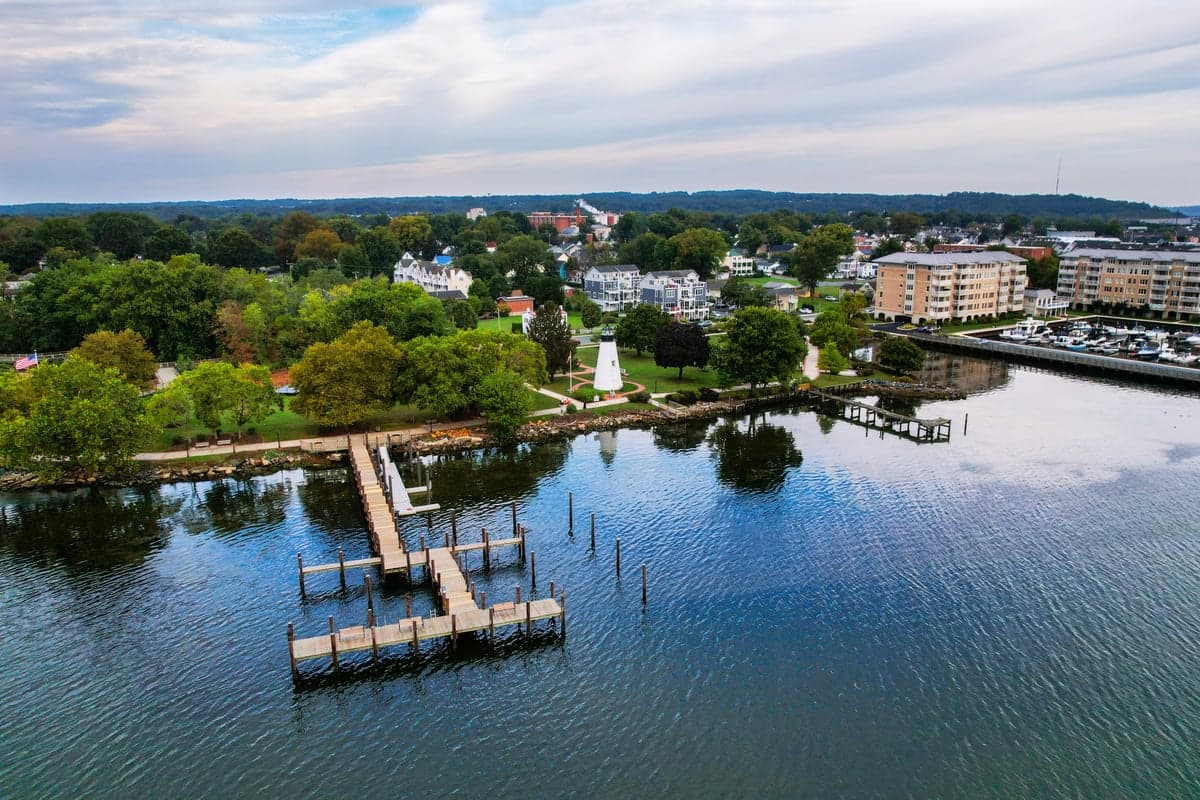
Photo: Wikipedia
Personal Sovereignty in Havre De Grace, MD
Moderate friction. Expect trade-offs in some aspect of personal liberty and independence.
What does Personal Sovereignty tell us?
Personal Sovereignty measures your capacity for self-reliance and independence with minimal government friction. Higher scores mean fewer barriers between you and the way you want to live... but it assumes you have the space you need and good neighbors.
What does this tell us?
Personal Sovereignty measures your capacity for self-reliance and independence with minimal government friction. Higher scores mean fewer barriers between you and the way you want to live... but it assumes you have the space you need and good neighbors.
State Policy
Energy independence: Importer (8% of energy produced in-state)
Personal Liberty
Homesteading

Personal Liberty Analysis
For the individual or family who values personal sovereignty above all else—who sees government overreach as a creeping threat and wants a place where self-reliance isn't just tolerated but structurally possible—Havre de Grace, Maryland presents a deeply mixed picture. This historic waterfront town at the mouth of the Susquehanna River offers a small-town feel, a tight-knit community, and proximity to the Chesapeake Bay, but it sits squarely within a state that has increasingly centralized power, raised taxes, and restricted personal freedoms. The autonomy environment here is one of careful navigation: you can carve out a life of independence, but you will have to work against the grain of state-level policies that favor collective mandates over individual choice. For the prepper or survivalist, Havre de Grace is a location to be approached with eyes wide open—not a sanctuary, but a potential base of operations if you know how to work the system.
Tax burden and regulatory posture in Havre de Grace
Maryland is one of the most heavily taxed states in the union, and Havre de Grace residents feel that weight directly. The state income tax is progressive, topping out at 5.75%, but when combined with the county-level tax in Harford County (which adds roughly 2.83%), effective rates can exceed 8.5% for higher earners. Property taxes in Havre de Grace are moderate for the region—around $1.10 per $100 of assessed value—but the state's property tax system is notoriously complex, with assessments that can rise sharply. Sales tax is 6%, and it applies to most goods, though groceries and prescription drugs are exempt. For the self-reliant individual, the regulatory posture is equally burdensome: Maryland has a reputation for aggressive environmental regulations, particularly around the Chesapeake Bay watershed, which can affect everything from septic system approvals to stormwater management on rural properties. Building permits, zoning variances, and even simple home renovations often require multiple layers of county and state approval. This is not a state that trusts its citizens to manage their own land without oversight. For the prepper looking to minimize tax exposure and bureaucratic friction, Havre de Grace is a compromise—you get a lower cost of living than nearby Baltimore or D.C., but you are still paying for the privilege of living in a state with a large, interventionist government.
Self-defense and gun law specifics in Harford County
On the issue of self-defense, Maryland is one of the most restrictive states in the country, and Havre de Grace offers no local relief. The state requires a Handgun Qualification License (HQL) to purchase a handgun—a process that includes fingerprinting, a background check, and an approved training course. For concealed carry, Maryland is a "may-issue" state that became "shall-issue" only after the Bruen decision (2022), but the process remains onerous: applicants must complete a 16-hour training course, submit references, and undergo a thorough background investigation. The state also bans so-called "assault weapons" and standard-capacity magazines over 10 rounds, and it has a red flag law that allows authorities to seize firearms based on a complaint without a criminal conviction. For the survivalist, this is a significant red flag: your ability to defend yourself and your family is subject to the whims of a state government that views firearms as a public health problem rather than a right. Harford County's sheriff's office is generally more supportive of Second Amendment rights than Baltimore City or Prince George's County, but they are bound by state law. If you want to keep a fully equipped armory for worst-case scenarios, Havre de Grace is not the place. The best you can do is comply with the letter of the law while staying under the radar—and hope that the political winds don't shift further against you.
Self-reliance and homesteading viability in Havre de Grace
For those who want to grow their own food, raise livestock, or live off-grid, Havre de Grace offers limited but not impossible opportunities. The town itself is dense and historic, with many homes on small lots of 0.1 to 0.25 acres—fine for a vegetable garden and a few chickens, but not for serious homesteading. The real potential lies in the surrounding unincorporated areas of Harford County, where you can find parcels of 1 to 5 acres within a 15-minute drive of town. Zoning in these rural-residential areas allows for horses, goats, and other livestock, though you will need to navigate county health department rules for septic systems and well water. Off-grid living is effectively illegal in Maryland: the state requires connection to the electrical grid for any habitable structure, and solar panels must be grid-tied unless you jump through expensive permitting hoops. Rainwater collection is allowed but regulated, and composting toilets are not permitted as a primary sanitation solution. For the prepper who dreams of a self-sufficient homestead with no utility bills and no government oversight, Havre de Grace is a disappointment. However, for the pragmatic survivalist who wants a small plot to supplement store-bought food, keep a few animals, and maintain a low profile, the area is workable—especially if you buy land in the more rural parts of Harford County, like Street, Pylesville, or Whiteford, where neighbors are more likely to mind their own business.
Personal liberties: parental rights, medical autonomy, speech, and property
Maryland's record on personal liberties is a mixed bag that leans toward government control. On parental rights, the state has been moving in a direction that alarms many conservative families: it mandates that public schools adopt curricula that include LGBTQ+ topics, and it has laws that allow minors to consent to certain medical treatments without parental notification. For the parent who wants to opt their child out of controversial lessons or maintain authority over medical decisions, the state offers limited recourse. Homeschooling is legal and relatively straightforward—you must submit a notice of intent and provide a portfolio review annually—but the state does not have a robust homeschool-friendly culture like you'd find in Texas or Idaho. On medical autonomy, Maryland was an early adopter of vaccine mandates and public health orders, and the COVID-19 era saw significant overreach, including business closures and mask mandates that were enforced more aggressively than in many other states. Free speech is protected under the First Amendment, but the state has a hate speech law that can be used to prosecute certain types of expression, and local governments have been known to restrict public gatherings during emergencies. Property rights are perhaps the brightest spot: Harford County does not have a countywide zoning overlay that restricts what you can do on your land, and the area has a strong tradition of private property ownership. However, the state's environmental regulations can still limit what you build or how you use your land, especially near waterways. For the individualist who values the right to speak freely, raise their children without state interference, and make their own medical choices, Havre de Grace is a place where you will need to be vigilant and politically active to protect those freedoms.
In the broader landscape of personal sovereignty, Havre de Grace occupies a middle ground that will appeal to some preppers and repel others. It is not a libertarian haven like rural New Hampshire or a low-tax refuge like Tennessee. But it is also not the worst place in the country for the self-reliant individual. The town's small size, historic character, and community-oriented culture offer a buffer against the worst excesses of state-level overreach. If you are willing to pay higher taxes, navigate restrictive gun laws, and accept that off-grid living is off the table, you can build a life here that prioritizes family, preparedness, and local community. The key is to understand that Havre de Grace is a place to work within the system, not to escape it. For the survivalist who values strategic location—close to the Bay, near major highways, but far enough from urban chaos—and who is willing to trade some autonomy for access to resources and community, Havre de Grace is worth a serious look. Just don't expect it to be a fortress of freedom. It's a compromise, and in a world of increasing government control, compromise may be the best most of us can hope for.

* Values derived from national, state, county, city and local statistics and may differ in a specific area. Last updated: 2026-04-19T06:59:54.000Z
Narrative content on this page is AI-generated and may contain mistakes. Verify any details that matter before acting on them.
ReloMaps may earn a commission from affiliate links at no extra cost to you.

