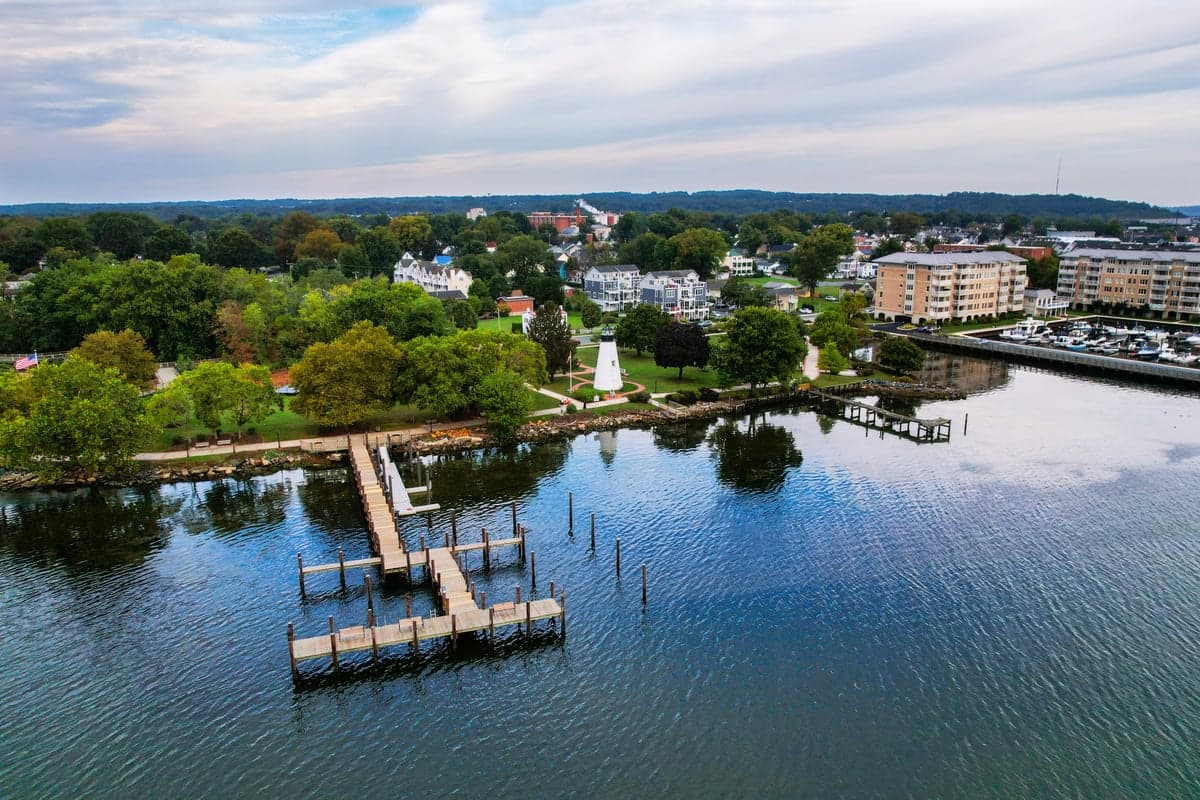
Photo: Wikipedia
Political ClimatePolitical Climate in Havre De Grace, MD
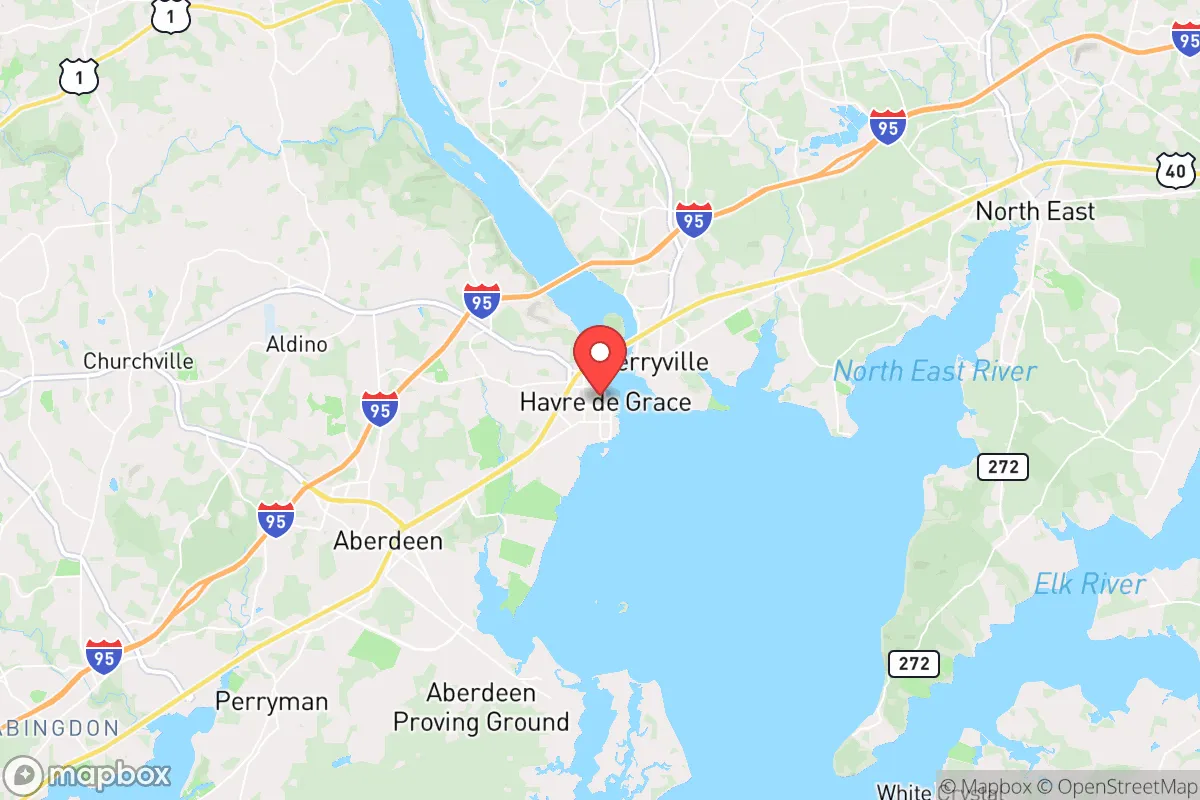
District shown is the primary district for this city’s centroid. Cities may span multiple districts.
Local Political AnalysisPolitical Analysis of Havre De Grace, MD
Havre de Grace leans conservative, but it's not the rock-ribbed Republican stronghold it was thirty years ago. The city itself has a Cook PVI of R+8, meaning it votes about eight points more Republican than the national average, but that number masks a slow, steady drift leftward, especially in the downtown core. Harford County as a whole still tilts red, but the old-timers will tell you the days of unopposed conservative dominance are fading, replaced by a more contested, suburban-style politics where every local school board and city council race feels like a proxy war for national issues.
How it compares
Drive ten miles west to Aberdeen, and you'll find a similar blue-collar conservatism, but with a heavier military influence from Aberdeen Proving Ground that keeps things reliably Republican. Head south across the Susquehanna into Cecil County, and places like Perryville and Port Deposit are even more deeply red, with fewer of the coastal transplants that are slowly changing Havre de Grace's character. The real contrast is east, toward Bel Air, the county seat, where the politics are more establishment Republican—chamber of commerce types who focus on tax rates and development. Havre de Grace, by comparison, has a grittier, more independent streak; it's the kind of place where people distrust both parties equally, but they've learned the hard way that progressive experiments in Baltimore—just 35 miles south—tend to mean higher crime, higher taxes, and more bureaucracy. That wariness keeps the city from swinging too far left, even as new coffee shops and art galleries pop up along the waterfront.
What this means for residents
For the average family, the R+8 lean means your property taxes stay reasonable and your Second Amendment rights aren't under daily assault—at least not yet. The city council has held the line on most gun control measures that Annapolis keeps trying to push statewide, and the local police still operate with a "we know the neighborhood" approach rather than the heavy-handed, data-driven tactics you see in larger jurisdictions. But the warning signs are there: every few years, a proposal surfaces to rezone historic districts in ways that favor developers over homeowners, or to add new fees on everything from boat slips to parking permits. The creeping sense is that the same progressive playbook that turned Baltimore into a fiscal mess is being tested here in smaller doses. Long-term, the concern is that Havre de Grace becomes a bedroom community for D.C. and Baltimore commuters who bring big-government voting habits with them, slowly eroding the R+8 rating into something closer to a toss-up.
Culturally, the city still feels like a fishing town that happens to have a nice bed-and-breakfast district. The annual Seafood Festival and the Decoy Museum are genuine local institutions, not tourist traps, and the volunteer fire department remains a pillar of the community—something that's becoming rare in Maryland. The biggest policy distinction is the city's fierce independence from Harford County government; locals fought hard to keep control of their own zoning and police, and that distrust of higher-ups is baked into the civic DNA. If you're looking for a place where you can still have a conversation with your neighbor without worrying about political litmus tests, Havre de Grace is it. Just keep an eye on the city council meetings—that's where the future of the place gets decided, one zoning variance at a time.

State Political ClimatePolitical Climate in Maryland
State Political AnalysisPolitical Environment in the State
Maryland has long been a deep blue state, but the reality on the ground is far more fractured than the statewide numbers suggest. Since 2008, Democrats have held a supermajority in the General Assembly and have won every presidential election by double digits, but that dominance is almost entirely driven by the Washington, D.C. suburbs and Baltimore City. If you look at the actual landmass and the people living outside the I-95 corridor, this state is far more conservative than the headlines imply, and the gap between the ruling class in Annapolis and the rest of us has only widened over the last 20 years.
Urban vs. rural divide
The political map of Maryland is a tale of two states. The western counties—Garrett, Allegany, and Washington—vote reliably Republican, often by 30-40 point margins. The Eastern Shore, places like Queen Anne’s, Talbot, and Wicomico counties, is also solidly red, with a strong agricultural and maritime culture that resents the regulatory creep from Annapolis. Meanwhile, the D.C. suburbs—Montgomery, Prince George’s, and Howard counties—are the engine of the state’s Democratic majority. Montgomery County alone casts more votes than the entire western half of the state combined. Baltimore City is another deep blue stronghold, but its population has been shrinking for decades, while the suburban ring around D.C. keeps growing. The result is a state where the rural and exurban areas feel increasingly powerless, and the urban corridor dictates policy. A notable exception is Frederick County, which has been trending purple for a decade; it voted for Biden in 2020 but elected a Republican county executive in 2022, reflecting a genuine split between its growing commuter population and its traditional conservative base.
Policy environment
Maryland’s policy environment is a textbook case of progressive governance with a heavy hand. The state has a graduated income tax that tops out at 5.75%, but when you add county-level taxes, effective rates can exceed 8% in places like Baltimore City and Montgomery County. Property taxes are also high, especially in the D.C. suburbs, where a $500,000 home can carry a $6,000 annual tax bill. The state has a strict regulatory posture on everything from land use to business licensing, and it’s one of the few states with its own version of the Clean Air Act that goes beyond federal standards. On education, Maryland spends more per pupil than almost any other state, but outcomes are wildly uneven: Montgomery County schools are among the best in the nation, while Baltimore City schools are among the worst. The state has also enacted a series of election laws that make it easier to vote—automatic voter registration, same-day registration, and no-excuse mail-in voting—which critics argue erodes ballot security. There is no voter ID requirement, and the state’s voter rolls have been flagged for containing thousands of potentially ineligible names.
Trajectory & freedom
Over the last five years, Maryland has moved decisively in the direction of less personal freedom. The most glaring example is the Firearm Safety Act of 2013, which banned assault weapons and limited magazine capacity to 10 rounds, and the state has only tightened restrictions since then, including a 2023 law requiring a seven-day waiting period for all gun purchases and expanding the list of prohibited places to carry. On parental rights, the state passed the Blueprint for Maryland’s Future in 2021, which centralizes education policy and mandates curriculum standards that many conservatives view as undermining local control. The state also enacted the Trans Health Equity Act in 2023, which requires Medicaid to cover gender transition procedures for minors, a move that has sparked fierce debate. On the tax front, the state has not cut income tax rates in over a decade, and in 2024, lawmakers proposed a new tax on digital advertising that was ultimately blocked by a federal court. Medical autonomy took a hit with the state’s strict COVID-19 mandates, which included one of the longest-lasting indoor mask mandates in the country. Property rights are also under pressure: the state’s Department of the Environment has aggressively pursued wetland and forest conservation easements that limit what landowners can do with their land, and the 2023 Climate Solutions Now Act imposes binding emissions targets that will likely force further restrictions on development and energy use.
Civil unrest & political movements
Maryland has seen its share of civil unrest, most notably the 2015 Baltimore riots following the death of Freddie Gray, which left a lasting scar on the city’s reputation and accelerated its population decline. Since then, organized activist movements have been active on both sides. On the left, groups like CASA and the Maryland Working Families Party have pushed for sanctuary policies and rent control, and the state has indeed adopted a sanctuary law that limits cooperation between local law enforcement and federal immigration authorities. On the right, the Maryland State Rifle and Pistol Association has been a persistent legal force, successfully challenging some of the state’s gun laws in federal court. There have also been localized secession movements: in 2021, a group in Garrett County proposed breaking off to form a new state called “Liberty,” and while it went nowhere, it reflected deep frustration. Election integrity has been a flashpoint, with Republican candidates repeatedly losing by narrow margins in districts that were redrawn after the 2020 census; the state’s congressional map was struck down by a court as an unconstitutional partisan gerrymander, but a new map was quickly drawn that still favors Democrats. A new resident would notice the stark contrast between the polite, orderly suburbs of Howard County and the more confrontational politics of the rural areas, where “Don’t Tread on Me” flags are common.
Projection
Over the next 5-10 years, Maryland is likely to become even more blue, but the nature of that blue is shifting. The D.C. suburbs continue to grow, driven by federal employment and tech jobs, and they are becoming more progressive with each election cycle. Meanwhile, the rural counties are losing population, especially in the west, where young people leave for jobs elsewhere. The state’s in-migration is overwhelmingly from other blue states, particularly New York and California, which reinforces the existing political culture. However, there are countercurrents: Frederick County is attracting families from both sides of the aisle, and its political future is genuinely up for grabs. The state’s high cost of living and heavy tax burden are also pushing some retirees and small business owners to move to Florida or the Carolinas, which could slightly slow the leftward drift. But the bottom line is that anyone moving to Maryland now should expect to live under a government that is comfortable with high taxes, strict regulation, and progressive social policies, and that is unlikely to change in the next decade.
For a conservative-leaning individual or family, Maryland presents a mixed bag. If you live in the western counties or on the Eastern Shore, you can find a community that shares your values, but you will still be subject to state-level policies you disagree with. The schools in those areas are generally decent but underfunded compared to the D.C. suburbs, and your property taxes will still be higher than in neighboring Pennsylvania or West Virginia. The best advice is to look at Frederick County or the northern reaches of Carroll County, where you can still find affordable land and a conservative local government, while accepting that Annapolis will always be a few steps ahead of you. If you value low taxes, gun rights, and local control above all else, Maryland is probably not the right fit. But if you need to be near D.C. for work or family, and you’re willing to fight for your freedoms at the local level, it’s a state where you can still make a difference.
* Values derived from national, state, county, city and local statistics and may differ in a specific area. Last updated: 2026-04-19T06:59:54.000Z
Narrative content on this page is AI-generated and may contain mistakes. Verify any details that matter before acting on them.
ReloMaps may earn a commission from affiliate links at no extra cost to you.

