Photo: Wikipedia
Demographics of Henderson, NV
Affluence Level in Henderson, NV
A middle-class area roughly in line with national averages across income, home values, education, and employment.
People of Henderson, NV
The people of Henderson, Nevada today form a predominantly white, family-oriented suburban population of 324,523, with a notably low foreign-born share of 4.4% that sets it apart from neighboring Las Vegas. The city’s character is defined by master-planned communities, a strong police presence, and a median age that skews older than the national average, attracting retirees and conservative-leaning families. Distinctive markers include a high rate of homeownership, a growing East/Southeast Asian community concentrated in newer developments, and a Hispanic population of 18.2% that is largely U.S.-born and integrated into the city’s fabric.
How the city was settled and grew
Henderson was not a pioneer settlement but a planned industrial town born in the 1940s. The U.S. government built the Basic Magnesium Plant here during World War II, drawing thousands of workers from across the country—many from the Midwest and South—to produce magnesium for aircraft. The original population was overwhelmingly white and native-born, housed in temporary barracks that later became the core of the Pittman neighborhood. After the war, the plant closed but the city incorporated in 1953, retaining a blue-collar, pro-business ethos. The Downtown Henderson historic district retains the small-scale bungalows and grid streets built for those early plant workers. No significant immigrant waves arrived during this period; the city grew through domestic in-migration from other Western states, especially California, drawn by defense-related jobs and the nearby Nevada Test Site.
Modern era (post-1965)
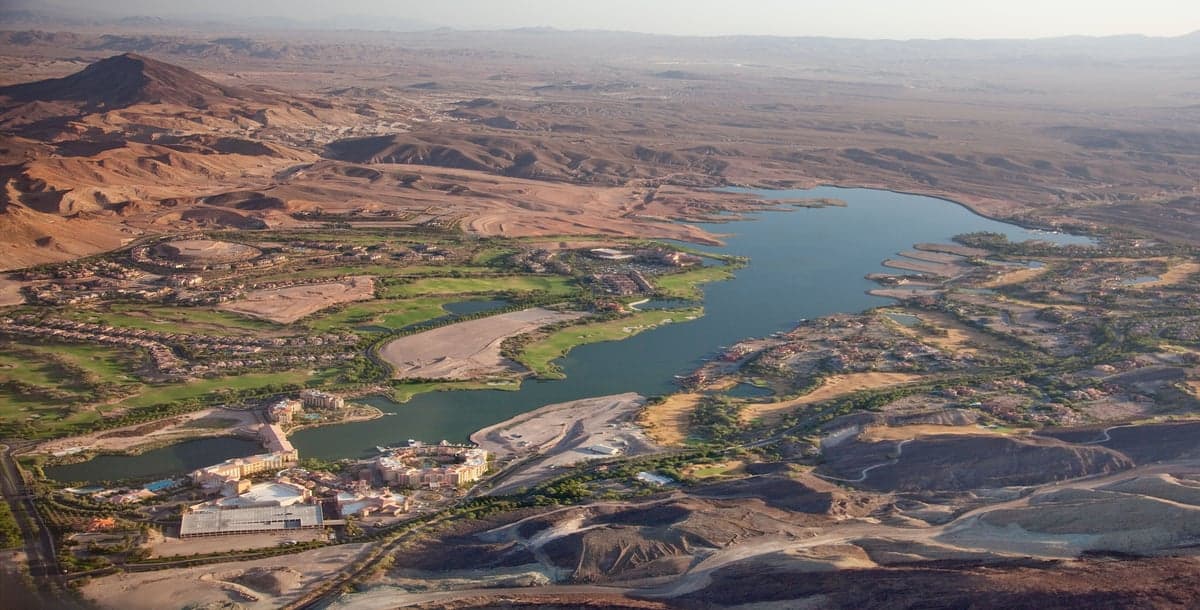
The post-1965 Immigration Act had a muted effect on Henderson compared to Las Vegas. The city’s foreign-born share remains just 4.4%, far below the national average. Instead, the modern era has been defined by explosive domestic suburbanization. From the 1990s onward, master-planned communities like Green Valley and Seven Hills attracted middle-class and upper-middle-class families from California, Arizona, and other Western states seeking lower taxes, newer homes, and a safer environment than Las Vegas. Green Valley, developed in the 1980s and 1990s, became the heart of white, college-educated Henderson (36.8% college educated). The Hispanic population grew from a small base to 18.2%, but these are largely second- and third-generation U.S. citizens, not recent immigrants, concentrated in older neighborhoods like Whitney Ranch and parts of West Henderson. The East/Southeast Asian community (8.0%) is a newer, more affluent wave, settling in newer luxury developments such as Lake Las Vegas and the Anthem area, drawn by tech and hospitality management jobs. The Indian-subcontinent population (1.2%) is small but growing, primarily in professional households in Seven Hills. The Black population (5.9%) is dispersed, with no single dominant enclave, reflecting Henderson’s overall pattern of integration rather than segregation.
The future
Henderson’s population is heading toward continued growth, but at a slower pace as land for new master-planned communities becomes scarce. The city is not homogenizing into a single identity; rather, it is tribalizing into distinct enclaves by income and lifestyle. Older, established neighborhoods like Pittman and Downtown Henderson are seeing modest infill and some Hispanic growth, while newer luxury areas like Lake Las Vegas and Anthem are becoming more East/Southeast Asian and Indian. The white share (58.9%) is declining gradually as younger, more diverse families move in, but the city remains far whiter than Las Vegas. The foreign-born share is likely to rise slowly, but Henderson will not become a major immigrant gateway—its high home prices and family-oriented zoning favor established, native-born households. The next 10-20 years will see a continued shift toward a more Asian and Hispanic population, but these groups are assimilating quickly into the city’s existing suburban culture, not forming separate ethnic enclaves.
For someone moving in now, Henderson is becoming a more diverse but still predominantly white, conservative-leaning suburb where newcomers are expected to integrate into a pre-existing family-and-safety culture. The city offers stability, low crime, and good schools, but little of the ethnic dynamism or immigrant-driven energy found in nearby Las Vegas. It is a place where demographic change is gradual and largely invisible in daily life, making it a predictable choice for those prioritizing order and community over urban diversity.

* Values derived from national, state, county, city and local statistics and may differ in a specific area. Last updated: 2026-04-15T23:42:49.000Z
Narrative content on this page is AI-generated and may contain mistakes. Verify any details that matter before acting on them.
ReloMaps may earn a commission from affiliate links at no extra cost to you.

