
Photo: Wikipedia
Demographics of Hermitage, PA
Affluence Level in Hermitage, PA
A middle-class area roughly in line with national averages across income, home values, education, and employment.
People of Hermitage, PA
The people of Hermitage, Pennsylvania today form a predominantly white, settled community of 16,132 residents, characterized by a quiet, family-oriented density typical of a small Rust Belt city that has absorbed suburban growth from nearby Sharon and Youngstown. With 89.7% of the population identifying as white and a foreign-born share of just 1.1%, Hermitage retains a notably homogeneous character compared to national averages, though small Black (3.4%) and Hispanic (2.5%) communities add modest diversity. The city's identity is shaped by its history as a manufacturing and railroad hub that drew European immigrants, followed by a long period of stability and slow suburbanization that has left it with a distinctively local, rooted population.
How the city was settled and grew
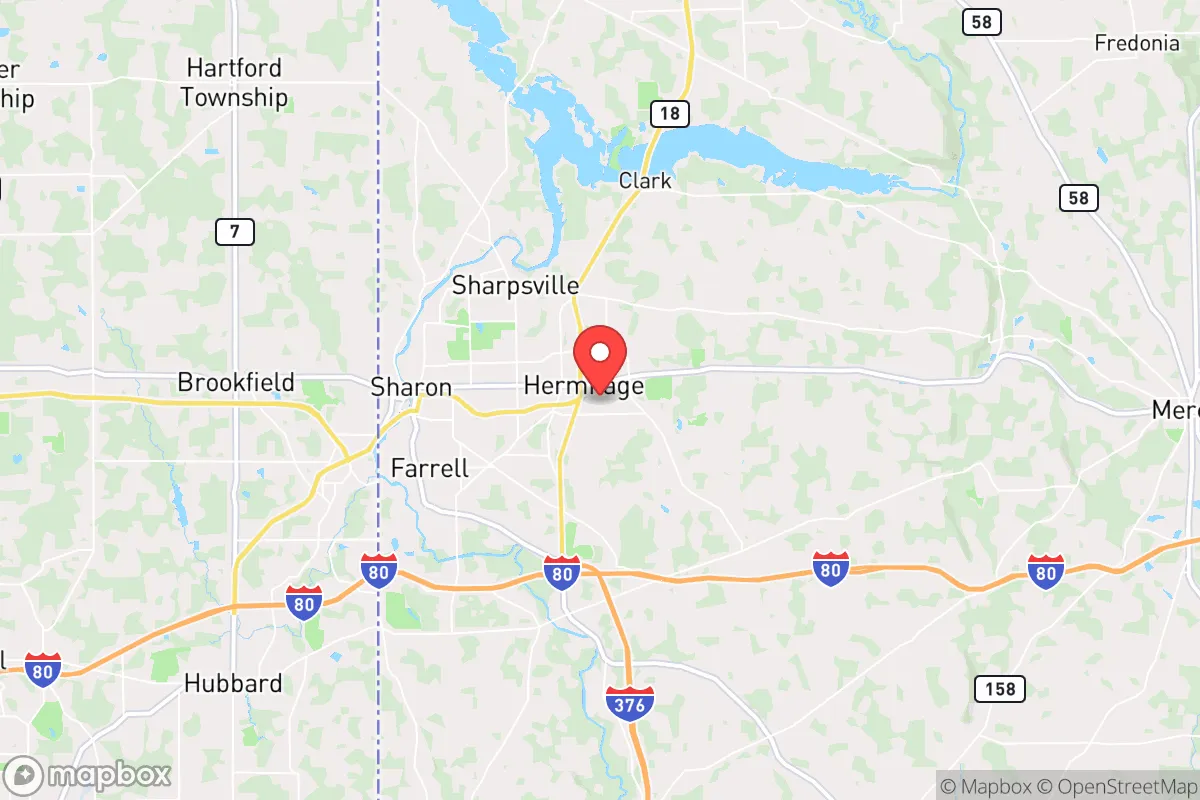
Hermitage's population history begins in the early 19th century, when the area was part of the Connecticut Western Reserve and later the Erie Land District, attracting Yankee settlers from New England and New York who cleared land for farming. The arrival of the Erie Extension Canal in the 1830s and the railroad in the 1860s transformed the hamlet into a transportation node, drawing Irish laborers who settled in what is now the South Hermitage neighborhood, near the rail corridor. By the 1880s, the discovery of limestone and the rise of the Shenango Valley's iron and steel industries brought waves of Eastern and Southern European immigrants — primarily Italians, Slovaks, and Poles — who found work in the mills and quarries. These groups concentrated in the East Hermitage and West Hermitage districts, building ethnic churches and social halls that still anchor those areas. The city's formal incorporation in 1975 consolidated several townships and villages, but the original settlement patterns remain visible: the historic Downtown Hermitage core, centered on East State Street, retains its early 20th-century commercial stock, while the surrounding grid of modest frame houses reflects the working-class roots of the immigrant waves.
Modern era (post-1965)
After the 1965 Hart-Cellar Act, Hermitage saw only a trickle of new immigration, unlike larger Rust Belt cities. The foreign-born share has never exceeded 2%, and the city's population has been remarkably stable — it was 16,132 in 2020, virtually unchanged from 16,248 in 2000. The major demographic shift of the modern era was domestic: the suburbanization of Sharon's middle class, which began in the 1970s as white families moved east to escape Sharon's industrial decline and rising crime. These relocating families filled the Bentley Creek and Tam O'Shanter subdivisions, planned developments of single-family homes built on former farmland along the city's eastern edge. The Black population, which grew from roughly 1% in 1980 to 3.4% today, is concentrated in the South Hermitage area, near the Sharon border, reflecting a modest spillover from Sharon's larger Black community. The Hispanic population (2.5%) and the small East/Southeast Asian community (0.5%) are dispersed across the city, with no single ethnic enclave forming. The Indian-subcontinent population (0.3%) is negligible and largely composed of professionals employed at the local hospital or the nearby Penn State Shenango campus.
The future
Hermitage's population is aging — the median age is 45.7, well above the national median of 38.8 — and the city is projected to shrink slowly over the next decade as natural decrease (more deaths than births) outpaces any in-migration. The foreign-born share is unlikely to rise significantly, as the city lacks the job base or social networks to attract new immigrants; the dominant industries are healthcare, education, and retail, none of which generate the labor demand that drives immigration. The white population will remain the overwhelming majority, but the Black and Hispanic shares may inch upward as younger families from Sharon and Youngstown seek safer, better-funded schools in Hermitage's Hickory Township district, which has a reputation for strong academics. The city is not tribalizing into distinct ethnic enclaves; rather, it is slowly homogenizing as older ethnic neighborhoods fade and new subdivisions fill with a largely white, middle-class population. The small Asian and Indian communities are likely to plateau or assimilate into the broader white-collar workforce.
For someone moving in now, Hermitage is becoming a stable, low-diversity bedroom community with an aging population and limited demographic change. It offers safety, decent schools, and a quiet pace, but little of the cultural dynamism or ethnic variety found in larger cities. The city's future is one of gentle decline in numbers but preservation of its character — a place where the population is more likely to stay than to change.

* Values derived from national, state, county, city and local statistics and may differ in a specific area. Last updated: 2026-05-01T02:39:57.000Z
Narrative content on this page is AI-generated and may contain mistakes. Verify any details that matter before acting on them.
ReloMaps may earn a commission from affiliate links at no extra cost to you.

