
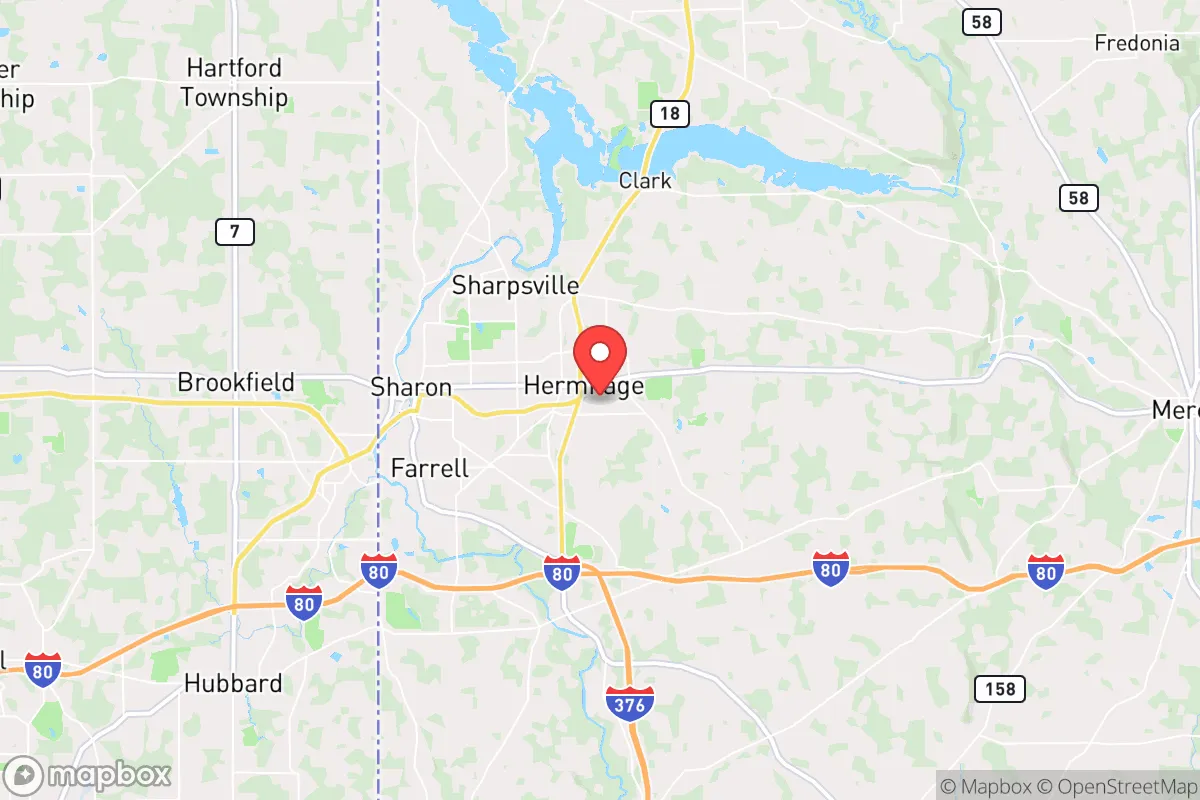
Photo: Wikipedia
Political ClimatePolitical Climate in Hermitage, PA
District shown is the primary district for this city’s centroid. Cities may span multiple districts.
Local Political AnalysisPolitical Analysis of Hermitage, PA
Hermitage, Pennsylvania, has long been a solidly conservative community, and that hasn't changed much. With a Cook PVI of R+11, the area leans Republican by a comfortable margin, and you can feel it in the local elections and everyday conversations. Over the past decade, the political trajectory has held steady, though there's a growing unease among long-time residents about outside influences creeping in from the bigger cities nearby. The core values here are still about personal responsibility, limited government, and keeping the government out of your business, but you can see the pressure building as the state and national trends push in the opposite direction.
How it compares
If you drive just a few miles north to Sharon or west to Youngstown, Ohio, you'll hit areas that have shifted more toward the progressive side, especially in the city cores. Hermitage, by contrast, has stayed reliably red, and that's not by accident. The surrounding Mercer County is more mixed, but Hermitage itself has a strong base of folks who remember when the steel mills were running and the unions had real power—and they've watched those institutions fade, replaced by a distrust of big government promises. Compared to Pittsburgh, which is about an hour south and trending hard left, Hermitage feels like a different world. The contrast is stark: Pittsburgh's city council is pushing things like rent control and sanctuary city policies, while Hermitage is still focused on keeping taxes low and zoning simple. That R+11 rating isn't just a number; it reflects a community that votes its conscience on the Second Amendment, school choice, and local control.
What this means for residents
For the people living here, the political climate means a few concrete things. First, you're not going to see a lot of government overreach in your daily life—the local officials tend to take a hands-off approach, which is exactly how most folks want it. Second, the schools and local ordinances are still largely run by common-sense conservatives, so you won't run into the kind of progressive experiments you see in places like Philadelphia or even Erie. That said, there's a real concern about the long-term trend. As younger people move out and the state legislature keeps trying to push mandates from Harrisburg, there's a feeling that the buffer is thinning. The local Republican committee is active, but they're fighting an uphill battle against state-level policies on energy and land use that don't reflect Hermitage's values.
One cultural distinction that sets Hermitage apart is its strong sense of self-reliance. You don't see a lot of hand-wringing over national headlines here; people are more worried about the potholes on State Street or the cost of heating their homes. There's a quiet resistance to the idea that government knows best, and that's reflected in the low number of local regulations compared to neighboring towns. The biggest red flag for residents is any sign that the progressive wave from the cities is starting to wash over—like when the county considered mask mandates during the pandemic, which was met with a lot of pushback. For now, Hermitage remains a place where you can still live your life without a lot of bureaucratic nonsense, but keeping it that way takes vigilance. The next few years will tell whether the R+11 holds or starts to slip, and a lot of folks are watching closely.

State Political ClimatePolitical Climate in Pennsylvania
State Political AnalysisPolitical Environment in the State
Pennsylvania is a true battleground state, and if you're looking at it through a conservative lens, the picture is complicated. The state leans slightly Democratic in statewide elections, but it’s a razor-thin margin—think 2020 where Biden won by just over 80,000 votes out of nearly 7 million cast. Over the last 20 years, the state has shifted from a reliably blue stronghold to a purple toss-up, driven by a collapse of Democratic support in rural areas and a simultaneous consolidation of progressive power in the major metros. The old coalitions of union labor and ethnic Catholics have fractured, replaced by a stark urban-rural divide that makes Pennsylvania a microcosm of the national political war.
Urban vs. rural divide
The political map of Pennsylvania is a tale of two worlds. The Democratic strongholds are Philadelphia and its collar counties (Montgomery, Delaware, Chester, Bucks), plus Pittsburgh and its immediate suburbs. These areas are increasingly progressive, with Philadelphia County delivering about 80% of its vote to Democrats. Meanwhile, the vast rural expanse—from the northern tier along the New York border down through the central ridges and into the southwestern coal country—is deeply red. Lancaster County is a fascinating battleground: it’s historically conservative but has seen rapid suburbanization from Philly commuters, making it a bellwether that flipped from Trump +20 in 2016 to Biden +3 in 2020. Erie County on Lake Erie is another key pivot—it went for Obama twice, then Trump in 2016, then Biden in 2020, reflecting the blue-collar swing. The Scranton/Wilkes-Barre area (Lackawanna and Luzerne counties) is the classic "coal country" that has shifted hard right, with Luzerne going from Obama +5 in 2012 to Trump +14 in 2020. The Harrisburg metro (Dauphin County) is split between the progressive capital city and its conservative suburbs and farmland. The State College area (Centre County) is a blue island thanks to Penn State, but the surrounding counties are deep red. The Lehigh Valley (Allentown, Bethlehem, Easton) is a critical swing region that has trended blue as it suburbanizes, but the rural parts of Northampton and Lehigh counties still lean right.
Policy environment
Pennsylvania’s policy environment is a mixed bag for conservatives. The state has a flat income tax rate of 3.07%, which is relatively low and hasn’t been raised in decades—a rare bright spot. Property taxes, however, are among the highest in the nation, especially in the Philadelphia suburbs, and there’s no statewide cap on how much they can increase. The state’s regulatory posture is generally moderate, but the Department of Environmental Protection can be aggressive, particularly on energy extraction. Education policy is a major flashpoint: the state has a massive funding disparity between wealthy suburban districts and poor rural ones, and the courts have recently ordered a massive funding overhaul that could lead to tax hikes. Election laws are a constant source of tension—no-excuse mail-in voting was passed in 2019 (Act 77) and has been a partisan battleground ever since, with Republicans pushing for voter ID and signature verification. Gun laws are relatively favorable: Pennsylvania is a "shall issue" state for concealed carry, and there’s no state-level assault weapons ban, though Philadelphia and Pittsburgh have tried to enact their own local restrictions (which are often struck down by state preemption laws). The state has a Right-to-Work law? No, it doesn’t—union power remains strong, especially in public sector and construction, which drives up costs and limits labor freedom.
Trajectory & freedom
On the freedom front, Pennsylvania is a state in flux, and the trend is concerning for conservatives. Gun rights saw a win in 2024 when the state Supreme Court struck down Philadelphia’s attempt to ban "ghost guns" and require lost/stolen reporting, citing state preemption. But the legislature has been unable to pass constitutional carry, and the governor (Josh Shapiro, a Democrat) has vetoed bills that would expand gun rights. Parental rights are under siege: the state Department of Education has pushed "gender identity" policies that allow students to change names and pronouns without parental consent, and several school districts (like Central Bucks and Pennridge) have been battlegrounds over library books and curriculum transparency. Medical autonomy took a hit with the 2024 expansion of "shield laws" that protect out-of-state abortion providers from extradition, effectively making Pennsylvania a regional abortion destination. Property rights are threatened by the growing push for "upzoning" in cities like Philadelphia and Pittsburgh, which allows developers to override local zoning rules. Taxation is a creeping concern: while the income tax is flat, the state has a high corporate net income tax (8.49%) and is considering a carbon tax on energy producers. The overall trajectory is one of slow, steady expansion of government control, especially on social issues and energy.
Civil unrest & political movements
Pennsylvania has seen its share of political flashpoints. The 2020 election aftermath was intense, with massive "Stop the Steal" rallies in Harrisburg and Gettysburg, and a controversial audit push in 2021 that was ultimately blocked by the courts. Philadelphia has been a hotspot for left-wing activism, including Black Lives Matter protests in 2020 that turned violent, leading to looting and property destruction. The city’s progressive district attorney, Larry Krasner, has been a lightning rod, with his "bail reform" policies leading to a surge in retail theft and carjackings that have spilled into the suburbs. Immigration politics are heating up: Philadelphia is a self-declared "sanctuary city," and the state has seen a surge in migrant arrivals from the southern border, straining resources in places like Allentown and Reading. On the right, the "Pennsylvania Freedom Caucus" in the state legislature has been a vocal force, pushing for election integrity, school choice, and anti-censorship bills. The Lancaster County area has seen a growing "constitutional sheriff" movement, with local officials refusing to enforce certain state mandates. The overall atmosphere is one of simmering tension, with the urban-rural divide manifesting in everything from school board meetings to county fair protests.
Projection
Looking ahead 5-10 years, the trend is not favorable for conservatives. Demographic shifts are the key driver: the Philadelphia suburbs are becoming more diverse and more Democratic, while rural areas are aging and shrinking. The Lehigh Valley and Lancaster County are absorbing New York and New Jersey transplants who bring their blue-state voting habits. The state’s population is projected to grow slowly, but the growth is concentrated in the already-blue metros. In-migration from deep-blue states is a double-edged sword: it brings economic activity but also shifts the electorate left. The state legislature is likely to remain Republican-controlled for the near term due to gerrymandering, but the governor’s mansion and the state Supreme Court are likely to stay in Democratic hands. This means a continued stalemate on issues like school choice, tax reform, and election integrity. The biggest wildcard is energy: if the state embraces natural gas and hydrogen hubs, it could bring economic revival to rural areas and slow the leftward drift. But if the environmental lobby succeeds in shutting down fracking, the rural economy will crater, accelerating the political realignment. A new resident moving in now should expect a state that is increasingly polarized, with the cultural and political center of gravity shifting toward the Philadelphia orbit.
Bottom line for a new resident: If you’re a conservative looking to move to Pennsylvania, pick your location carefully. The rural areas and small towns (like Wellsboro, Bedford, or Mercer) still offer a strong sense of community, low crime, and a traditional way of life. But you’ll be fighting an uphill battle in statewide elections, and you’ll see the progressive agenda creep in through court rulings and executive orders. The state’s tax burden is moderate, but property taxes are a killer, and the regulatory environment is getting tighter. If you value personal liberty, low taxes, and a culture that respects traditional values, you can find it here—but you’ll need to be intentional about where you plant your flag. The state is not lost, but it’s in a fight, and every election matters more than the last.
* Values derived from national, state, county, city and local statistics and may differ in a specific area. Last updated: 2026-05-01T02:39:57.000Z
Narrative content on this page is AI-generated and may contain mistakes. Verify any details that matter before acting on them.
ReloMaps may earn a commission from affiliate links at no extra cost to you.

