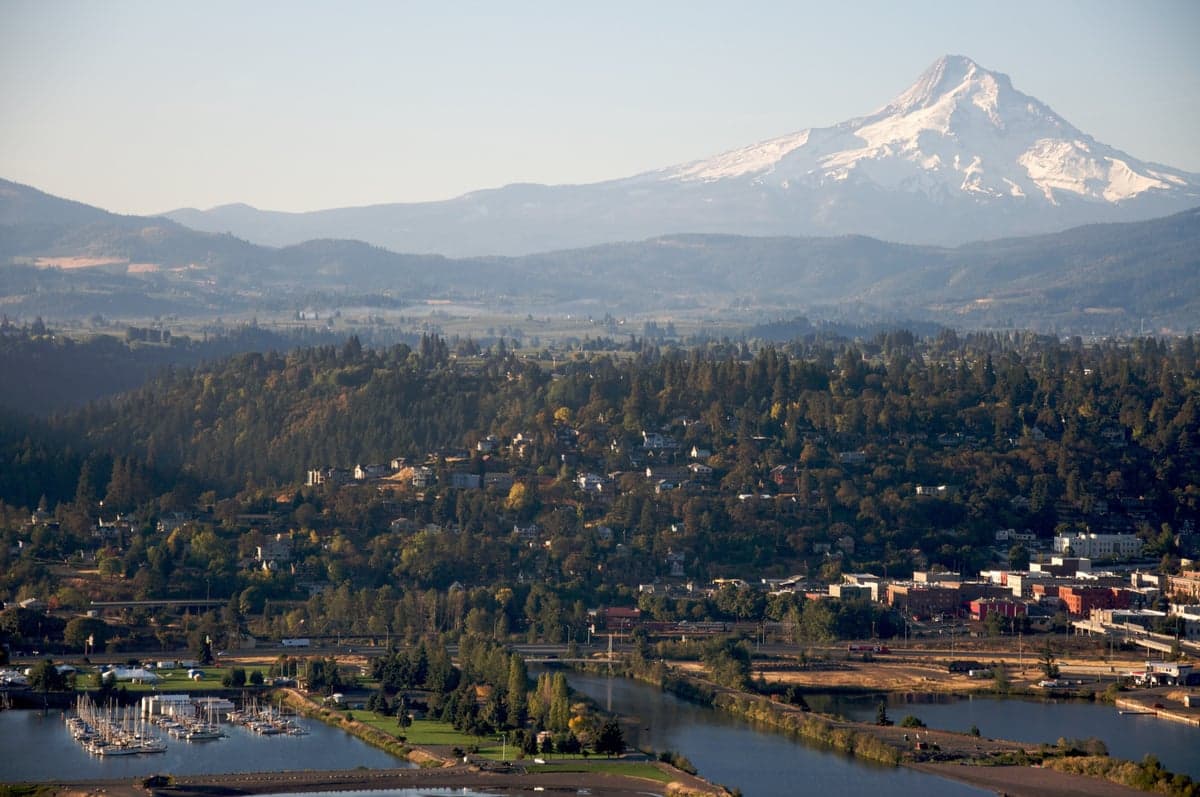
Photo: Wikipedia
Demographics of Hood River, OR
Affluence Level in Hood River, OR
An upper-middle-class area. Household wealth, education levels, and homeownership run ahead of national benchmarks.
People of Hood River, OR
The people of Hood River, Oregon, today number 8,360, forming a community defined by a striking blend of a white-majority population (64.4%) and a substantial Hispanic community (25.0%), with a small but notable East/Southeast Asian presence (1.7%) and a foreign-born share of 9.2%. This is a relatively dense, compact city of 2.5 square miles, where 45.5% of adults hold a college degree, reflecting a highly educated workforce drawn to the area’s outdoor recreation economy and agricultural roots. Hood River’s identity is distinctly bicultural—a place where a long-established white population, a growing Latino workforce, and a newer wave of remote professionals and retirees coexist, creating a dynamic that is both progressive in lifestyle and traditional in its working-class agricultural heritage.
How the city was settled and grew
Hood River’s human history begins with the indigenous Wasco and Wishram peoples, who fished and traded along the Columbia River for millennia. The first permanent non-Native settlers arrived in the 1850s, drawn by the Donation Land Claim Act, which granted 320 acres to white settlers. These early pioneers—mostly of Anglo-American and German stock—established farms in what is now the Heights neighborhood, the city’s original residential core on the bluff above the river. The arrival of the Oregon Railroad and Navigation Company in the 1880s transformed the area: the railroad opened the fertile Hood River Valley to large-scale apple and pear orchards, attracting a wave of Scandinavian and Swiss immigrants who settled in the Waterfront District and the Downtown area, building the packing sheds and warehouses that still define the city’s industrial character. By 1900, the population had reached about 1,000, and the city incorporated in 1908. A significant early non-white group were Japanese immigrants, who arrived in the 1900s-1910s as farm laborers and orchardists, establishing a small community in the Pine Grove area east of downtown. However, World War II internment forcibly removed nearly all of Hood River’s Japanese residents, a demographic blow from which the community never fully recovered—today, East/Southeast Asians make up just 1.7% of the population.
Modern era (post-1965)
The post-1965 period reshaped Hood River’s population in two major ways. First, the Immigration and Nationality Act of 1965 opened the door for a new wave of Mexican and Central American farmworkers, who began arriving in the 1970s and 1980s to work in the valley’s expanding pear and cherry orchards. These families settled primarily in the Westside neighborhood—the area west of 12th Street—and in the Odell area just south of the city limits, where lower housing costs and proximity to agricultural jobs created a concentrated Latino community. Today, the Hispanic share of Hood River’s population stands at 25.0%, making it one of the most Latino cities in Oregon outside the Willamette Valley. Second, the 1980s and 1990s saw a wave of domestic in-migration from Portland and other urban areas, drawn by the world-class windsurfing and kiteboarding on the Columbia River. These newcomers—predominantly white, college-educated, and affluent—bought up historic homes in the Heights and renovated the Waterfront District, driving up property values and shifting the city’s economic base from agriculture to tourism and recreation. The result is a city where the white population (64.4%) is split between long-time orchard families and newer outdoor enthusiasts, while the Latino population (25.0%) remains largely tied to the agricultural economy, with a growing second generation entering professional fields. The Black population is negligible at 1.0%, and the Indian subcontinent population is 0.0%.
The future
Hood River’s population is heading toward greater diversity, but the trajectory is complex. The Hispanic share is projected to grow steadily, driven by both natural increase and continued immigration from Mexico and Central America, with the Westside and Odell areas likely to see further concentration. At the same time, the white population is aging and being partially replaced by younger, more affluent remote workers and retirees from California and the Pacific Northwest, who are dispersing across the Heights and Waterfront District. The city’s housing crisis—median home prices exceeding $600,000—is pushing many Latino families and younger workers into outlying areas like Pine Grove and Odell, while the urban core becomes increasingly white and wealthy. The East/Southeast Asian population (1.7%) is expected to remain small, as the city lacks the job base in tech or academia that draws larger Asian communities. Over the next 10-20 years, Hood River will likely become more economically stratified along ethnic lines, with a growing, younger Latino population in the outskirts and a whiter, older, and wealthier population in the historic neighborhoods. The cultural identity is evolving from a white-dominated orchard town to a bicultural city where Spanish is increasingly heard in schools and businesses, but where economic opportunity remains uneven.
For someone moving in now, Hood River offers a community that is genuinely bicultural—not a melting pot, but a place where two distinct populations share a small geography. The city is becoming more diverse in its Latino population, but also more economically polarized, with the white, college-educated cohort driving housing costs upward. New residents should expect a town where the outdoor lifestyle is central, but where the agricultural economy still shapes daily life, and where the demographic future is one of continued growth in the Latino share and continued gentrification of the historic core.

* Values derived from national, state, county, city and local statistics and may differ in a specific area. Last updated: 2026-08-15T00:43:48.000Z
Narrative content on this page is AI-generated and may contain mistakes. Verify any details that matter before acting on them.
ReloMaps may earn a commission from affiliate links at no extra cost to you.

