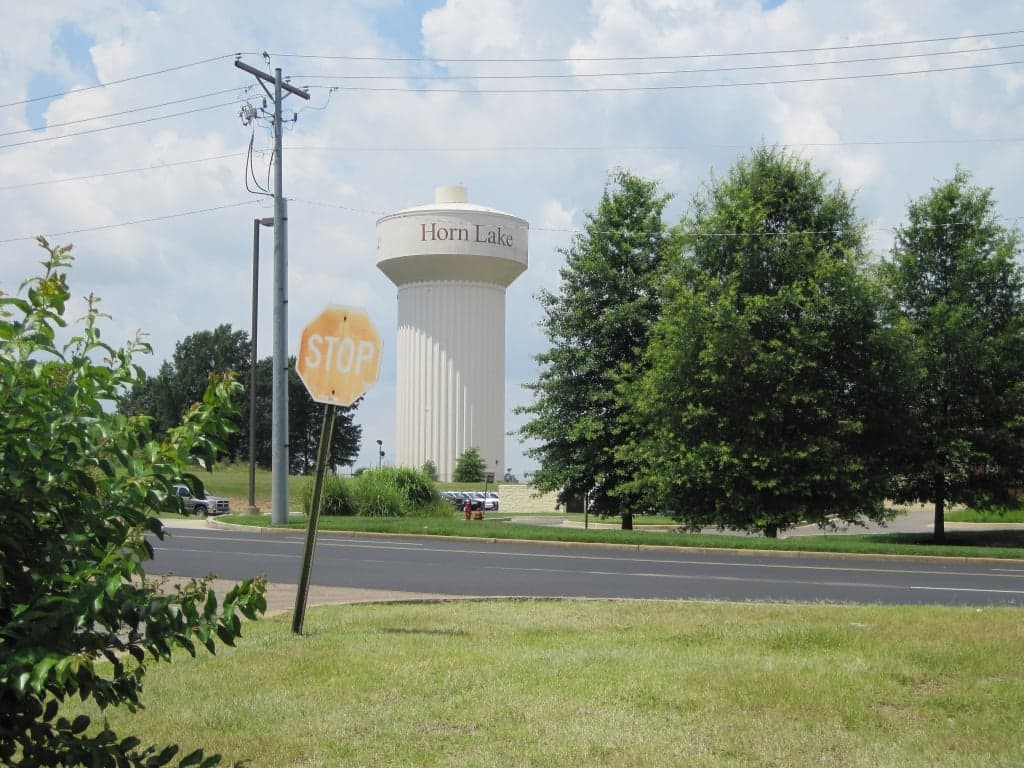
Photo: Wikipedia
Demographics of Horn Lake, MS
Affluence Level in Horn Lake, MS
A low-income area with significant economic hardship. Household wealth and educational attainment are well below national averages.
People of Horn Lake, MS
Horn Lake, Mississippi, is a rapidly diversifying suburban city of 26,622 residents where no single racial or ethnic group holds a majority. The population is nearly evenly split between Black (44.5%) and White (42.0%) residents, with a growing Hispanic community (8.9%) and small but present East/Southeast Asian (1.1%) and Indian (0.3%) populations. Despite its modest size, the city has a distinctly working-class character—only 17.3% of adults hold a college degree—and a feel that is more family-oriented bedroom community than urban center. The people of Horn Lake today are overwhelmingly native-born (96.6% U.S.-born), but the city's demographic story is one of successive waves of domestic migration, not international immigration.
How the city was settled and grew
Horn Lake was never a plantation-era settlement or a river town. It was founded in the late 19th century as a railroad stop along the Illinois Central line, and its early population was a mix of White yeoman farmers and a small number of Black sharecroppers who worked the sandy-loam cotton fields. The city incorporated in 1907 with fewer than 300 residents. The first distinct neighborhood to form was Old Horn Lake, the original grid of streets around the railroad depot (roughly bounded by Goodman Road and Horn Lake Road), where the founding families—mostly of Scots-Irish and English descent—built modest frame houses and a handful of churches. A second early cluster, South Horn Lake (the area south of Goodman Road toward the state line), developed as a scattering of farmsteads and remained rural well into the 1950s. The population grew slowly, reaching just 1,200 by 1950, and was overwhelmingly White and native-born. The city's character during this era was that of a quiet, insular farming community with little connection to Memphis, just 12 miles north.
Modern era (post-1965)
The post-1965 transformation of Horn Lake was driven not by the Hart-Cellar Act but by the suburbanization of Memphis. As White families left Memphis in the wake of school desegregation and the 1968 sanitation strike, Horn Lake became a destination for what was then called "white flight" across the state line into Mississippi, where schools remained segregated longer and property taxes were lower. The Greenbrook subdivision, built in the early 1970s off Greenbrook Drive, was the first major planned subdivision to absorb this wave—a neighborhood of ranch-style homes on quarter-acre lots that was almost entirely White through the 1980s. A second wave, Horn Lake Heights (centered around Horn Lake Road north of Goodman), filled in during the 1980s with slightly larger homes and attracted a mix of White middle-class families and, increasingly, Black families moving south from Memphis. By 1990, the city's population had surged to 14,099, and the Black share had risen to roughly 20%.
The 1990s and 2000s brought a third wave: Black families from Memphis seeking lower crime rates and better school options, alongside a smaller number of Hispanic families drawn to construction and warehouse jobs in the expanding logistics corridor along Interstate 55. The Willow Creek subdivision (off Getwell Road) became a predominantly Black middle-class enclave during this period, while Pleasant Hill (the area near Pleasant Hill Road and I-55) saw a growing Hispanic presence, concentrated in apartment complexes and older single-family rentals. By 2020, the Black population had reached parity with the White population, and the Hispanic share had climbed to 8.9%. The East/Southeast Asian community, though small at 1.1%, is clustered in a handful of newer subdivisions near the interstate, notably Briarwood Estates, where Vietnamese and Filipino families have bought homes since 2010. The Indian population (0.3%) is too small to form a distinct neighborhood and is scattered across the city.
The future
Horn Lake's population is trending toward a stable biracial equilibrium, with the White and Black shares likely to remain within a few points of each other for the next decade. The Hispanic share is growing slowly—driven by natural increase rather than new immigration—and may reach 12-14% by 2035, but the city's low foreign-born rate (3.4%) means it will not become a major immigrant gateway. The East/Southeast Asian and Indian populations are likely to remain small, as the city lacks the professional job base or ethnic institutions that attract larger Asian communities. The most significant demographic trend is internal: the city is not tribalizing into hostile enclaves, but it is sorting by income and housing age. Older neighborhoods like Old Horn Lake are becoming more Black and lower-income, while newer subdivisions like Briarwood Estates and the recently built Lake Forest section (off Goodman Road near the lake) are drawing a mix of White and Black middle-class families. The college-educated share, though low, is slowly rising as remote workers from Memphis discover Horn Lake's lower housing costs.
For someone moving to Horn Lake now, the city offers a straightforward choice: a working-to-middle-class suburb where racial diversity is a fact of daily life, not a political abstraction. The population is stable, native-born, and family-oriented, with a clear trajectory toward a Black plurality and a modestly growing Hispanic minority. The city is not becoming a cosmopolitan melting pot, but it is becoming a genuinely integrated Southern suburb—a place where the old racial lines are blurring, even if economic ones remain sharp.

* Values derived from national, state, county, city and local statistics and may differ in a specific area. Last updated: 2026-05-01T05:12:39.000Z
Narrative content on this page is AI-generated and may contain mistakes. Verify any details that matter before acting on them.
ReloMaps may earn a commission from affiliate links at no extra cost to you.

