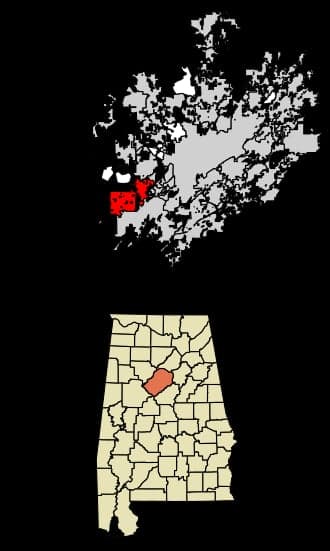
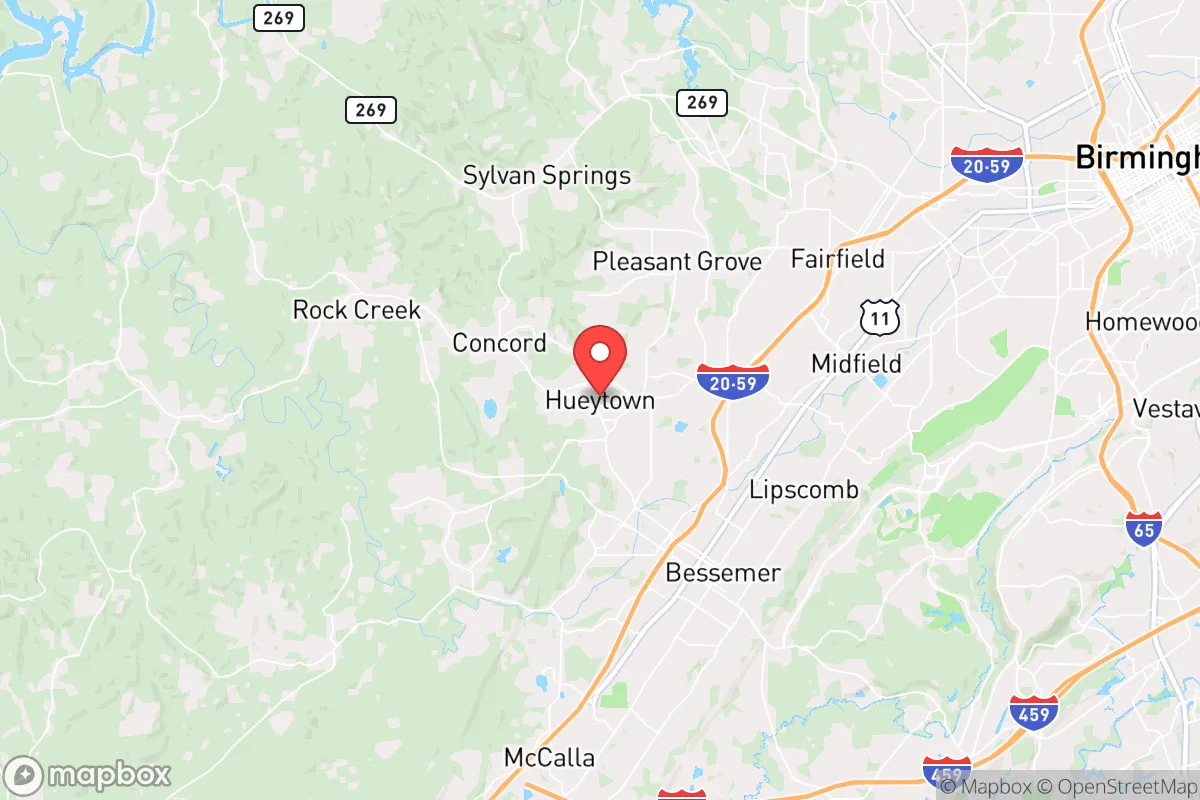
Photo: Wikipedia
Demographics of Hueytown, AL
Affluence Level in Hueytown, AL
A below-average socioeconomic profile. Incomes, home values, and educational attainment trail the U.S., with higher poverty and unemployment.
People of Hueytown, AL
Hueytown, Alabama, today is a working-class suburb of Birmingham with a population of 16,541 that has undergone a dramatic demographic transformation over the past three decades. Once a nearly all-white industrial satellite, the city is now nearly evenly split between white (46.2%) and Black (39.9%) residents, with a growing Hispanic population (10.1%) and a small foreign-born share of 4.7%. The city retains a strong blue-collar identity rooted in its steel and coal history, though only 23.2% of adults hold a college degree, and the population has been slowly declining since its 1970 peak.
How the city was settled and grew
Hueytown was not a colonial-era settlement but a product of the post-Civil War industrial boom. The city was officially incorporated in 1914, though its roots trace to the 1880s when the Pratt Coal and Coke Company opened mines in the area. The original white settlers were largely native-born Appalachian migrants—Scots-Irish and English families from rural Alabama and Tennessee—who came to work the coal seams and later the steel mills of nearby Bessemer and Fairfield. These early residents built modest homes in what is now Old Hueytown, the historic core around Hueytown Road and the original downtown commercial strip. A second wave arrived during the 1920s and 1930s, drawn by the expansion of U.S. Steel's Fairfield Works; these workers settled in Edgewater, a neighborhood of small frame houses just west of the city center. By 1950, Hueytown was a solidly white, working-class community of about 5,000, with a social fabric centered on the First Baptist Church, the local VFW hall, and the annual Hueytown Daze festival.
Modern era (post-1965)
The post-1965 period brought the first significant demographic shifts. The 1970s and 1980s saw the beginning of Black in-migration from Birmingham's inner city and rural Jefferson County, as families sought affordable housing and quieter streets. These new residents concentrated in the Fairview neighborhood, a grid of ranch-style homes east of Hueytown Road, and in the West Hueytown area near the city limits. By 1990, Hueytown's Black population had risen to roughly 15%, and by 2000 it had reached 25%. The 2010s accelerated this trend: the white share fell from 62% in 2010 to 46.2% by the 2020 Census, while the Black share rose to 39.9%. Hispanic growth began later, accelerating after 2000 as immigrant laborers—predominantly from Mexico and Central America—moved into the Rocky Ridge area, a cluster of apartment complexes and older single-family homes near the intersection of Hueytown Road and Allison-Bonnett Memorial Drive. The Asian population remains negligible at 0.4%, and the Indian-subcontinent share is effectively zero. The foreign-born share of 4.7% is modest but concentrated among Hispanic households, many of whom work in construction, landscaping, and the remaining light manufacturing in the corridor.
The future
Hueytown's population is trending toward a white-Black-Hispanic tri-ethnic mix, with the white share likely to continue declining slowly and the Hispanic share rising. The city is not homogenizing; rather, it is tribalizing into distinct enclaves. Old Hueytown and Edgewater remain predominantly white and older, with many residents in their 60s and 70s. Fairview and West Hueytown are now majority-Black and younger, with families drawn by home prices averaging $120,000—among the lowest in Jefferson County. Rocky Ridge is the Hispanic hub, though it remains a small pocket rather than a large barrio. The immigrant community is growing but plateauing, as the local economy offers few high-wage jobs to attract new arrivals. The city's population has declined from a peak of 18,000 in 1970 to 16,541 today, reflecting the broader loss of heavy industry and the out-migration of younger white families to exurban Shelby County. The next 10-20 years will likely see continued slow decline, with the Black share stabilizing near 40-42% and the Hispanic share rising to 12-14%, while the white share settles around 44-46%.
For someone moving in now, Hueytown is becoming a more diverse, lower-cost alternative to Birmingham's eastern suburbs, but it remains a place where neighborhood identity is strongly tied to race and era of settlement. The city's future is one of modest diversity within a shrinking population—a stable, working-class community where the old industrial economy has faded but the blue-collar ethos endures.

* Values derived from national, state, county, city and local statistics and may differ in a specific area. Last updated: 2026-04-19T18:55:11.000Z
Narrative content on this page is AI-generated and may contain mistakes. Verify any details that matter before acting on them.
ReloMaps may earn a commission from affiliate links at no extra cost to you.

