
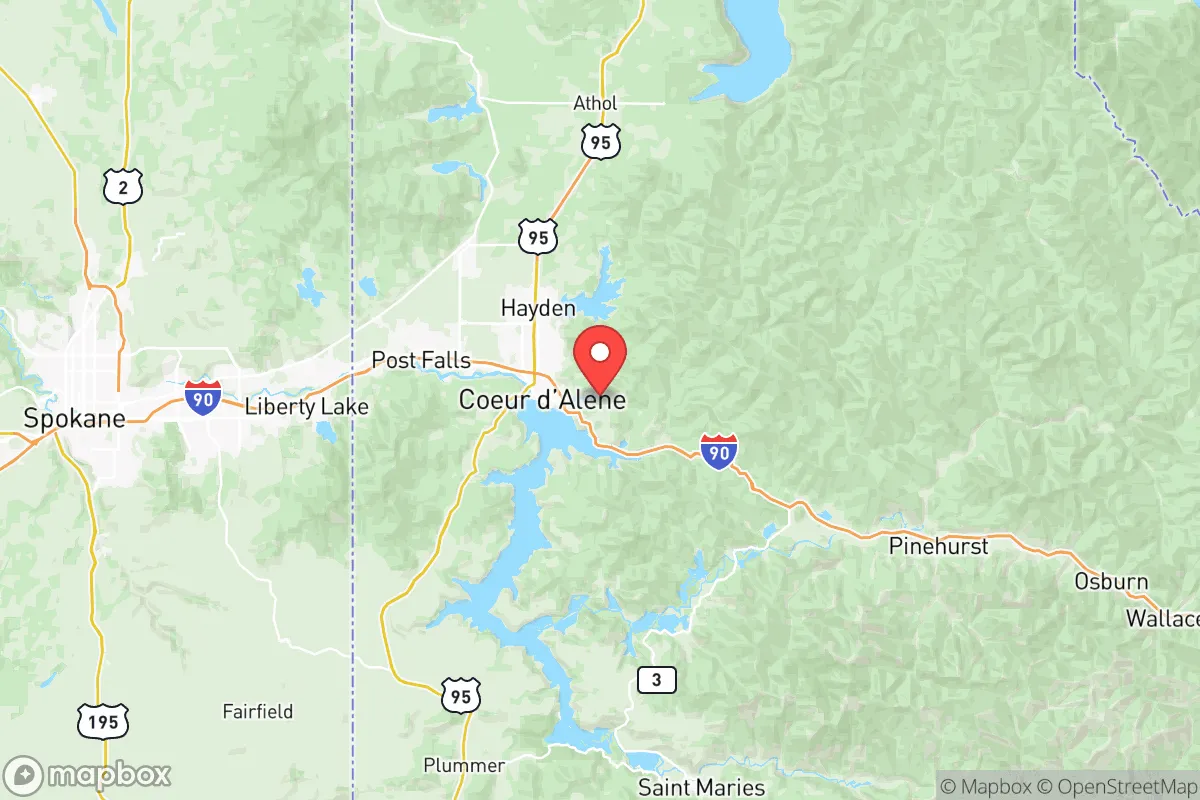
Photo: Wikipedia
Personal Sovereignty in Kootenai County
Viable for self-reliance. Generally workable, though some barriers may limit total independence.
What does Personal Sovereignty tell us?
Personal Sovereignty measures your capacity for self-reliance and independence with minimal government friction. Higher scores mean fewer barriers between you and the way you want to live... but it assumes you have the space you need and good neighbors.
What does this tell us?
Personal Sovereignty measures your capacity for self-reliance and independence with minimal government friction. Higher scores mean fewer barriers between you and the way you want to live... but it assumes you have the space you need and good neighbors.
State Policy
Energy independence: Importer (25% of energy produced in-state)
Personal Liberty
Homesteading

Personal Liberty Analysis
Kootenai County, Idaho, offers one of the strongest environments for personal sovereignty in the inland Northwest, where state preemption laws and a deeply ingrained culture of self-reliance create a buffer against the regulatory creep seen in coastal states. For those prioritizing autonomy—whether as a single individual or a parent—this region stands out for its low-touch government, robust Second Amendment protections, and practical feasibility of off-grid living. The county’s ethos is less about political affiliation and more about a lived commitment to individual control over property, family, and defense, making it a strategic relocation target for those concerned with preserving personal freedoms in an era of expanding federal and state oversight.
Tax burden and regulatory posture: How Kootenai County compares to surrounding areas
Kootenai County benefits from Idaho’s overall low-tax framework, but the local regulatory posture is what truly distinguishes it. Property taxes here average around 0.69% of assessed value, significantly lower than neighboring Washington’s Spokane County (roughly 1.1%), and there is no state income tax on wages—a direct advantage for remote workers or business owners. The county’s planning and zoning departments, particularly in unincorporated areas like Rathdrum and Post Falls, are notably less intrusive than those in Boise’s Ada County or even nearby Kootenai’s own city of Coeur d’Alene, which has stricter building codes and environmental overlay zones. For example, building permits in rural Spirit Lake or Bayview are often processed with minimal red tape, and accessory dwelling units (ADUs) are generally permitted without the lengthy variance processes seen in more urbanized jurisdictions. This regulatory lightness extends to business licensing—home-based enterprises, from welding shops to online retail, face few hurdles, and the county’s right-to-farm ordinance protects agricultural activities from nuisance complaints, a critical detail for anyone planning to raise livestock or operate a small farm.
Self-defense and gun law specifics: What the Second Sanctuary status means for daily carry
Kootenai County is a Second Amendment Sanctuary, and this isn’t just symbolic—it translates into concrete legal protections that affect daily life. Idaho is a constitutional carry state, meaning no permit is required for open or concealed carry for anyone 18 or older who can legally possess a firearm. In Kootenai County, local law enforcement, particularly the Sheriff’s Office under Sheriff Bob Norris, has publicly stated they will not enforce federal firearms laws they deem unconstitutional, such as potential future bans on certain semi-automatic rifles or magazine capacities. This creates a de facto safe zone for gun owners that is more robust than in states like Montana or Arizona, where sanctuary resolutions exist but enforcement varies by county. For parents, this means firearm safety education is normalized—many local ranges, like the Fernan Rod and Gun Club near Coeur d’Alene, offer youth programs without the political friction found in urban centers. The practical effect: you can carry a concealed handgun into most businesses (unless posted), and there are no waiting periods or background checks for private sales between individuals. This is a stark contrast to Washington, where a 10-day waiting period and magazine capacity limits are now law, making Kootenai County a logical relocation for those who view firearm ownership as a non-negotiable personal right.
Self-reliance and homesteading viability: Lot sizes, zoning, and off-grid feasibility across the county
The viability of self-reliant living varies sharply across Kootenai County, and knowing where to buy is critical. In unincorporated areas like Harrison and Worley, minimum lot sizes for rural residential zoning are typically 5 to 10 acres, allowing for substantial gardens, chicken coops, and even small livestock operations without triggering county health department scrutiny. Off-grid living is legally feasible here—Idaho has no state law requiring grid connection, and Kootenai County’s building code allows for alternative energy systems (solar, wind) as long as they meet basic safety standards. However, the city of Coeur d’Alene and its urban growth boundary enforce stricter codes, including mandatory sewer connections and minimum square footage requirements that can hinder a minimalist homestead. For those seeking true autonomy, the area around Medimont or Cataldo offers the best combination of large parcels (often 20+ acres), lax enforcement of nuisance ordinances, and proximity to Coeur d’Alene for supplies. Water rights are a key consideration—while Idaho follows prior appropriation doctrine, exempt wells for domestic use (up to 13,000 gallons per day) are generally permitted on parcels over one acre, though drilling costs can run $15,000-$25,000. The county’s soil quality varies, with the Rathdrum Prairie offering sandy loam ideal for gardening, while the mountainous eastern sections require more intensive amendment.
Personal liberties: Parental rights, medical autonomy, speech, and property protections
Kootenai County’s legal environment strongly favors parental rights and medical autonomy, with Idaho law requiring parental consent for minors’ medical procedures and prohibiting mask mandates in schools without legislative approval. The local school districts—particularly Lake Pend Oreille School District (which covers the county’s eastern portion) and Post Falls School District—have resisted federal overreach on curriculum content, with school boards often dominated by conservative majorities that prioritize transparency in instructional materials. Medical freedom is reinforced by Idaho’s broad conscience clause for healthcare providers, and Kootenai County has a growing network of direct-primary-care clinics and functional medicine practitioners who operate outside insurance constraints. Property rights are protected by Idaho’s “private property protection act,” which requires compensation for any regulatory taking, and the county’s planning department rarely enforces aesthetic covenants outside of platted subdivisions. Free speech is robust—public meetings in Coeur d’Alene and Rathdrum regularly feature citizens criticizing government actions without the time limits or content moderation seen in more progressive jurisdictions. For parents concerned about medical mandates or educational indoctrination, Kootenai County offers a legal shield that is increasingly rare in the United States, with state preemption laws preventing cities like Coeur d’Alene from enacting their own vaccine mandates or speech restrictions.
Overall, Kootenai County ranks among the top 10% of U.S. counties for personal sovereignty, particularly when measured against the regulatory environments of the Pacific Coast or even parts of the Mountain West like Colorado’s Front Range. The combination of constitutional carry, low property taxes, permissive zoning for homesteading, and strong parental rights creates a cohesive ecosystem where individual autonomy is the default rather than the exception. While no location is perfect—the county’s rapid growth is driving up land prices and occasional friction with newcomers who want to import urban regulations—the institutional culture here remains resistant to government overreach. For those who view personal sovereignty as the foundation of a free society, Kootenai County provides a rare environment where that principle is still practiced, not just preached.

* Values derived from national, state, county, city and local statistics and may differ in a specific area. Last updated: 2026-05-28T00:23:13.000Z
Narrative content on this page is AI-generated and may contain mistakes. Verify any details that matter before acting on them.
ReloMaps may earn a commission from affiliate links at no extra cost to you.

