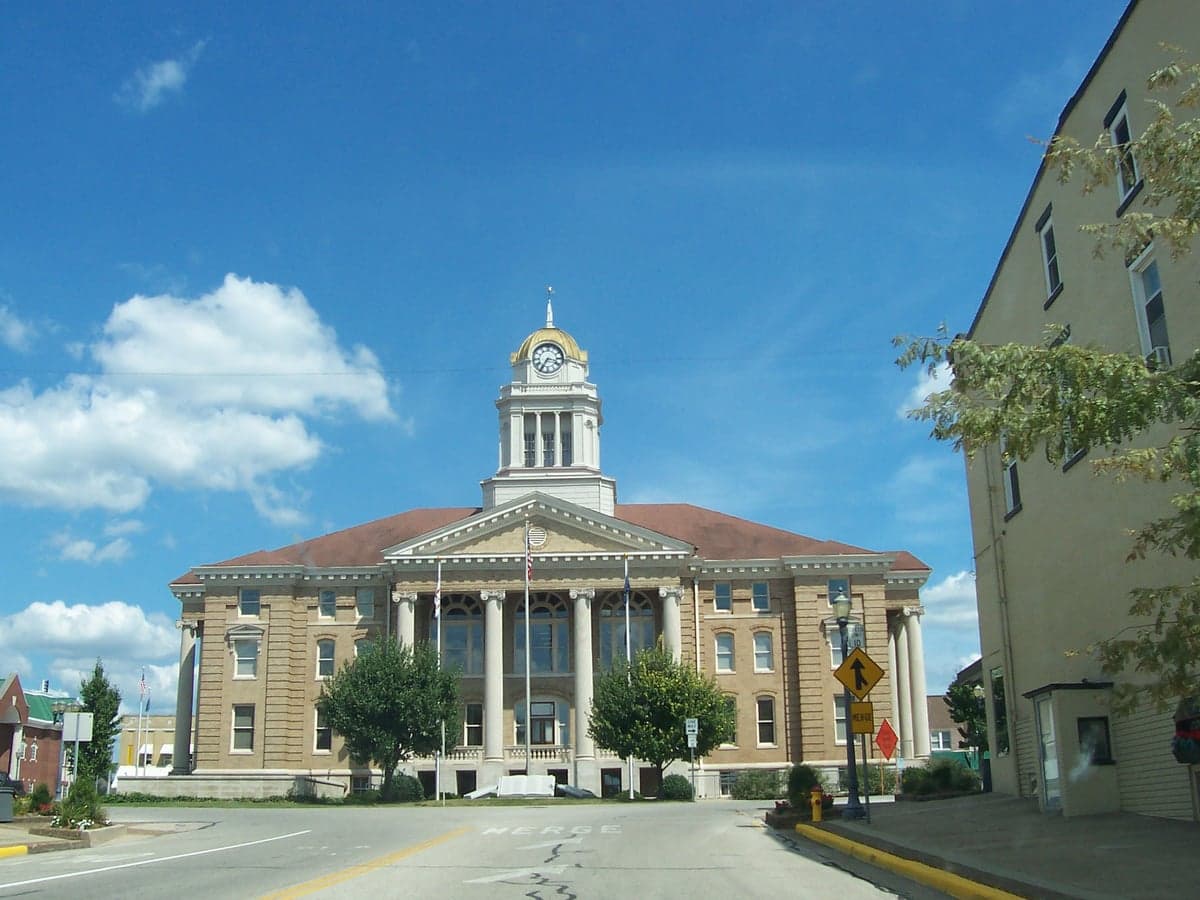
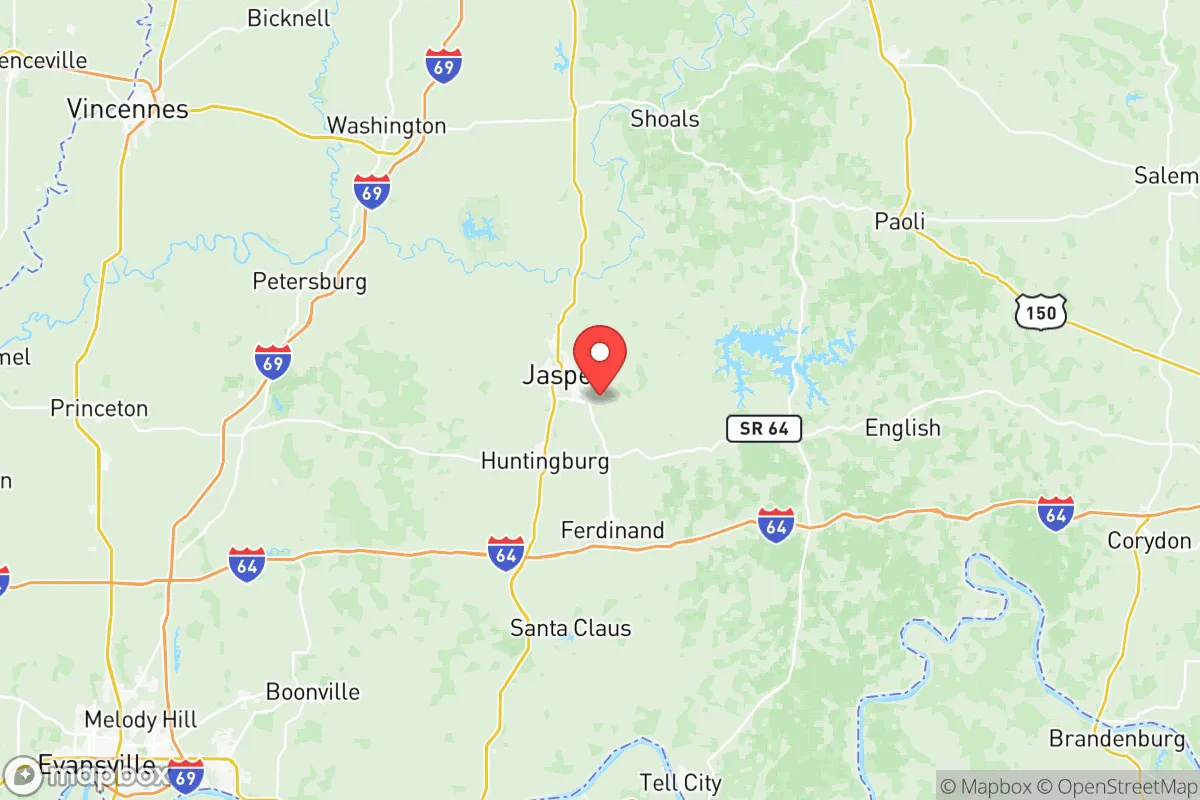
Photo: Wikipedia
Demographics of Dubois County
Affluence Level in Dubois County
A middle-class area roughly in line with national averages across income, home values, education, and employment.
People of Dubois County
Dubois County, Indiana, is home to 43,563 residents, a population that remains predominantly white (87.4%) with a growing Hispanic community (9.7%) and a very small foreign-born share of 3.5%. The county’s character is deeply rooted in its German Catholic heritage, visible in the church steeples of Jasper and Huntingburg, and in the local dialect and festivals that persist today. This is a place where family-owned manufacturing, particularly in cabinetry and woodworking, anchors the economy, and where the population is slowly diversifying while retaining a strong sense of cultural continuity.
Settlement & growth (pre-1960)
Before European settlement, the area that is now Dubois County was part of the hunting grounds of the Miami and Shawnee nations, who used the Patoka River and its tributaries for travel and trade. The first white settlers arrived in the first decade of the 1800s, primarily of Scots-Irish and English stock, moving into the dense forests along the river valleys. The county was formally organized in 1818, named after Toussaint Dubois, a French-Canadian fur trader who had fought alongside George Rogers Clark. These early pioneers were subsistence farmers, and the county’s first seat was established at Portersville, a now-vanished settlement on the Patoka River.
The defining demographic wave began in the 1840s and 1850s, when German Catholic immigrants began arriving in large numbers, drawn by cheap land and the promise of religious freedom. They were fleeing economic hardship and political unrest in the German states, particularly from the Baden and Palatinate regions. These settlers did not spread evenly; they clustered in distinct communities. The town of Jasper, founded in 1830, became the epicenter of German Catholic life, with St. Joseph’s Church serving as a cultural and spiritual anchor. Huntingburg, founded in 1837, also attracted a heavy German Catholic population, as did the smaller hamlets of Ferdinand and St. Anthony. The Benedictine monks and nuns who established Monastery Immaculate Conception in Ferdinand in 1867 further cemented the region’s religious identity, creating a network of parishes and schools that kept the German language and traditions alive well into the 20th century.
By 1900, Dubois County was overwhelmingly German Catholic, with a small minority of English-speaking Protestants. The economy shifted from subsistence farming to timber and then to manufacturing, particularly after the arrival of the railroad. The German American Woodworking Company in Jasper, founded in 1907, was a precursor to the county’s modern furniture and cabinetry industry. The county’s population grew steadily, reaching 23,000 by 1950, and remained almost entirely white and native-born. The only significant non-white presence was a tiny number of African American families, mostly working as railroad laborers, who settled in Huntingburg and Jasper.
Modern era (post-1965)
The post-1965 era brought modest but meaningful demographic change to Dubois County, driven primarily by labor demand in manufacturing. The county’s furniture and woodworking factories, including the massive Kimball International complex in Jasper, began recruiting workers from outside the region as the local labor pool tightened. The first wave of Hispanic immigrants, primarily from Mexico, arrived in the 1970s and 1980s, taking jobs in factories and on farms. They settled mostly in Jasper and Huntingburg, where they formed small but stable enclaves. By 2000, the Hispanic share of the population had risen to 3.5%, and it has since more than doubled to 9.7% as of the latest data.
The Hart-Cellar Act of 1965 had a limited direct impact on Dubois County, as the region did not attract significant numbers of Asian or African immigrants. The Asian population (East and Southeast Asian) remains at 0.0%, and the Indian subcontinent population is a tiny 0.6%, likely professionals working in healthcare or engineering at Memorial Hospital and Health Care Center in Jasper. The Black population is also very small at 0.9%, concentrated in Jasper and Huntingburg, and has not grown substantially. Domestic migration has been minimal; the county has not experienced the Rust Belt-to-Sun Belt flight seen in other parts of Indiana. Instead, it has retained its population through natural increase and the steady arrival of Hispanic workers, who now make up a visible presence in local schools and churches.
Suburbanization has been limited, with most growth occurring within the existing town boundaries of Jasper (population 15,000) and Huntingburg (population 6,000). The county’s rural character remains intact, with small unincorporated communities like Ireland, Dubois, and Birdseye retaining their historic German Catholic identities. The foreign-born share of the population is just 3.5%, well below the national average, reflecting the county’s limited appeal to international migrants outside of the Hispanic labor pipeline.
The future
Dubois County is likely to become slowly more diverse over the next 10-20 years, but the pace of change will be gradual. The Hispanic population, now at 9.7%, is projected to continue growing as second- and third-generation families expand and as new workers are recruited to fill manufacturing jobs. This growth will be concentrated in Jasper and Huntingburg, where existing social networks and Spanish-language services already exist. The white population, while still the overwhelming majority, is aging and experiencing lower birth rates, which will gradually reduce its share of the total.
The county is not expected to attract significant numbers of Asian, Indian, or Black residents, given the lack of large universities, tech hubs, or major immigrant gateways. The cultural identity of Dubois County will remain rooted in its German Catholic heritage, but it will increasingly be a bilingual, bicultural community, with Spanish spoken alongside the local German-influenced English dialect. The county’s political leanings, which are strongly conservative, may shift slightly as the Hispanic population grows, but the overall character of the region as a family-oriented, manufacturing-based, religiously observant community is likely to persist.
For someone moving in now, Dubois County offers a stable, safe, and culturally cohesive environment with a strong sense of place. The population is slowly diversifying, but the change is incremental and unlikely to disrupt the county’s core identity. New residents, particularly those from outside the Midwest, should expect a community where church, family, and local manufacturing still define daily life, and where the German Catholic traditions of the 19th century remain a living presence in the 21st.

* Values derived from national, state, county, city and local statistics and may differ in a specific area. Last updated: 2026-08-04T23:58:35.000Z
Narrative content on this page is AI-generated and may contain mistakes. Verify any details that matter before acting on them.
ReloMaps may earn a commission from affiliate links at no extra cost to you.

