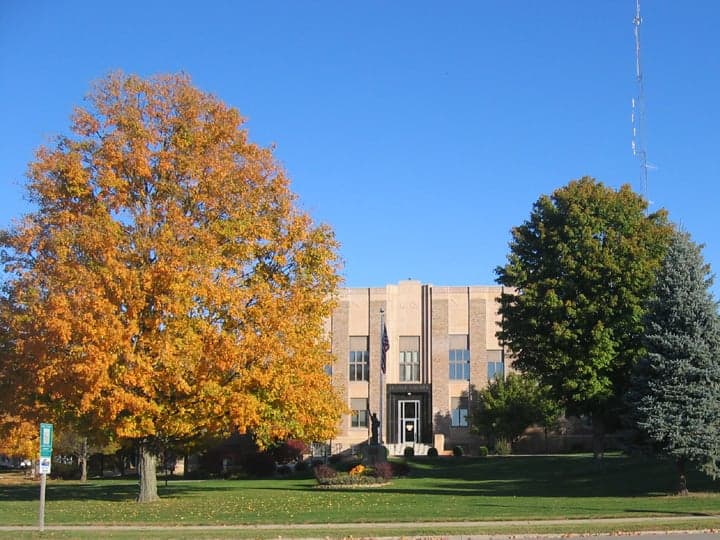
Photo: Wikipedia
Political ClimatePolitical Climate in Bremer County
Showing district-level results — no local-only data available.
Local Political AnalysisPolitical Analysis of Bremer County
Bremer County, Iowa, leans reliably Republican with a Cook PVI of R+4, though it is slightly less conservative than the state of Iowa as a whole, which sits at R+6. This means the county has voted for Republican presidential candidates in recent cycles, but by narrower margins than the statewide average. The political trajectory here has been fairly stable, with no dramatic shifts in party registration or voting patterns over the past decade, though local races often see more competition than statewide contests.
How it compares
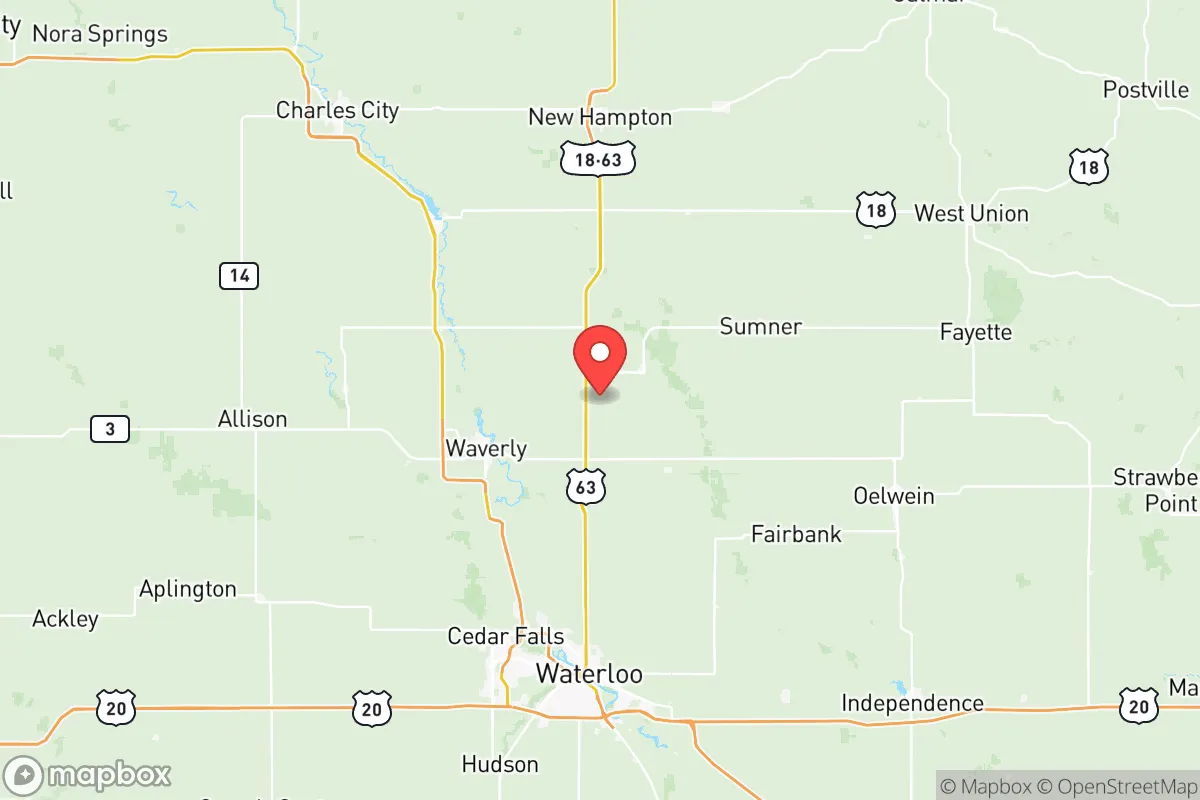
Bremer County’s R+4 rating places it to the left of Iowa’s R+6, reflecting a more moderate Republican lean than the state average. This difference is driven by the county’s mix of small cities and rural areas. The city of Waverly, home to Wartburg College and a sizable student population, tends to lean more Democratic, with precincts around the campus often voting blue in local and national elections. In contrast, the towns of Tripoli and Sumner are more solidly red, with Republican candidates routinely winning by double-digit margins. The swing precincts are typically found in the unincorporated areas and smaller communities like Plainfield and Readlyn, where independent voters can tip the balance in close races. Compared to neighboring counties like Black Hawk (D+5) to the south or Fayette (R+16) to the north, Bremer occupies a middle ground—more conservative than the Waterloo area but less so than the deeply red rural counties to the east.
What this means for residents
For conservative residents, Bremer County’s R+4 lean means their views are broadly represented in county government and state legislative races, though they may need to work harder to win primaries or local offices compared to more uniformly red areas. Liberal residents, particularly in Waverly, find a supportive community in the college town but face an uphill battle in countywide elections. In practice, this creates a political environment where both sides can be heard, but policy outcomes—such as tax levies, school board decisions, and zoning laws—tend to reflect the Republican majority. The county’s moderate lean also means that statewide ballot measures or controversial issues often see closer votes here than in the rest of Iowa, giving residents a sense that their individual votes carry more weight.
Culturally, Bremer County is distinct from the broader state in its emphasis on local governance and community engagement. The county’s small-town character means that political discussions often happen face-to-face at coffee shops, church gatherings, or school events, rather than through partisan media. Policy-wise, the county has maintained a relatively low-tax environment, with property tax rates below the state average, and has resisted some of the more aggressive cultural wars seen in other parts of Iowa, such as book bans or strict abortion ordinances. This pragmatic approach reflects the influence of Waverly’s college-educated population and the county’s agricultural roots, creating a political climate that is conservative but not rigidly ideological.

State Political ClimatePolitical Climate in Iowa
State Political AnalysisPolitical Environment in the State
Iowa has shifted from a classic purple swing state to a solidly Republican-leaning one, carrying a Cook PVI of R+6. Over the past 20 years, the state has moved decisively rightward: it voted for Obama in 2008 and 2012, then flipped to Trump by nearly 10 points in 2016 and stayed there in 2020 and 2024. The dominant coalition today is a mix of rural conservatives, evangelical voters, and working-class manufacturing and agricultural workers, while Democrats hold ground only in a few urban islands and college towns. For a relocator, this means the state’s politics are now reliably conservative at the state level, but with enough local variation that your experience will depend heavily on which county you land in.
Urban vs. rural divide
The political map of Iowa is a textbook study in the urban-rural split. The Democratic strongholds are Polk County (Des Moines), Johnson County (Iowa City), and Story County (Ames) — home to the state capital, the University of Iowa, and Iowa State University, respectively. These three counties reliably deliver 60-70% Democratic votes in statewide races. In contrast, the rest of the state is deeply red. Counties like Sioux County in the northwest (home to a large Dutch Reformed population) and Plymouth County routinely vote 75-80% Republican. The real story is the suburban and exurban ring around Des Moines: Dallas County (suburbs like Waukee and West Des Moines) flipped from blue to red in the 2010s and now leans Republican by about 10 points, while Warren County (south of Des Moines) has been reliably red for decades. The Mississippi River counties — Dubuque, Scott (Davenport), and Black Hawk (Waterloo) — are classic swing areas that have trended redder, with Dubuque County flipping to Trump in 2016 and staying there. If you move to Des Moines proper or Iowa City, you’ll be in a blue bubble; anywhere else, expect a conservative environment.
Policy environment
Iowa’s state-level policy is unambiguously conservative. The state has a flat income tax of 3.8% (phased down from a progressive top rate of 8.53% in 2018), and property taxes are among the lowest in the Midwest. There is no estate tax. The regulatory posture is business-friendly, with a right-to-work law and no state-level minimum wage above the federal $7.25. Education policy is a flashpoint: Iowa enacted a universal school voucher program in 2023 (Students First Act), allowing any family to use public funds for private or homeschool expenses. The state also passed a law in 2022 banning instruction on sexual orientation and gender identity through grade 6 (SF 496). On healthcare, Iowa expanded Medicaid under the ACA but has since imposed work requirements (currently tied up in court). Election laws tightened in 2021 with SF 413, which reduced early voting days, closed polls at 8 p.m. instead of 9, and banned private funding of election offices. Gun laws are permissive: permitless carry was enacted in 2021, and there is no state-level red flag law. For a conservative relocator, the policy environment is very favorable; for a liberal one, it will feel restrictive, especially on education and voting access.
Recent policy direction
The last five years have seen a sharp rightward turn across nearly every policy dimension. On gun and self-defense law, Iowa passed permitless carry (HF 756) in 2021, removing the requirement for a permit to carry a concealed firearm. On parental and education rights, the 2023 Students First Act created universal education savings accounts worth about $7,600 per child, and SF 496 (2022) banned transgender athletes from girls’ sports and restricted classroom discussion of gender identity. On speech and privacy, Iowa passed a law in 2024 (HF 2606) requiring age verification for adult websites and restricting minors’ access to social media algorithms — a move framed as child safety but criticized as a speech restriction. On medical and bodily autonomy, Iowa banned abortion at roughly six weeks (fetal heartbeat) in 2023 via HF 732, with no exceptions for rape or incest; the law was upheld by the Iowa Supreme Court in 2024. On property rights, the state has strong eminent domain protections for landowners, and in 2022 it passed a law limiting county and city zoning authority over agricultural land. On taxation, the 2022 tax reform (HF 2317) accelerated the flat tax phase-in and eliminated the inheritance tax. On voting and ballot access, SF 413 (2021) shortened the early voting window from 29 to 20 days, required absentee ballot requests to be made earlier, and banned ballot drop boxes except at county auditor offices. The direction is clear: Iowa is moving toward a low-tax, limited-government, culturally conservative model.
Civil unrest & political movements
Iowa has not seen the kind of large-scale civil unrest common in coastal states, but there have been notable flashpoints. In 2020, Des Moines and Iowa City saw Black Lives Matter protests, including a march on the Iowa Capitol that drew several thousand people; a few nights of property damage occurred in downtown Des Moines, but the response was largely peaceful. On the right, the Iowa Freedom Riders (a group opposing COVID-19 mandates) held regular protests at the Capitol in 2020-2021, and the Iowa Gun Owners group is highly active in lobbying. Immigration politics are less heated than in border states, but in 2024, Governor Kim Reynolds deployed the Iowa National Guard to Texas under a mutual aid agreement, and the state passed a law (SF 2340) making it a state crime to enter Iowa after being deported — a direct challenge to federal authority that is currently in court. There is no serious secession or nullification movement, but the state has a strong strain of “state sovereignty” rhetoric, especially around gun laws and federal land management. Election integrity controversies flared in 2020 when Trump narrowly lost Iowa (by about 7 points) despite winning it in 2016; the state’s Republican-led audit found no widespread fraud, but the issue remains a live topic in conservative circles. A new resident would notice that political signs and bumper stickers are common, especially in rural areas, but the overall atmosphere is civil — Iowans tend to be polite even when they disagree.
Projection
Over the next 5-10 years, Iowa is likely to become more Republican, not less. The demographic trends favor the GOP: the state’s population is aging (median age 38.8, above the national average), and younger, more liberal residents tend to leave for Minneapolis, Chicago, or the coasts. In-migration is modest and comes mostly from other Midwestern states, with a slight tilt toward conservative-leaning retirees from Illinois and Minnesota. The urban counties (Polk, Johnson, Story) will remain blue, but their growth is slower than the red exurbs — Dallas County grew 35% between 2010 and 2020, and it’s now solidly Republican. The 2024 election results (Trump won by 13 points) suggest the R+6 PVI may even understate the current lean. Expect further tax cuts, continued expansion of school choice, and more restrictions on abortion and transgender rights. The wild card is the agricultural economy: if commodity prices crash or trade wars hit Iowa’s corn and soybean exports, economic discontent could shift the ground, but for now, the political trajectory is a steady march rightward.
For a new resident, the bottom line is this: if you’re conservative, you’ll find a state that matches your values on taxes, guns, education, and cultural issues, with a government that is actively moving in your direction. If you’re liberal, you’ll find a state where your vote matters little in statewide races, but you can still live comfortably in Des Moines, Iowa City, or Ames — just expect to be politically isolated outside those bubbles. The practical takeaway is that Iowa is a great place for someone who wants low taxes, strong schools (if you choose the right district), and a quiet, family-oriented life, but it’s not a place where political diversity is celebrated at the state level. Choose your county carefully, and you’ll be fine either way.
* Values derived from national, state, county, city and local statistics and may differ in a specific area. Last updated: 2026-06-12T20:43:15.000Z
Narrative content on this page is AI-generated and may contain mistakes. Verify any details that matter before acting on them.
ReloMaps may earn a commission from affiliate links at no extra cost to you.

