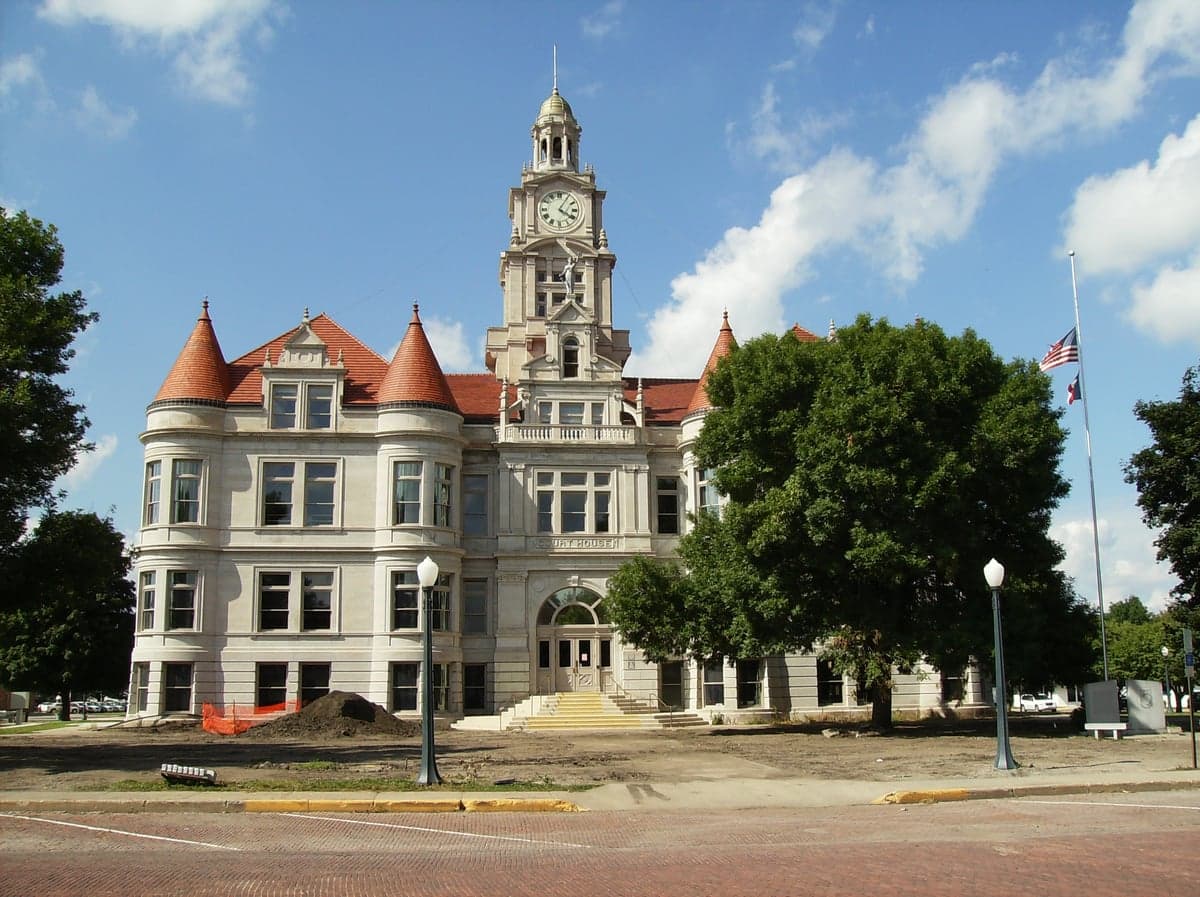
Photo: Wikipedia
Demographics of Dallas County
Affluence Level in Dallas County
An upper-middle-class area. Household wealth, education levels, and homeownership run ahead of national benchmarks.
People of Dallas County
Dallas County, Iowa, today is a rapidly growing, predominantly white, and highly educated suburban powerhouse west of Des Moines, home to 104,136 residents. Its population is characterized by a strong conservative-leaning tilt, a median household income well above the state average, and a distinctive identity as a destination for families seeking newer housing, top-rated schools, and a quieter lifestyle while remaining within commuting distance of the capital. The county’s human history is a story of successive waves—from Native American tribes to Yankee settlers, European immigrants, and now a surge of domestic migrants from other parts of Iowa and the Midwest—each leaving a mark on the communities of Adel, Waukee, and Perry.
Settlement & growth (pre-1960)
Before American settlement, the area now known as Dallas County was home to the Sauk and Meskwaki (Fox) tribes, who used the land for hunting and seasonal camps along the Raccoon River and its tributaries. The 1832 Black Hawk Purchase opened the region to Euro-American settlers, and the county was officially organized in 1846. The first wave of settlers were primarily Yankees from New England and New York, drawn by the promise of cheap, fertile prairie land under the Preemption Act of 1841 and later the Homestead Act of 1862. These early arrivals established the county seat of Adel in 1847 and the river town of Perry in 1856, the latter becoming a key stop on the Chicago & North Western Railway.
A second, larger wave arrived from the 1860s through the 1890s: German and Scandinavian immigrants, particularly Danes and Swedes, who were recruited by railroad companies and land agents to farm the rich loam soil. Waukee, platted in 1869, was initially a Danish farming community, while Woodward and Granger attracted a mix of German and Swedish families. These groups established Lutheran and Catholic churches, built one-room schoolhouses, and created a stable, rural society centered on corn, oats, and livestock. By 1900, the county’s population had reached roughly 23,000, a figure that would remain relatively flat for the next 60 years as the agricultural economy limited new opportunities.
The early 20th century saw a small but notable influx of Mexican laborers, who arrived to work on the railroads and in the sugar beet fields around Perry. This community, though tiny, established roots that would later expand significantly. The Dust Bowl and Great Depression had little direct impact on Dallas County’s population, as the area was not a major destination for Okies or other displaced farmers. The post-World War II era brought modest suburbanization, with Van Meter and Dallas Center seeing some growth as Des Moines workers sought rural acreages, but the county remained overwhelmingly agricultural and homogeneous through 1960.
Modern era (post-1965)
The 1965 Hart-Cellar Act had a limited direct effect on Dallas County, as the area did not become a primary destination for post-1965 immigration waves. Instead, the county’s modern demographic transformation has been driven almost entirely by domestic migration. The construction of Interstate 80 and the expansion of the Des Moines metropolitan area in the 1980s and 1990s triggered a suburban boom that reshaped the county’s population. Waukee emerged as the epicenter of this growth, transforming from a village of 1,500 in 1980 to a city of over 25,000 by 2020, fueled by young families and professionals fleeing higher taxes and older housing stock in Des Moines proper.
The foreign-born population remains modest at 4.9%, but it is concentrated in specific enclaves. Perry has seen the most significant change, with a growing Hispanic community—now roughly 30% of the city’s population—descended from the earlier Mexican railroad workers and later arrivals employed in the Tyson Foods pork processing plant. This community is predominantly Mexican-American, with smaller numbers from Central America. The Indian subcontinent population (2.8%) and East/Southeast Asian population (1.8%) are newer, arriving primarily since 2000, and are concentrated in Waukee and West Des Moines (the latter partially in Dallas County), drawn by tech and finance jobs in the Des Moines metro. These groups are highly educated and often employed in professional services, healthcare, and information technology.
The Black population (2.5%) is smaller and more dispersed, with no single concentrated enclave, though a growing number of Black professionals have settled in Waukee and Adel. The overall racial shift has been gradual: the county was 96% white in 1990, dropping to 81.7% white today, with the change driven almost entirely by Hispanic and Asian/Indian in-migration. Suburbanization has been the dominant force, with new housing developments, retail corridors, and school expansions reshaping the landscape. The county’s college-educated rate of 51.6% is among the highest in Iowa, reflecting the professional nature of its new residents.
The future
Dallas County’s population is projected to continue growing, likely reaching 130,000–140,000 by 2040, driven by ongoing suburban expansion and the annexation of farmland into new subdivisions. The county is not tribalizing into distinct ethnic enclaves in the way larger metros do; instead, the pattern is one of assimilation into a broadly conservative, family-oriented suburban culture. The Hispanic community in Perry remains somewhat distinct due to its concentration and lower median income, but second-generation residents are increasingly moving to Waukee and Adel for better schools and jobs, accelerating integration. The Indian and East/Southeast Asian populations are growing but remain small enough to be absorbed into the general professional class without forming separate ethnic neighborhoods.
The cultural identity of the county is being shaped by in-migration from other parts of Iowa and the Midwest, not from coastal transplants. New residents tend to share similar values—emphasis on schools, safety, low taxes, and outdoor recreation—which reinforces the existing conservative character rather than diluting it. The next 10–20 years will likely see continued homogenization around a suburban, family-centric lifestyle, with the county becoming slightly more diverse in terms of race and ethnicity but not in terms of political or cultural outlook. The main challenge will be managing growth: infrastructure, school capacity, and water resources will be tested as farmland gives way to rooftops.
For someone moving in now, Dallas County offers a stable, growing, and culturally cohesive environment where the population is becoming more diverse in background but not in values. The county is not a melting pot of competing identities but a destination for those seeking a predictable, high-quality suburban life within reach of a mid-sized city. The people of Dallas County are, in essence, the future of Iowa’s metropolitan fringe: educated, conservative, and increasingly removed from the state’s rural agricultural past.

* Values derived from national, state, county, city and local statistics and may differ in a specific area. Last updated: 2026-05-09T23:49:42.000Z
Narrative content on this page is AI-generated and may contain mistakes. Verify any details that matter before acting on them.
ReloMaps may earn a commission from affiliate links at no extra cost to you.

