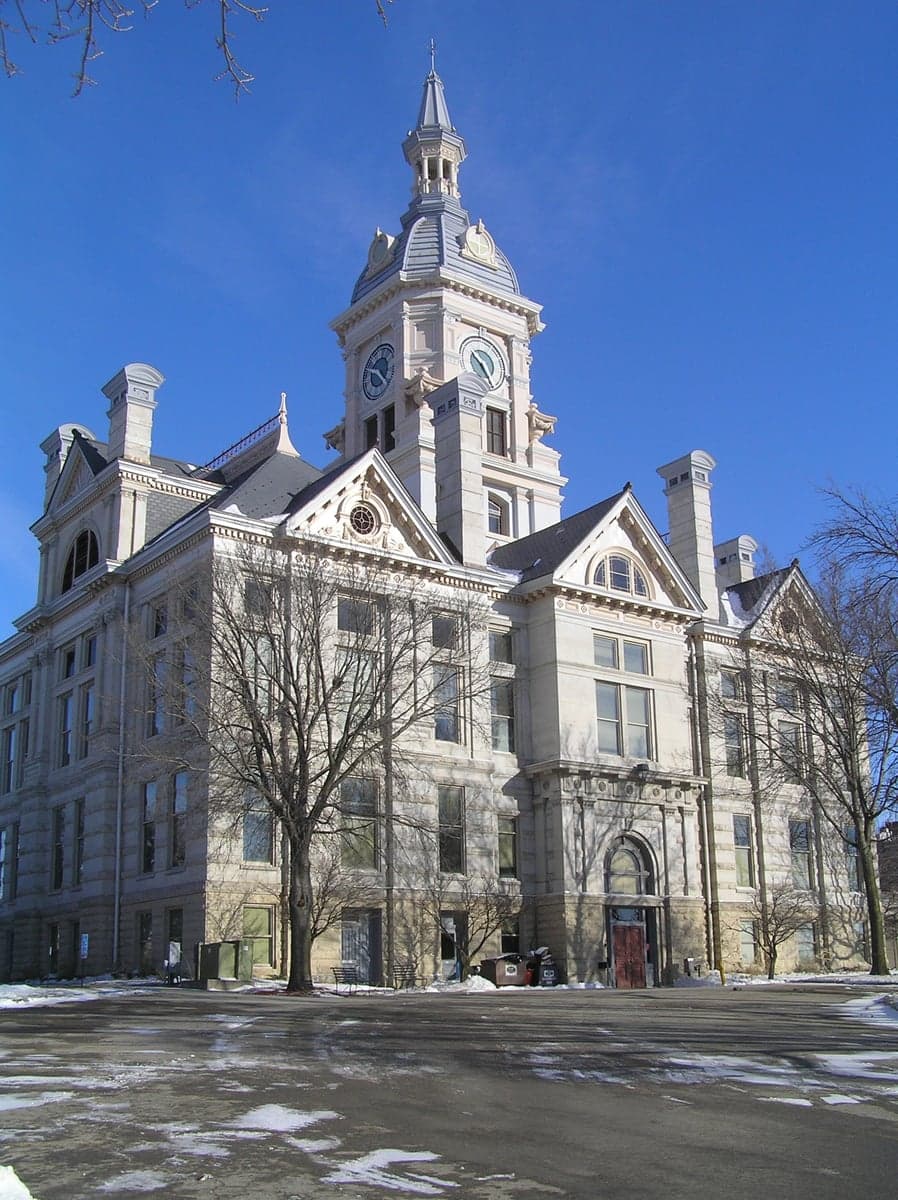
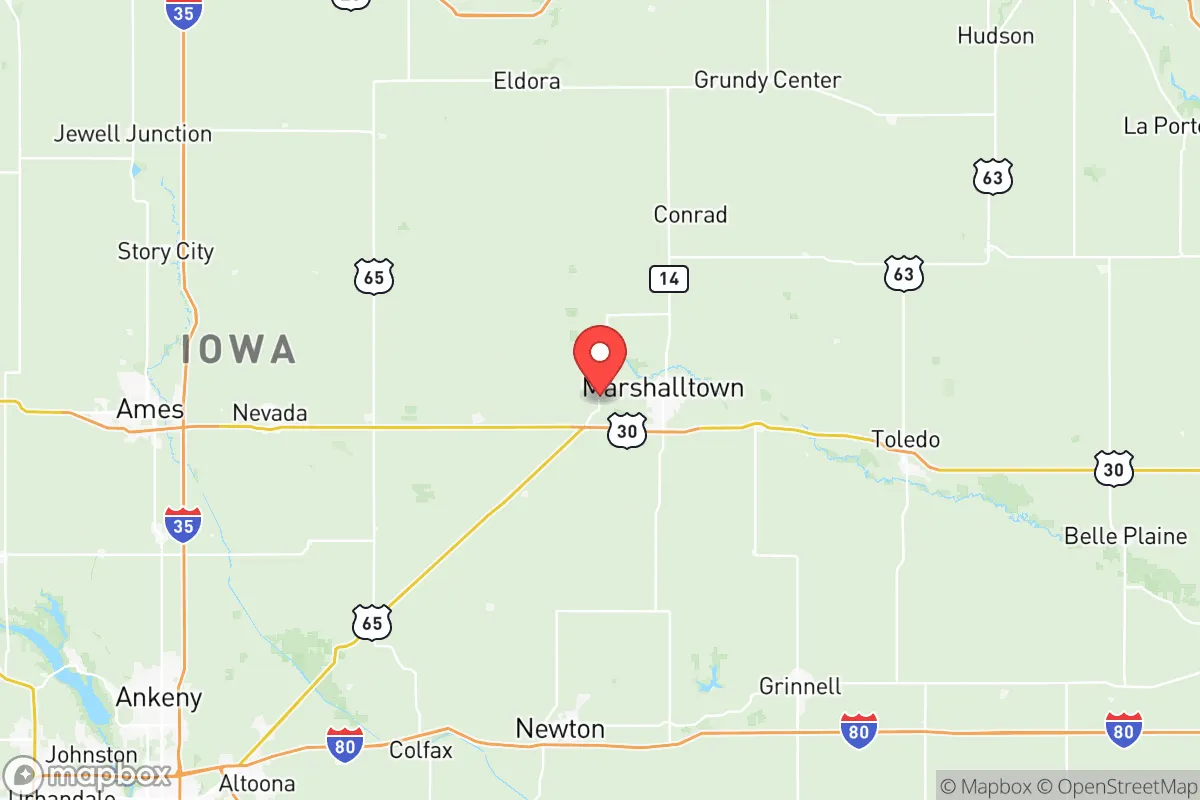
Photo: Wikipedia
Demographics of Marshall County
Affluence Level in Marshall County
A middle-class area roughly in line with national averages across income, home values, education, and employment.
People of Marshall County
Marshall County, Iowa, today is a community of roughly 40,000 residents defined by its agricultural and industrial roots, a growing Hispanic plurality, and a predominantly white but diversifying population. The county seat, Marshalltown, serves as the economic and cultural hub, where a significant Hispanic population (nearly a quarter of the county) and a notable East/Southeast Asian community (over 4%) have reshaped the area's identity since the late 20th century. With a foreign-born population of 8.7%—nearly double the state average—Marshall County is more ethnically diverse than much of rural Iowa, yet it retains a strong, conservative-leaning character rooted in its history of European settlement and small-town civic life.
Settlement & growth (pre-1960)
Before American settlement, the land that is now Marshall County was part of the traditional territory of the Fox (Meskwaki) and Sauk nations, who used the area for hunting and seasonal camps along the Iowa River. The first permanent American settlers arrived in the 1840s and 1850s, following the Black Hawk Purchase (1832) and the subsequent forced removal of Native tribes. These early pioneers were primarily Yankee migrants from New England and New York, drawn by the promise of fertile, cheap land under the Preemption Act and later the Homestead Act. They founded the county's first towns: Marshalltown (established 1851), Liscomb (1853), and Le Grand (1855). The arrival of the Chicago and North Western Railway in the 1860s transformed Marshalltown into a regional agricultural shipping center, attracting a second wave of settlers.
From the 1870s through the early 1900s, a significant influx of German immigrants arrived, many coming directly from the German states or via earlier settlements in the Midwest. They established farms and businesses, particularly in the townships around State Center and Albion, where German-language churches and schools persisted into the early 20th century. A smaller but notable group of Irish immigrants settled in Marshalltown and Green Mountain, working on the railroad and in the new brickyards and foundries. The county's population peaked at around 38,000 in 1910, driven by agricultural prosperity and the growth of Marshalltown's manufacturing sector, including the Marshalltown Trowel Company (founded 1893), which became a global supplier of masonry tools.
The period from 1920 to 1960 saw slower growth, with the population hovering around 37,000. The Great Depression and Dust Bowl years brought a small number of Okie and Arkie migrants from the Southern Plains, but Marshall County's diversified agricultural economy—corn, soybeans, and livestock—proved more resilient than the single-crop regions further west. The post-World War II era saw a modest suburbanization around Marshalltown, but the county remained overwhelmingly white and native-born, with a population that was 99% white as late as 1960.
Modern era (post-1965)
The 1965 Hart-Cellar Act fundamentally altered Marshall County's demographic trajectory, though the changes took decades to fully manifest. The first major post-1965 shift came in the 1970s and 1980s, when Marshalltown's meatpacking plants—particularly the Swift & Company (later JBS USA) plant—began actively recruiting immigrant labor. This drew a wave of Mexican and Central American migrants, initially men seeking industrial work, followed by family reunification. By 1990, the Hispanic population had grown to roughly 5% of the county; by 2020, it had surged to 23.8%, concentrated heavily in Marshalltown's south side and in the smaller towns of Gilman and Laurel, where affordable housing and proximity to the plant made settlement practical.
A second, smaller but significant wave came in the 1990s and 2000s, when the meatpacking industry also recruited East/Southeast Asian workers, primarily from Vietnam, Laos, and Myanmar. These communities settled almost exclusively in Marshalltown, forming a small but visible enclave near the plant and along the Center Street corridor. Today, East/Southeast Asians make up 4.2% of the county's population, with many second-generation members now working in healthcare, education, and small business. The Indian subcontinent population remains negligible at 0.1%, reflecting the absence of the tech-sector pull that drives Indian immigration to larger Iowa cities like Des Moines and Ames.
Domestic migration patterns since 2000 have been mixed. The county has experienced a net outflow of young, college-educated whites to larger metro areas, contributing to a college attainment rate of just 21.4%—well below the national average. However, this has been partially offset by an influx of retirees and remote workers from more expensive states, drawn by Marshall County's low cost of living and conservative cultural climate. The Black population remains small (1.5%), with most African American residents concentrated in Marshalltown and Ferguson, a legacy of limited Great Migration-era settlement and little subsequent in-migration.
The future
Marshall County's population is projected to remain stable or decline slightly over the next decade, as natural increase among the white population is negative and Hispanic growth rates moderate. The county is not homogenizing into a single cultural identity; rather, it is tribalizing into distinct enclaves along ethnic and geographic lines. The Hispanic community, now a quarter of the population, is growing through both births and continued immigration, and is increasingly visible in local politics and business. The East/Southeast Asian community is plateauing, with younger generations assimilating into the broader white-majority culture through intermarriage and out-migration to urban centers.
The white population, while still the majority at 67.4%, is aging and shrinking, with many young adults leaving for college and not returning. This creates a demographic tension: the county's economic base—agriculture and manufacturing—depends on immigrant labor, but the cultural identity remains rooted in its European-American heritage. The next 10-20 years will likely see a continued Hispanicization of the working class, while the professional and political leadership remains predominantly white. In-migration from outside Iowa is unlikely to change this dynamic significantly, as most newcomers are either retirees seeking low taxes or immigrants seeking industrial work.
For someone moving in now, Marshall County offers a stable, affordable, and safe environment with a clear conservative ethos, but it is not a culturally homogeneous place. The Hispanic community is large enough to sustain its own churches, festivals, and businesses, while the white population maintains a distinct small-town Midwestern character. The two groups coexist with minimal friction, but integration is limited—most social and civic life remains segmented by ethnicity. The county is becoming a bi-cultural rural community, where the future depends on whether these groups find common ground in shared economic interests and local institutions, or continue to drift into parallel societies.

* Values derived from national, state, county, city and local statistics and may differ in a specific area. Last updated: 2026-05-12T17:59:37.000Z
Narrative content on this page is AI-generated and may contain mistakes. Verify any details that matter before acting on them.
ReloMaps may earn a commission from affiliate links at no extra cost to you.

