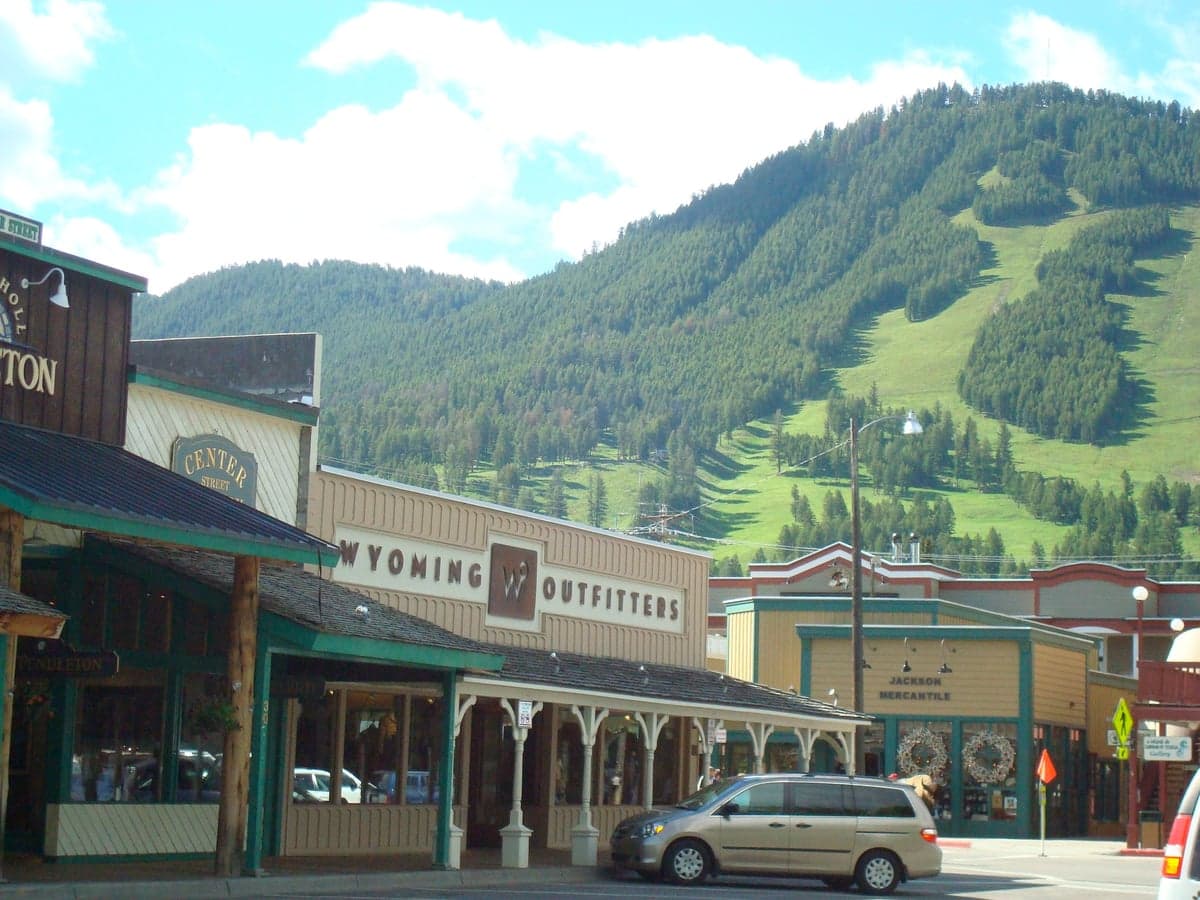
Photo: Wikipedia
Political ClimatePolitical Climate in Jackson, WY
District shown is the primary district for this city’s centroid. Cities may span multiple districts.
Inherited from parent state — no local data available.
Local Political AnalysisPolitical Analysis of Jackson, WY
Jackson Hole has long been a deep red stronghold, with Teton County’s Cook PVI of R+23 reflecting a solid conservative base that values personal freedoms, limited government, and a hands-off approach to local life. But if you’ve been around here as long as I have, you’ve seen the winds shift—especially in the town of Jackson itself, where a growing influx of out-of-state transplants and seasonal workers has started to nudge the local politics leftward. The surrounding county still votes reliably Republican, but the town council and school board races are getting tighter, and you can feel the tension between the old ranching families and the new crowd pushing for more progressive policies.
How it compares
Drive 30 minutes north to Driggs, Idaho, and you’ll find a place that feels like Jackson did 20 years ago—staunchly conservative, with a county commission that still talks about property rights and Second Amendment protections without apology. Down south in Pinedale, Sublette County is even more solidly red, with a PVI of R+40, and folks there look at Jackson’s recent zoning battles and mask mandates like they’re watching a cautionary tale. The contrast is stark: while Jackson’s town council debates affordable housing mandates and bike lane expansions, the surrounding towns are more focused on keeping taxes low and letting people live their lives without a lot of red tape. It’s a reminder that the political climate here isn’t uniform—the valley floor is trending purple, but the hills and neighboring counties are still deep crimson.
What this means for residents
For those of us who’ve lived here long enough to remember when the biggest political fight was over grazing rights on public land, the recent push for progressive policies feels like a slow creep of government overreach. The town’s new housing regulations, for example, come with a lot of mandates that tell property owners what they can and can’t do with their land—something that would have been unthinkable a generation ago. If you value personal freedoms, you’ll want to keep an eye on the local ballot measures and school board elections, because that’s where the real battles are happening. The good news is that the county commission still leans conservative, so there’s a check on the town’s more ambitious ideas, but the trajectory is concerning if you believe that the best government is the one that stays out of your way.
Culturally, Jackson still holds onto its Western roots—rodeo, hunting, and a general distrust of bureaucracy—but the policy distinctions are becoming more pronounced. The town has embraced a few progressive pet projects, like a plastic bag ban and a push for electric vehicle charging stations, while the county has resisted similar measures. For a long-time resident, the takeaway is simple: if you want to keep Jackson from turning into another Aspen or Boulder, you’ve got to stay engaged and vote in every local election. The next few years will tell us whether the valley stays true to its independent spirit or gets swallowed by the kind of top-down governance that’s been creeping in from the coasts.

State Political ClimatePolitical Climate in Wyoming
State Political AnalysisPolitical Environment in the State
Wyoming is one of the most reliably Republican states in the nation, with a partisan lean that has only deepened over the past two decades. The state hasn’t voted for a Democratic presidential candidate since 1964, and in 2024, Donald Trump carried it by roughly 45 points. The dominant coalition is a blend of rural ranchers, energy-sector workers, and libertarian-leaning conservatives who prize low taxes and minimal government interference. Over the last 10-20 years, the state has shifted further right, driven by out-migration of moderates from small towns and a steady influx of conservatives seeking refuge from blue-state policies in places like Colorado and California.
Urban vs. rural divide
The political map of Wyoming is stark. The only real population centers—Cheyenne (Laramie County) and Casper (Natrona County)—are more moderate but still solidly red; Cheyenne voted +24 R in 2024, while Casper was +30 R. The true engine of the state’s conservatism is the rural expanse. Counties like Sublette (home to Pinedale), Carbon (Rawlins), and Fremont (Lander) routinely vote 70-80% Republican. The Jackson Hole area (Teton County) is the lone blue outlier—a wealthy resort community that voted +40 D in 2024—but its influence is negligible statewide. The divide isn’t just partisan; it’s cultural. In towns like Buffalo and Worland, the local economy revolves around energy extraction and agriculture, while Jackson’s politics are driven by tourism and second-home owners. This urban-rural split means that even Cheyenne’s moderate lean doesn’t threaten the state’s overall trajectory.
Policy environment
Wyoming’s policy environment is a conservative dream. There is no state income tax, and property taxes are among the lowest in the nation—roughly 0.6% of assessed value. The regulatory posture is aggressively pro-business, with minimal environmental oversight on oil, gas, and coal operations. Education policy is a mixed bag: the state funds schools through a mineral trust, but per-pupil spending is below the national average, and school choice is limited to a few charter schools. Healthcare is a sore spot—Wyoming has not expanded Medicaid, and rural hospital closures are a recurring issue. Election laws are strict: voter ID is required, same-day registration is not allowed, and mail-in voting is restricted to those with an excuse. The state legislature, dominated by the Wyoming Freedom Caucus, has pushed bills to ban ranked-choice voting and limit ballot initiatives, ensuring the political status quo remains entrenched.
Trajectory & freedom
Wyoming is becoming more free in many respects, but the trajectory is uneven. On gun rights, the state passed constitutional carry in 2021, allowing permitless concealed carry, and in 2024 it enacted a law prohibiting state enforcement of federal gun regulations—a direct challenge to federal overreach. Parental rights expanded with a 2023 law requiring schools to notify parents of any curriculum involving sexuality or gender identity. Medical autonomy took a hit in 2024 when the legislature banned nearly all abortions, with no exceptions for rape or incest, and criminalized providers. Property rights remain strong, with no statewide zoning and minimal eminent domain abuse. However, the state’s heavy reliance on federal mineral royalties means that Washington D.C. still holds a long leash over Wyoming’s economy—a freedom-limiting dependency that few locals discuss openly. The 2025 legislative session saw a bill to create a state-run cryptocurrency reserve, signaling a libertarian streak that could attract tech-minded conservatives.
Civil unrest & political movements
Wyoming is remarkably calm compared to coastal states. There have been no major protests in recent years, though the 2020 BLM demonstrations in Cheyenne drew a few hundred people—small by national standards. The dominant political movement is the Wyoming Freedom Caucus, which has effectively taken over the state GOP and pushed for nullification of federal gun laws and a state-level “Second Amendment Sanctuary” designation. Immigration politics are muted; the state has a tiny foreign-born population (less than 4%), and there are no sanctuary cities. Election integrity controversies flared after 2020, leading to a 2021 law that purged inactive voters and tightened absentee ballot rules. The most visible flashpoint for a new resident would be the tension between energy workers and environmentalists in places like Rock Springs and Gillette, where federal land-use decisions directly impact livelihoods. Secession rhetoric is rare but not absent—a 2021 poll found 25% of Wyomingites supported secession, though no serious movement exists.
Projection
Over the next 5-10 years, Wyoming will likely become even more conservative, but with a twist. In-migration from blue states—particularly remote workers and retirees—is accelerating, especially in towns like Laramie and Sheridan. These newcomers are often fiscally conservative but socially moderate, which could create friction with the Freedom Caucus’s hardline social agenda. The energy transition will be the wild card: as coal declines, the state’s economy will shift toward tech and tourism, potentially pulling politics toward a more libertarian, less culture-war-focused conservatism. However, the state’s gerrymandered legislative districts and low population density mean that rural voices will continue to dominate. A new resident moving in now should expect to find a state that is fiercely independent, low-tax, and gun-friendly, but also one where the culture wars are fought in school boards and county commissions rather than on the streets. The biggest risk is economic stagnation if federal energy policy turns hostile, but for now, Wyoming remains a refuge for those seeking to escape the regulatory and cultural pressures of blue America.
For a new resident, the bottom line is this: Wyoming offers a high degree of personal freedom—low taxes, strong gun rights, and minimal government intrusion—but it comes with trade-offs. You’ll have to accept a limited job market, harsh winters, and a political scene that can feel insular and combative. If you value self-reliance and want to live somewhere that still respects the Second Amendment and local control, Wyoming is one of the last places in the Lower 48 where that’s still the norm. Just don’t expect the amenities or diversity of a big city—and be prepared to drive an hour for a decent grocery store.
* Values derived from national, state, county, city and local statistics and may differ in a specific area. Last updated: 2026-04-21T11:34:32.000Z
Narrative content on this page is AI-generated and may contain mistakes. Verify any details that matter before acting on them.
ReloMaps may earn a commission from affiliate links at no extra cost to you.

