Photo: Wikipedia
Demographics of Jasper, IN
Affluence Level in Jasper, IN
A middle-class area roughly in line with national averages across income, home values, education, and employment.
People of Jasper, IN
The people of Jasper, Indiana, today form a city of 16,421 residents, form a notably stable and culturally rooted community with a strong German Catholic heritage that still shapes its civic and social character. With a population that is 87.6% White and 7.9% Hispanic, Jasper is less diverse than the national average but has seen modest, steady growth in its Hispanic and Indian-subcontinent communities. The city’s identity is marked by a blend of small-town Midwestern conservatism, a robust manufacturing economy anchored in woodworking and manufacturing, and a palpable sense of place that newcomers often describe as welcoming but insular.
How the city was settled and grew
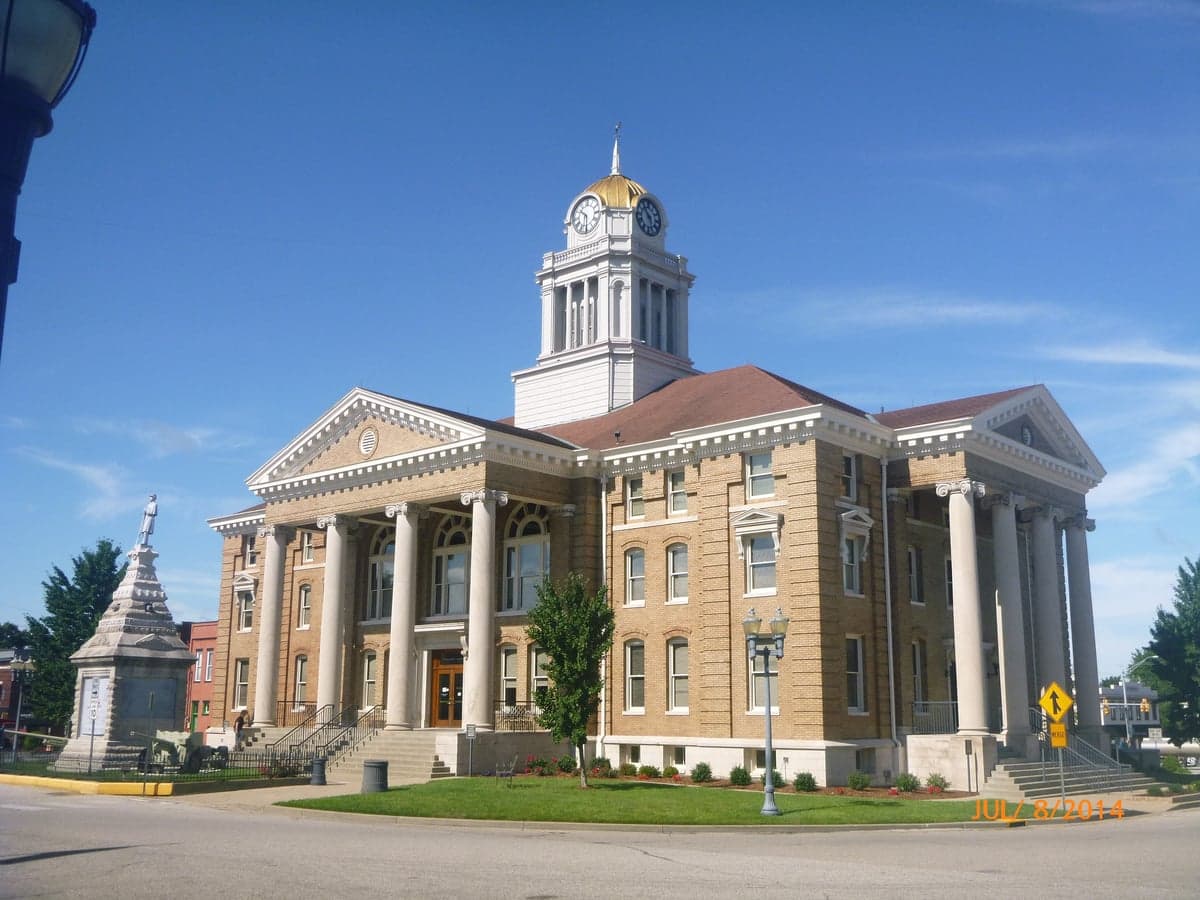
Jasper’s founding population was almost entirely German Catholic, drawn by the promise of farmland and religious freedom in the 1830s and 1840s. The first permanent settlement began in 1830 when Colonel William and his family arrived from Kentucky, but the real wave came after 1840, when German immigrants fleeing economic hardship and political unrest in Europe purchased land in the area. These early settlers built the core of what is now Historic Downtown Jasper, centered around the Dubois County Courthouse, and established St. Joseph’s Catholic Church in 1837, which became the spiritual and social anchor. The German-speaking population grew rapidly, and by the 1850s, the city’s character was firmly set: a tight-knit, Catholic, German-American community. The arrival of the Louisville, New Albany and Chicago Railway in 1854 spurred a second wave of German immigrants, who settled in the Railroad District south of downtown, working in the new rail yards and supporting industries. The woodworking industry—particularly the Jasper Desk Company (founded 1876) and later Kimball International—drew additional German and Swiss-German craftsmen, who established neighborhoods like St. Marys and St. Anthony, named after the parishes they built. By 1900, Jasper was over 95% German-born or of German descent, a homogeneity that persisted well into the 20th century.
Modern era (post-1965)
The 1965 Hart-Cellar Act had a minimal immediate impact on Jasper’s demographics, as the city’s German Catholic core remained dominant. However, the city’s manufacturing base—led by Kimball International, Jasper Engines & Transmissions, and MasterBrand Cabinets—began attracting domestic migrants from rural Indiana and Kentucky in the 1970s and 1980s. These newcomers, mostly White and Protestant, settled in the Northside neighborhoods around the new Jasper High School and the expanding industrial parks along State Road 162. The Hispanic population began to grow noticeably in the 1990s, driven by workers recruited for the woodworking and plastics industries, many from Texas and Mexico. They concentrated in the Southwest Jasper area, near the factories on 15th Street, and established small businesses and a Catholic mission that later became St. Mary’s Hispanic Ministry. The Indian-subcontinent community, though small at 1.5% of the population, is a more recent arrival, primarily professionals and engineers recruited by Kimball and Jasper Engines for engineering and IT roles since 2000. They have no single concentrated neighborhood but are scattered across the Hillside Estates and Forest Park subdivisions, reflecting their higher education levels (28.7% of Jasper adults hold a bachelor’s degree or higher). The East/Southeast Asian population remains negligible at 0.1%, and the Black population at 0.7%, both concentrated in rental units near the industrial corridors.
The future
Jasper’s population is slowly diversifying, but the pace is gradual and the city remains anchored by the German Catholic majority. The Hispanic share is projected to grow to 10-12% by 2035, driven by family reunification and continued manufacturing demand, with the Southwest Jasper corridor likely becoming a more established ethnic enclave. The Indian-subcontinent community is expected to grow modestly as professionals are recruited for specialized roles, but it will likely remain dispersed rather than forming a distinct neighborhood. The White population, while still dominant, is aging; the median age in Dubois County is 41.2, above the state average, and younger families are increasingly moving to newer subdivisions like Huntingburg Road and Northwood. The city is not tribalizing into distinct enclaves in the way larger metros are, but rather experiencing a slow, assimilation-driven diversification where newcomers are expected to adopt local norms. The German Catholic identity is softening but remains the cultural bedrock, visible in the annual Strassenfest and the continued dominance of St. Joseph’s and Holy Family parishes.
For someone moving in now, Jasper offers a stable, safe, and safe, and family-oriented community with a strong work ethic and low crime, but it is not a place of rapid demographic change or cosmopolitan diversity. The population trajectory points toward a slightly more Hispanic and professional Indian-subcontinent presence, but the city’s character will remain fundamentally German Catholic and Midwestern conservative for the foreseeable future. Newcomers who respect that heritage and integrate into its civic life—churches, schools, and local festivals—will find a welcoming, if insular, community.

* Values derived from national, state, county, city and local statistics and may differ in a specific area. Last updated: 2026-10-10T16:27:45.000Z
Narrative content on this page is AI-generated and may contain mistakes. Verify any details that matter before acting on them.
ReloMaps may earn a commission from affiliate links at no extra cost to you.

