Photo: Wikipedia
Demographics of Jeffersonville, VT
Affluence Level in Jeffersonville, VT
A below-average socioeconomic profile. Incomes, home values, and educational attainment trail the U.S., with higher poverty and unemployment.
People of Jeffersonville, VT
Jeffersonville, Vermont, is a small, tight-knit village of 729 residents that remains overwhelmingly white (91.5%) and native-born, with a foreign-born population of 0.0%. Its character is defined by a strong sense of rural New England tradition, a high college attainment rate of 46.5%, and a population that has been remarkably stable in its ethnic composition for generations. The village serves as a quiet hub for the surrounding farm and forest economy, with a population density that feels more like a crossroads than a suburb.
How the city was settled and grew
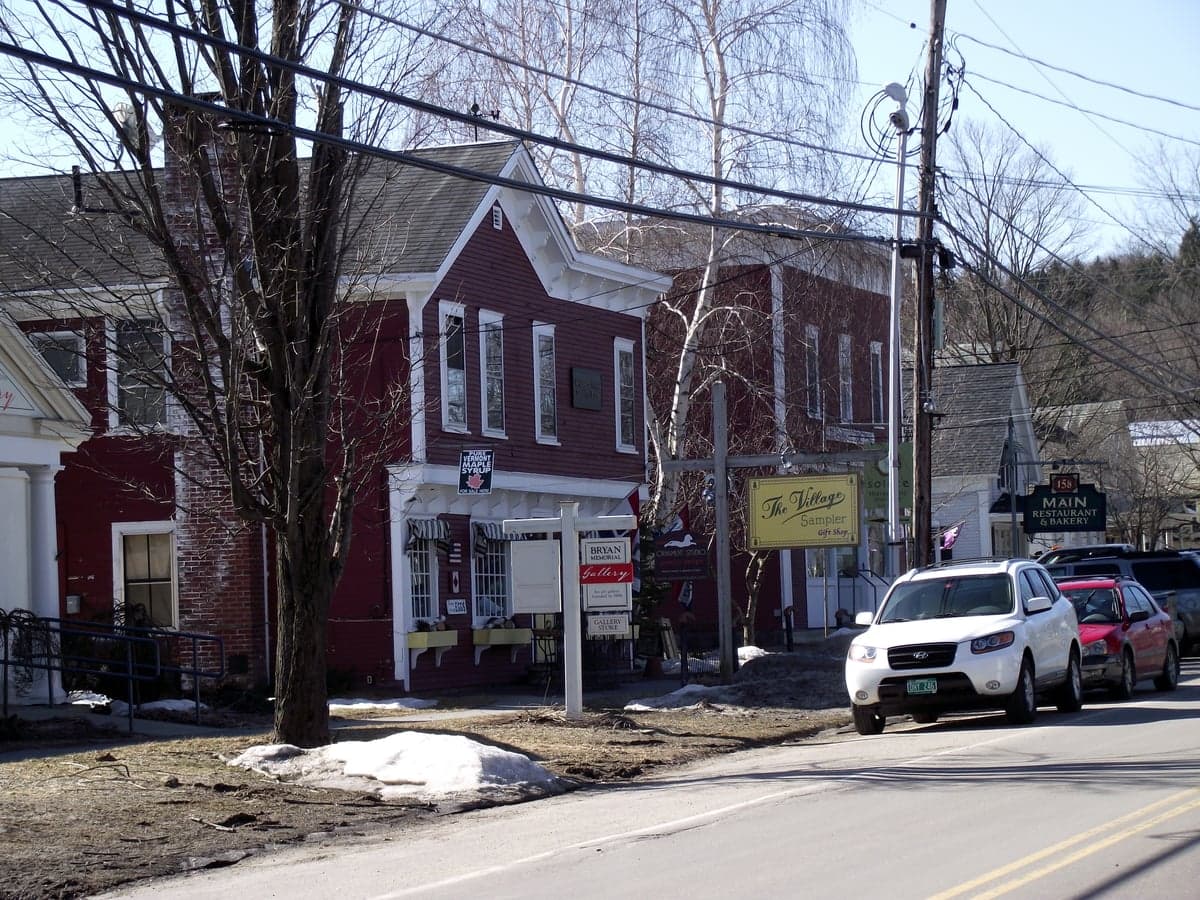
Jeffersonville’s human history begins with the Abenaki people, who used the area along the Lamoille River for seasonal fishing and hunting before European settlement. The first permanent white settlers arrived in the late 1790s, drawn by land grants from the Vermont Republic. These early families—mostly of English and Scottish descent—cleared farms and built the village around a central green. The construction of the Cambridge-Jeffersonville Bridge in the 1820s and the arrival of the Vermont Central Railroad in the 1850s spurred growth, turning the village into a milling and lumber center. The historic Village Center district, with its 19th-century clapboard homes and storefronts, was built by these Yankee settlers and their hired hands. A second wave came in the late 1800s with French-Canadian families from Quebec, who found work in the sawmills and the growing dairy industry. They settled along Main Street and the side lanes near the river, establishing a Catholic presence that remains visible today at St. John the Baptist Church. By 1900, the population had stabilized around 500, with a social fabric woven from Protestant Yankees and French-Canadian Catholics.
Modern era (post-1965)
The post-1965 period brought little demographic change to Jeffersonville. The village did not experience the large-scale immigration from Asia, Latin America, or the Indian subcontinent that reshaped many U.S. towns. Instead, domestic in-migration from other parts of Vermont and neighboring New Hampshire has been the primary driver of any population shift. The 1970s and 1980s saw a modest influx of back-to-the-land homesteaders and artists, drawn by the area’s natural beauty and low property costs. These newcomers tended to settle in the more rural outskirts, such as the Pleasant Valley area west of the village, rather than in the historic core. The racial composition has remained virtually unchanged: the 2020 census shows 91.5% white, with a tiny Black population of 0.7% and a Hispanic share of 0.5%. The 0.0% foreign-born figure underscores that Jeffersonville has not been a destination for international migration. The village’s character is thus one of deep generational continuity, with many current residents tracing their roots to the original Yankee and French-Canadian families. The Maple Street neighborhood, with its mix of older farmhouses and newer single-family homes, exemplifies this stability, housing families who have been in the area for three or four generations.
The future
Jeffersonville’s population is likely to remain small and demographically stable over the next 10–20 years. The village is not experiencing the rapid growth seen in Vermont’s Chittenden County suburbs; instead, it is slowly aging, with a median age that has crept upward. There is no evidence of significant new immigrant communities forming, and the 0.0% foreign-born rate suggests that international migration will not be a factor. The primary demographic trend is out-migration of young adults seeking jobs and education in Burlington or beyond, balanced by in-migration of retirees and remote workers drawn to the area’s quiet and affordability. The River Road corridor, running south along the Lamoille, has seen a few new subdivisions of single-family homes, but these are overwhelmingly occupied by white, native-born families. The village is not tribalizing into distinct ethnic enclaves; rather, it is homogenizing into an older, more settled population. The small Hispanic and Black populations are likely to remain tiny fractions, as there are no economic or social pull factors for larger communities.
For someone moving in now, Jeffersonville offers a stable, predictable community with deep roots and little demographic churn. It is a place where neighbors know each other’s families and where the pace of change is slow. The high college education rate suggests a literate, engaged population, but the lack of diversity means newcomers from different backgrounds may find limited social infrastructure. The village is becoming a quiet haven for those seeking a traditional New England small-town life, with the understanding that its future will look much like its past.

* Values derived from national, state, county, city and local statistics and may differ in a specific area. Last updated: 2026-04-19T23:59:48.000Z
Narrative content on this page is AI-generated and may contain mistakes. Verify any details that matter before acting on them.
ReloMaps may earn a commission from affiliate links at no extra cost to you.

