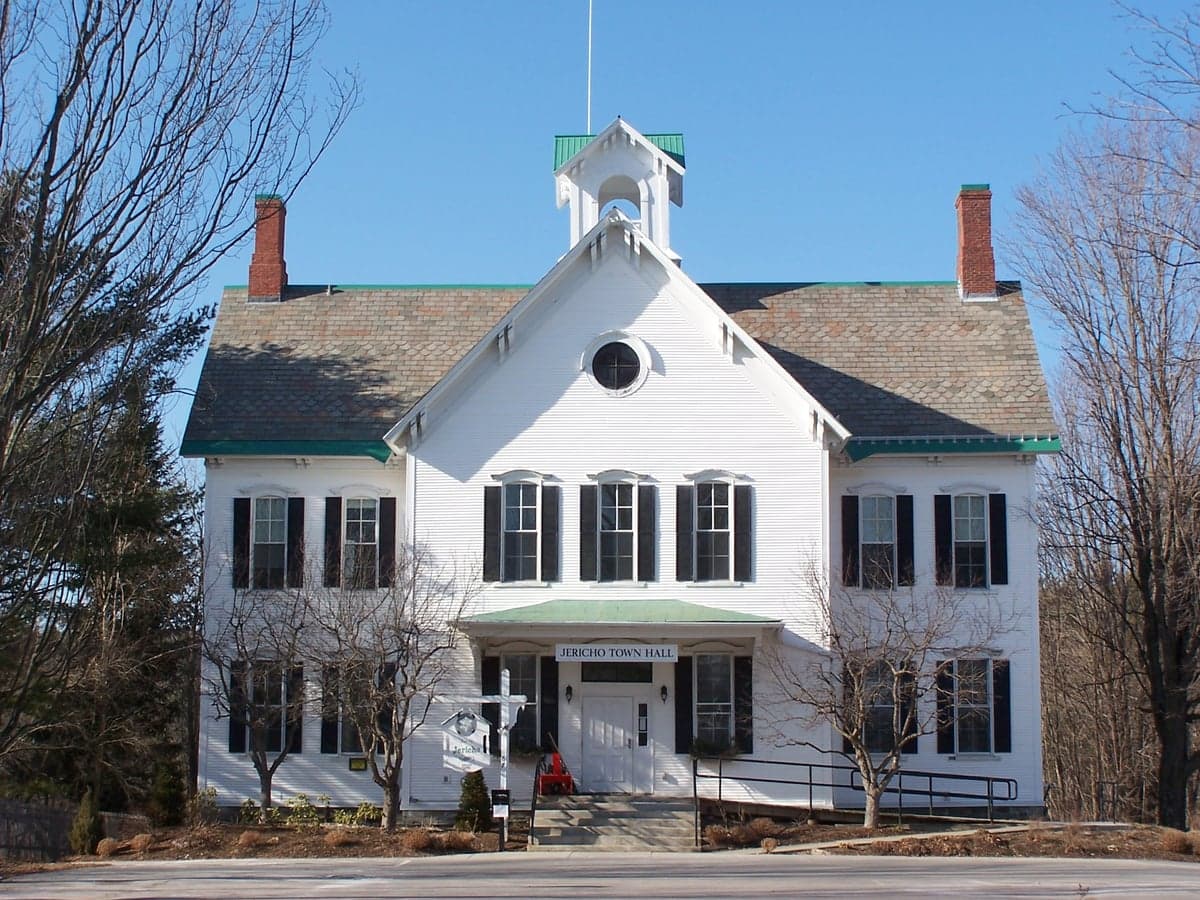
Photo: Wikipedia
Demographics of Jericho, VT
Affluence Level in Jericho, VT
An upper-middle-class area. Household wealth, education levels, and homeownership run ahead of national benchmarks.
People of Jericho, VT
Jericho, Vermont, is a small, tight-knit town of 1,230 residents that remains overwhelmingly white (85.4%) and highly educated (71.2% college-educated), with a foreign-born population of just 0.9%. Its people are defined by a strong sense of place rooted in agrarian history, a quiet independence, and a community identity that has changed little in its ethnic composition over generations. The town’s character is distinctly rural and family-oriented, with a population that values privacy, local governance, and the preservation of its historic landscape.
How the city was settled and grew
Jericho’s human history begins with the original inhabitants, the Abenaki people, who used the area along the Browns River for seasonal fishing and hunting. European settlement began in the 1760s, when the New Hampshire Grants drew families from southern New England and eastern New York. The town was chartered in 1763 and named after the biblical city, reflecting the settlers’ religious convictions. The first permanent white settlers, primarily of English and Scottish descent, arrived in the 1770s, clearing land for subsistence farming and building the town’s earliest homes along what is now Jericho Center, the historic village green. The construction of mills along the Browns River—gristmills, sawmills, and later woolen mills—drew a second wave of settlers in the early 1800s, including a small number of Irish laborers who worked on the mills and the railroad. These Irish families settled in the Lower Village area, near the mills and the river, forming a distinct working-class enclave. By the mid-19th century, Jericho’s population peaked at around 1,500, then declined as the mills closed and young people moved to Burlington or out of state for industrial jobs. The town remained a quiet farming community through the early 1900s, with little new in-migration.
Modern era (post-1965)
The post-1965 era brought no significant ethnic diversification to Jericho. The town’s population grew slowly, from about 800 in 1970 to 1,230 today, driven almost entirely by domestic in-migration of white families from other parts of Vermont and the Northeast. The 1965 Hart-Cellar Act, which opened immigration from Asia and Latin America, had virtually no effect on Jericho’s demographics. The small Black population (2.1%) and Hispanic population (0.7%) are recent arrivals, likely professionals or families drawn by the area’s schools and rural lifestyle, but they remain a tiny fraction of the total. The most notable modern wave was the suburbanization of the 1970s and 1980s, when families from Burlington and Chittenden County moved to Jericho for larger lots and lower taxes. These newcomers built homes in the Jericho Corners area, near the intersection of Route 15 and Route 117, and in the Browns River Estates subdivision, a planned development of single-family homes. The town’s college-educated share (71.2%) reflects this influx of professionals, many of whom commute to Burlington or work remotely. The Asian population (East/Southeast Asian) is recorded at 0.0%, and the Indian-subcontinent population is also 0.0%, underscoring the town’s lack of diversity from these groups. The foreign-born population (0.9%) is negligible, consisting of a handful of individuals from Europe or Canada.
The future
Jericho’s population is likely to remain stable and homogeneous over the next 10–20 years. The town has no major employer or development project that would attract significant new immigration, and its housing stock—mostly single-family homes on large lots—is expensive by Vermont standards, limiting affordability for lower-income or immigrant families. The small Black and Hispanic populations may grow slightly as remote work continues to draw professionals from more diverse areas, but they will likely remain a very small minority. The town is not tribalizing into distinct ethnic enclaves; rather, it is homogenizing further as older farming families sell land to newcomers who share similar socioeconomic and cultural backgrounds. The college-educated share may rise even higher as the town attracts more remote workers and retirees. For a conservative-leaning audience, Jericho represents a place where traditional community values, low crime, and a stable demographic profile are likely to persist. Someone moving in now should expect a town that is welcoming to individuals and families who value privacy, self-reliance, and a slow pace of life, but not one that offers ethnic or cultural diversity.
Jericho is becoming a quiet, well-educated, and overwhelmingly white bedroom community for Burlington and the surrounding region. For a relocation-minded individual or parent seeking a safe, rural environment with strong schools and a predictable social fabric, the town offers exactly that—but with the understanding that its population is unlikely to change significantly in the foreseeable future.

* Values derived from national, state, county, city and local statistics and may differ in a specific area. Last updated: 2026-04-30T13:12:10.000Z
Narrative content on this page is AI-generated and may contain mistakes. Verify any details that matter before acting on them.
ReloMaps may earn a commission from affiliate links at no extra cost to you.

