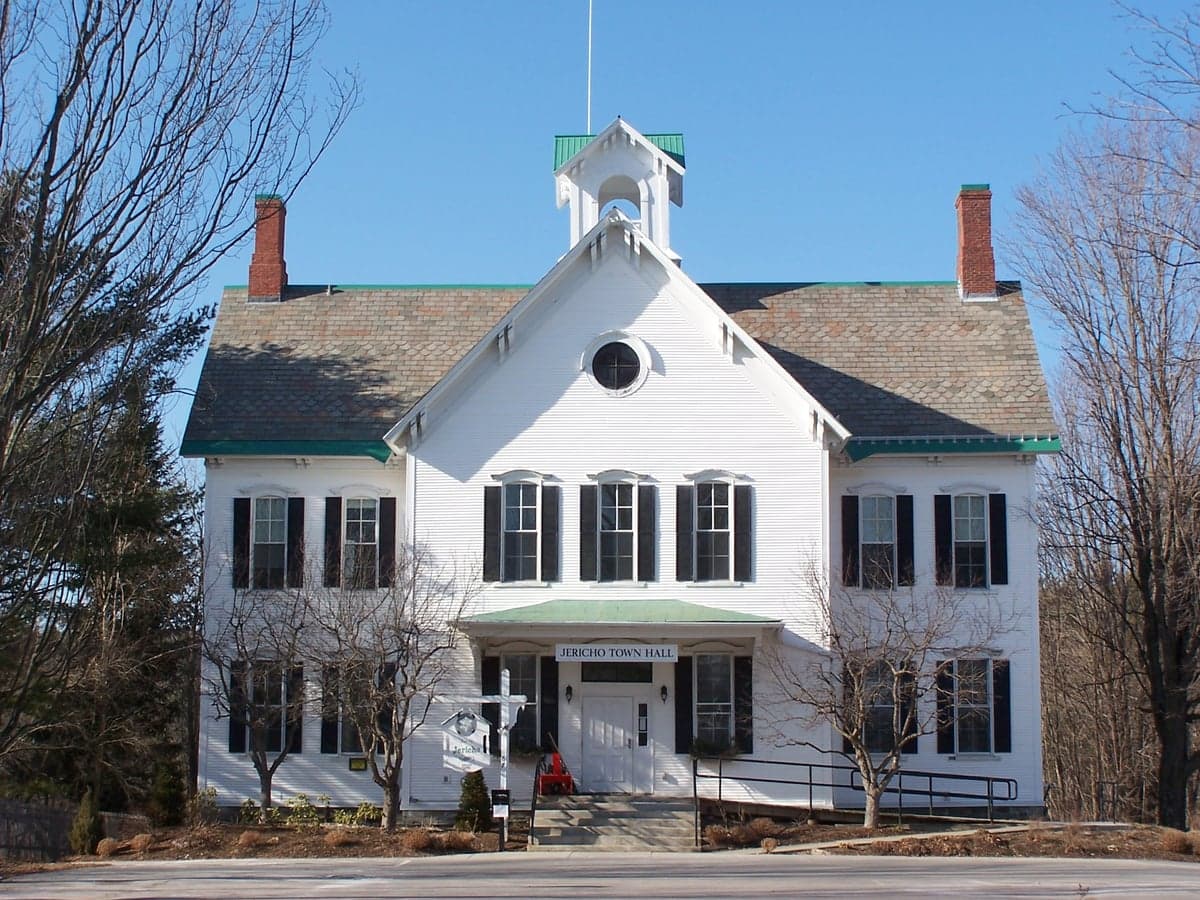
Photo: Wikipedia
Personal Sovereignty in Jericho, VT
Moderate friction. Expect trade-offs in some aspect of personal liberty and independence.
What does Personal Sovereignty tell us?
Personal Sovereignty measures your capacity for self-reliance and independence with minimal government friction. Higher scores mean fewer barriers between you and the way you want to live... but it assumes you have the space you need and good neighbors.
What does this tell us?
Personal Sovereignty measures your capacity for self-reliance and independence with minimal government friction. Higher scores mean fewer barriers between you and the way you want to live... but it assumes you have the space you need and good neighbors.
State Policy
Energy independence: Importer (15% of energy produced in-state)
Personal Liberty
Homesteading

Personal Liberty Analysis
Jericho, Vermont, offers a nuanced personal sovereignty environment that appeals to those seeking a balance between rural self-reliance and the practical realities of living in a state with a strong regulatory tradition. While Vermont is not a libertarian paradise, Jericho’s small-town character, low population density, and distance from the state capital in Montpelier create a buffer against the most intrusive aspects of government overreach. For the conservative-leaning individual or family concerned with preserving autonomy, Jericho represents a place where you can carve out a significant degree of personal freedom, provided you are willing to navigate the state’s tax and regulatory landscape with eyes wide open.
Tax burden and regulatory posture: what you pay and what you can do
Vermont’s tax burden is among the highest in the nation, and Jericho residents feel this directly. The state levies a progressive income tax with rates from 3.35% to 8.75%, and property taxes are notably high, driven largely by school funding. In Jericho, the combined property tax rate (municipal and education) typically hovers around $2.00 to $2.50 per $100 of assessed value, meaning a $300,000 home carries an annual tax bill of $6,000 to $7,500. This is a significant cost of sovereignty, as it funds a state apparatus that is not shy about regulation. Vermont’s regulatory posture is generally pro-environment and pro-safety, which translates to strict Act 250 land-use laws, building codes, and energy efficiency mandates. For the prepper or homesteader, this means you cannot simply do whatever you want on your land without permits, especially if you plan to build new structures or alter the landscape. However, Jericho’s town government is more pragmatic than the state’s, and many residents find that once you are established, local officials are less likely to interfere with day-to-day activities as long as you are not creating nuisances. The key takeaway: you pay a premium for the privilege of living here, but the trade-off is a community that largely minds its own business.
Self-defense and gun law specifics: what you can keep and carry
Vermont has a mixed record on gun rights. On the positive side, it is a constitutional carry state, meaning no permit is required to carry a concealed firearm for anyone legally allowed to possess one. This is a bedrock of personal sovereignty for the survivalist mindset. However, the state has enacted several restrictions in recent years that are worth noting. In 2018, Vermont passed a red flag law (Extreme Risk Protection Order) allowing law enforcement to seize firearms from individuals deemed a risk to themselves or others, based on a court order. Additionally, the state now requires background checks on all firearm sales, including private transactions, and bans magazines capable of holding more than 10 rounds (for long guns) and 15 rounds (for handguns). There is also a ban on bump stocks. For the prepper, this means your standard AR-15 with a 30-round magazine is illegal to purchase or possess unless it was grandfathered in before the ban took effect. Jericho itself is a rural town with a strong hunting culture, and local law enforcement is generally not aggressive in enforcing these laws against law-abiding citizens. But the legal landscape is clear: Vermont is not a gun-rights stronghold like Texas or Montana. If you value unrestricted access to standard-capacity magazines and no red flag laws, this is a point of concern. For most practical self-defense and hunting needs, however, the laws are manageable, and the constitutional carry provision is a major plus.
Self-reliance and homesteading viability: lot sizes, zoning, and off-grid feasibility
Jericho is a prime location for those seeking self-reliance, but with caveats. Minimum lot sizes in the town’s rural areas are typically 2 to 5 acres, which is sufficient for a substantial garden, small orchard, and a few livestock animals like chickens or goats. Zoning is generally permissive for agricultural uses, but you will need to check with the town’s development review board for any commercial-scale operations or major structures. Off-grid living is legally possible but not straightforward. Vermont requires that all dwellings have a potable water supply and a wastewater system that meets state standards, which usually means a drilled well and a septic system. Solar panels are allowed, but net metering regulations and building codes can complicate a fully off-grid setup. For example, you may be required to have a backup generator or a connection to the grid if you are building a new home, depending on the town’s interpretation of the building code. The good news is that Jericho has a strong DIY culture, and many residents heat with wood, grow their own food, and maintain deep freezers stocked with local game. The town’s general store and local farms provide a support network for those who want to reduce dependence on national supply chains. For the prepper, the ability to store water, fuel, and food is largely unregulated, and the rural character of the area means neighbors are unlikely to report you for having a well-stocked bunker or a large garden. Just be prepared for the upfront costs and bureaucratic hurdles of establishing a truly self-sufficient property.
Personal liberties: parental rights, medical autonomy, speech, and property
This is where Jericho and Vermont present the most significant challenges for the conservative-leaning individual. On parental rights, Vermont has some of the most progressive laws in the country. The state mandates that public schools teach comprehensive sex education, including LGBTQ+ topics, and there is no opt-out for parents who object to specific content. Additionally, Vermont has a universal school choice program that allows students to attend any public school in the state, but homeschooling is regulated: parents must submit an enrollment notice and provide annual assessments. For those concerned about medical autonomy, Vermont was an early adopter of vaccine mandates for school attendance, and during the COVID-19 pandemic, the state imposed some of the strictest and longest-lasting emergency orders in the nation, including mask mandates and business closures. This history is a red flag for those who prioritize medical freedom. On free speech, Vermont generally protects political expression, but the state’s social climate can be hostile to conservative viewpoints, especially in more populated areas. Jericho, being more rural, is more tolerant, but you will still encounter a strong progressive majority in local governance. Property rights are relatively strong, but Act 250 and local zoning can limit what you can do with your land, especially if you plan to subdivide or develop. The bottom line: if you value absolute parental control over education and medical decisions, Vermont’s laws will feel restrictive. However, the town’s small size and community bonds mean that many parents successfully navigate these systems by being involved and vocal.
In the broader context of the United States, Jericho offers a moderate level of personal sovereignty that is best suited for those who prioritize rural living, self-reliance, and a tight-knit community over absolute legal freedom. Compared to states like New Hampshire or Idaho, Vermont’s tax burden and regulatory environment are heavier, and its stance on parental rights and medical autonomy is more restrictive. However, compared to the Northeast corridor or the West Coast, Jericho feels like a bastion of independence. For the survivalist or prepper, the key is to leverage the town’s rural character and DIY culture while accepting that you will need to work within a state system that is not always aligned with your values. If you can afford the taxes and navigate the regulations, Jericho provides a solid foundation for a self-determined life, but it is not a place for those who want to operate entirely outside the system. It is a compromise, but for many, it is a worthwhile one.

* Values derived from national, state, county, city and local statistics and may differ in a specific area. Last updated: 2026-04-30T13:12:10.000Z
Narrative content on this page is AI-generated and may contain mistakes. Verify any details that matter before acting on them.
ReloMaps may earn a commission from affiliate links at no extra cost to you.

