Demographics of Jupiter Inlet Colony, FL
Affluence Level in Jupiter Inlet Colony, FL
An elite concentration of wealth — high incomes, strong home values, advanced degrees, and minimal poverty signal a top-tier socioeconomic profile.
People of Jupiter Inlet Colony, FL
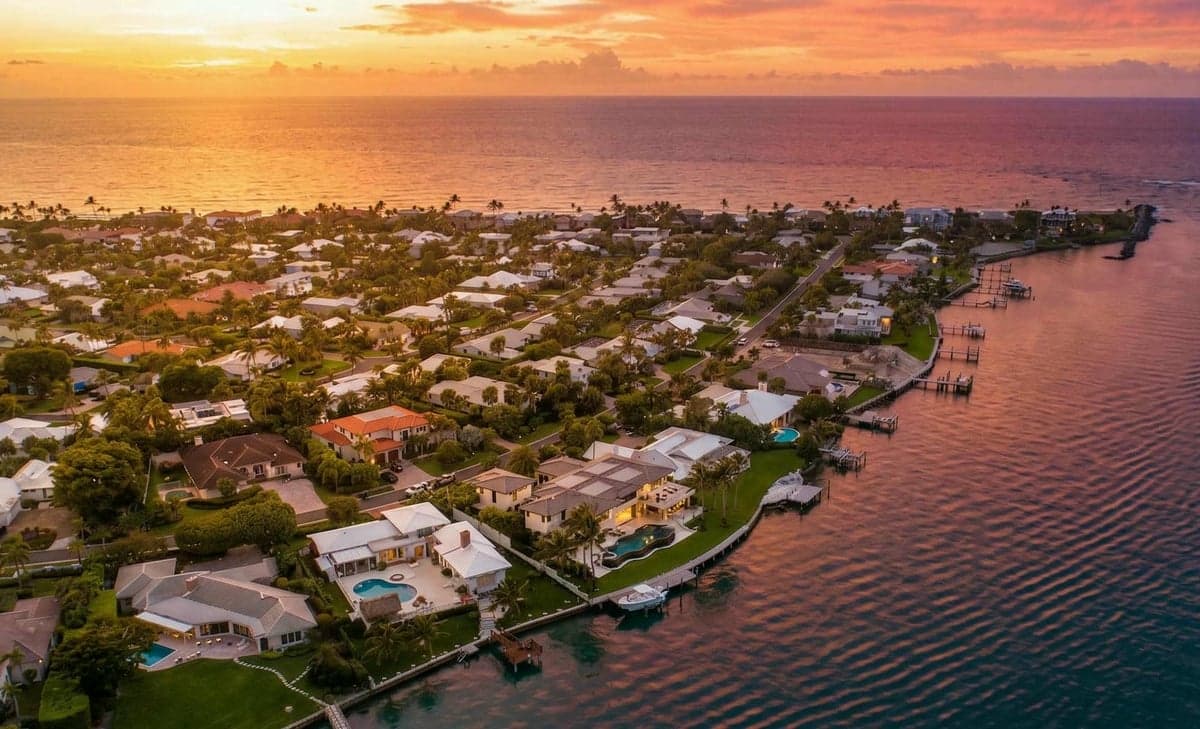
Jupiter Inlet Colony is a tiny, tightly-knit coastal enclave of 486 residents, overwhelmingly white (96.9%) and highly educated (74.1% college graduates), with virtually no foreign-born population (0.8%). Its character is that of an exclusive, low-density residential community defined by waterfront estates, strict zoning, and a deliberate small-town atmosphere. The population is older, affluent, and stable, with little demographic turnover or new construction altering its makeup.
How the city was settled and grew
Jupiter Inlet Colony was not settled in waves of immigrants or industrial expansion; it was a planned, post-World War II residential development carved from coastal scrubland. The town was incorporated in 1959 as a separate municipality from Jupiter, designed explicitly as a quiet, upscale residential retreat for wealthy retirees and second-home owners. The original settlers were predominantly white, upper-middle-class families from the Northeast and Midwest, drawn by the promise of direct ocean and inlet access, privacy, and low taxes. The first homes clustered along Beach Road and Inlet Road, where original mid-century ranch-style houses still stand. No historic colonial settlement or agricultural community preceded this development; the area was largely uninhabited before the 1950s. The town’s founding families—many of whom still own property—established a pattern of exclusivity that persists today, with no commercial zoning, no schools, and no public facilities beyond a small park.
Modern era (post-1965)
After the 1965 Hart-Cellar Act, Jupiter Inlet Colony saw virtually no influx of foreign-born residents; its foreign-born share remains below 1%. Instead, domestic in-migration from other parts of Florida and the U.S. continued, but at a very slow pace due to the town’s built-out nature and strict building codes. The population has hovered near 500 for decades. The Ocean Drive corridor and Colony Drive area saw infill construction of larger, custom homes in the 1980s and 1990s, attracting a slightly younger cohort of professionals and corporate executives. Hispanic residents (2.9%) and East/Southeast Asian residents (0.2%) are present in negligible numbers, concentrated in a handful of newer homes along Inlet Road. The Black population remains at 0.0%, and Indian-subcontinent residents are absent. The town has not diversified racially or ethnically; it remains a nearly monochrome, high-income enclave. The lack of rental housing, multi-family units, and commercial development has effectively filtered out all but the wealthiest buyers.
The future
Jupiter Inlet Colony’s population is aging and static. With no vacant land for new subdivisions and strict height and density limits, the town cannot absorb significant new residents. The next 10–20 years will likely see a slow turnover of existing homes as older owners sell to similarly affluent buyers, many from out of state. The town is homogenizing further, not tribalizing into distinct enclaves—there are no ethnic or immigrant neighborhoods to speak of. The tiny Hispanic and Asian populations are likely to remain stable or decline as home prices rise. The median home value exceeds $1.5 million, effectively locking out younger families and middle-income households. The only demographic shift may be a slight increase in seasonal residents, as more homes are purchased as second or third properties by out-of-state buyers.
For someone moving in now, Jupiter Inlet Colony offers a predictable, exclusive, and demographically uniform environment. It is a place for those seeking privacy, water access, and a like-minded, high-net-worth community—not for those looking for diversity, urban amenities, or a growing population. The town’s future is one of careful preservation, not transformation.

* Values derived from national, state, county, city and local statistics and may differ in a specific area. Last updated: 2026-05-14T02:28:04.000Z
Narrative content on this page is AI-generated and may contain mistakes. Verify any details that matter before acting on them.
ReloMaps may earn a commission from affiliate links at no extra cost to you.

