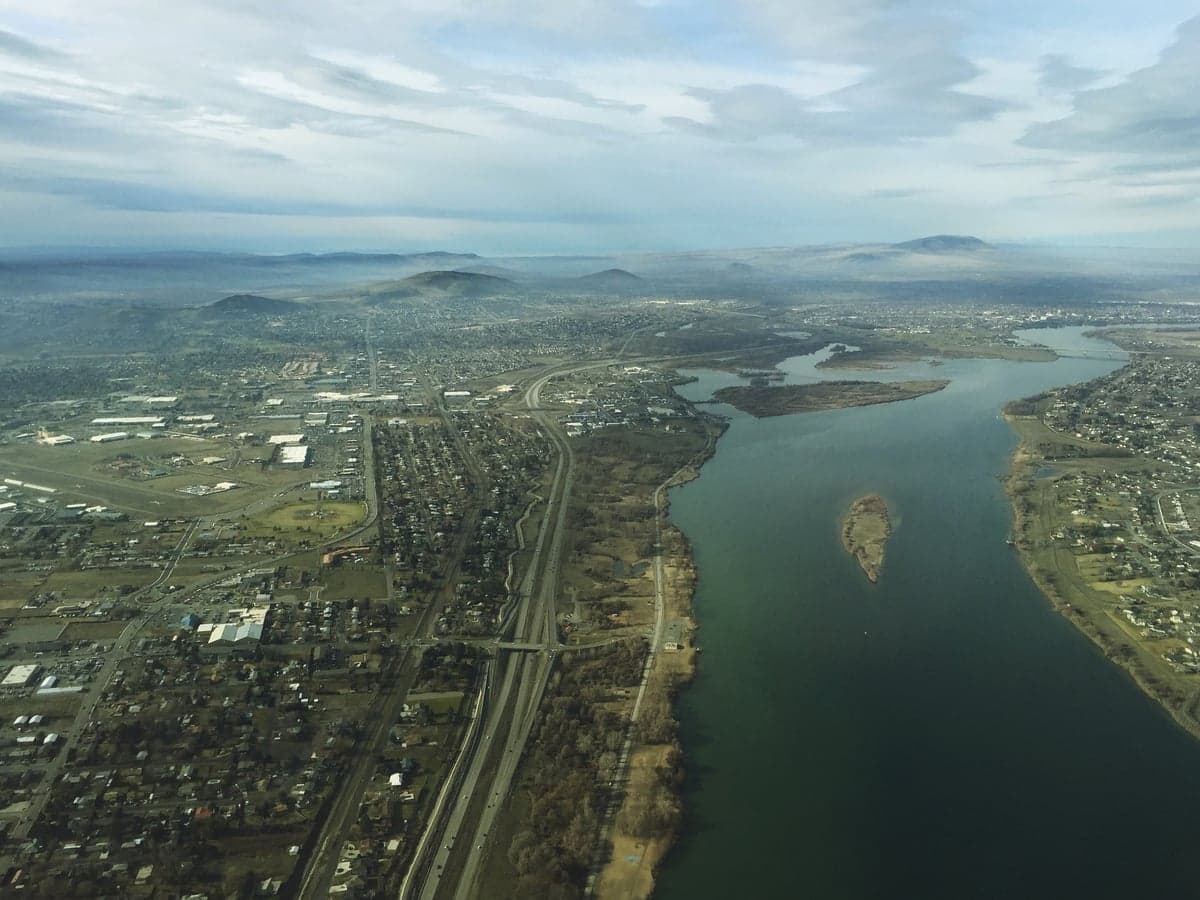
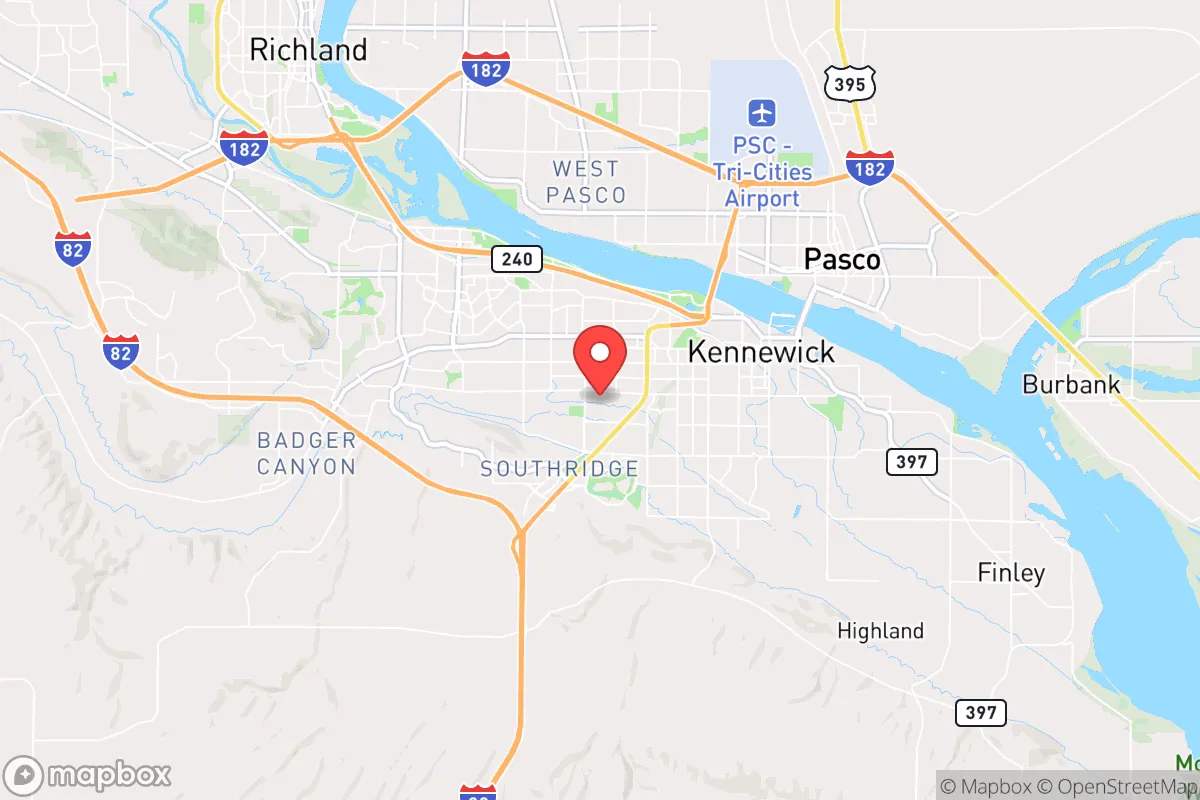
Photo: Wikipedia
Demographics of Kennewick, WA
Affluence Level in Kennewick, WA
A middle-class area roughly in line with national averages across income, home values, education, and employment.
People of Kennewick, WA
The people of Kennewick, Washington today number 84,389, forming a dense, family-oriented city that is notably more Hispanic and less white than the surrounding Tri-Cities region. With a foreign-born population of 8.5% and a population that is 59.6% white and 31.8% Hispanic, Kennewick has a working-class, blue-collar character, with only 26.9% of adults holding a college degree. Its identity is shaped by a history of agricultural labor, Hanford-era migration, and a recent surge in Hispanic families, making it the most ethnically diverse and fastest-growing of the three Tri-Cities.
How the city was settled and grew
Kennewick was formally founded in 1892 as a railroad town on the Columbia River, but its population remained sparse until the early 20th century. The first major wave of settlers were white homesteaders and farmers drawn by irrigation projects that turned the arid landscape into productive orchards and vineyards. By the 1910s, a small but significant community of Japanese immigrants had arrived to work in the railroad and agricultural sectors, settling in what is now the East Kennewick area near the railroad tracks. The city’s population exploded during World War II with the construction of the Hanford nuclear site, which brought thousands of white engineers, construction workers, and military personnel from across the country. These workers and their families settled in the Vista Field and Southridge neighborhoods, which were developed as planned subdivisions to house the influx. The post-war boom cemented Kennewick as a predominantly white, middle-class city, with agriculture and Hanford as the twin economic pillars.
Modern era (post-1965)
The 1965 Immigration and Nationality Act opened the door for a new wave of Hispanic migration, primarily from Mexico, to fill labor shortages in the region’s orchards and packing plants. These families initially concentrated in the East Kennewick and Downtown neighborhoods, where older, more affordable housing stock and proximity to agricultural jobs created a Hispanic enclave. By the 1990s, the Hispanic share of Kennewick’s population had risen sharply, and the community began to spread into the Desert Vista area as families moved into newer subdivisions. Domestic in-migration during this period was largely from other Western states, drawn by the region’s relatively low cost of living and Hanford-related employment. The Asian population, at 1.5% East/Southeast Asian and 0.4% Indian, remains small and is concentrated in the Southridge neighborhood, near the hospital and tech-adjacent jobs. The Black population, at 2.0%, is dispersed but has a slight presence in the West Kennewick area. The city’s white population, while still the majority, has declined from over 80% in 1990 to 59.6% today, as Hispanic families have grown through both immigration and higher birth rates.
The future
Kennewick’s population is heading toward a majority-minority status, likely within the next 15–20 years, driven by the continued growth of the Hispanic community. The city is not homogenizing but rather tribalizing into distinct enclaves: East Kennewick and Downtown remain heavily Hispanic, while Southridge and Vista Field are predominantly white and more affluent. The Hispanic population is growing through both immigration and natural increase, while the white population is aging and seeing slower growth. The Asian and Indian communities are small and plateauing, as the region lacks the professional job base to attract significant new arrivals from those groups. The next decade will likely see Kennewick become a majority-Hispanic city, with the white population falling below 50% by 2040. This shift is already visible in the city’s schools, where Hispanic students are now the largest ethnic group.
For someone moving in now, Kennewick is becoming a younger, more Hispanic, and more working-class city than its Tri-Cities neighbors, Richland and Pasco. The city offers affordable housing and a strong sense of community in its established neighborhoods, but the demographic transition means that newcomers should expect a city where Spanish is increasingly common in public life and where the cultural center of gravity is shifting away from its white, Hanford-era roots. This is a city in the middle of a rapid ethnic transformation, and the character of its neighborhoods will continue to evolve accordingly.

* Values derived from national, state, county, city and local statistics and may differ in a specific area. Last updated: 2026-04-21T17:23:29.000Z
Narrative content on this page is AI-generated and may contain mistakes. Verify any details that matter before acting on them.
ReloMaps may earn a commission from affiliate links at no extra cost to you.

