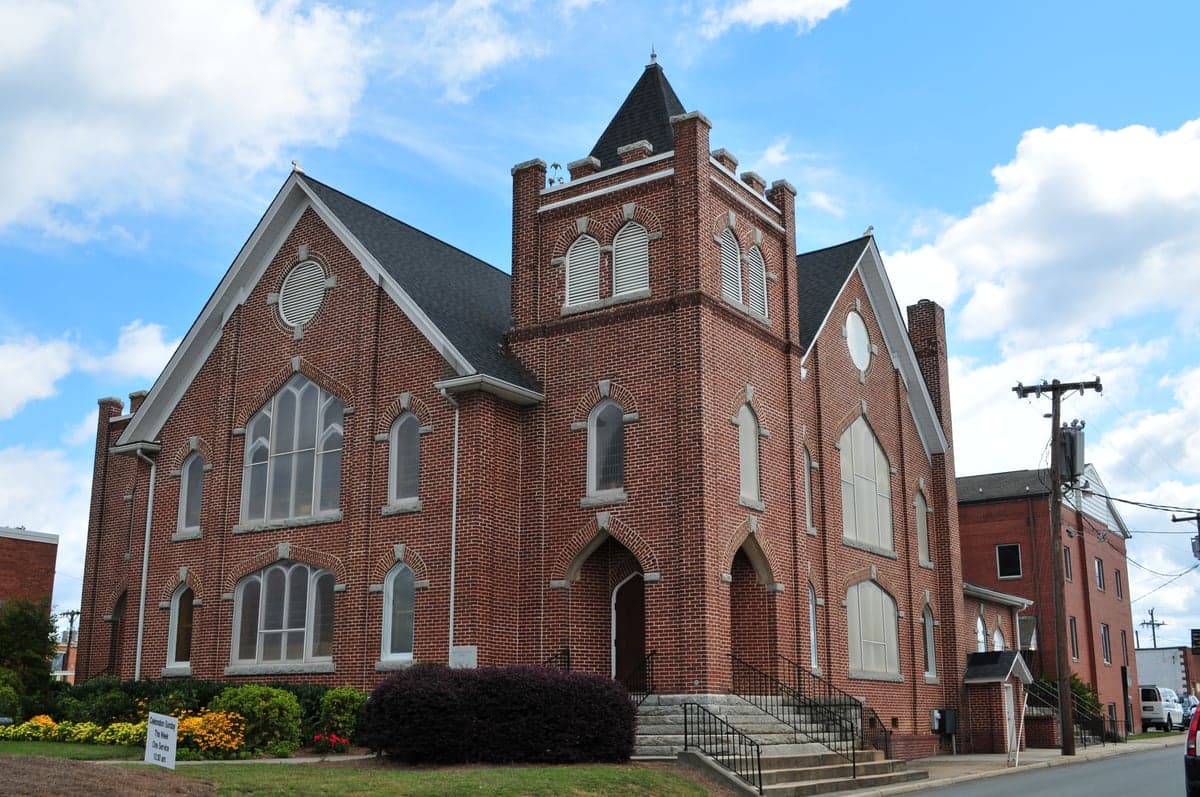
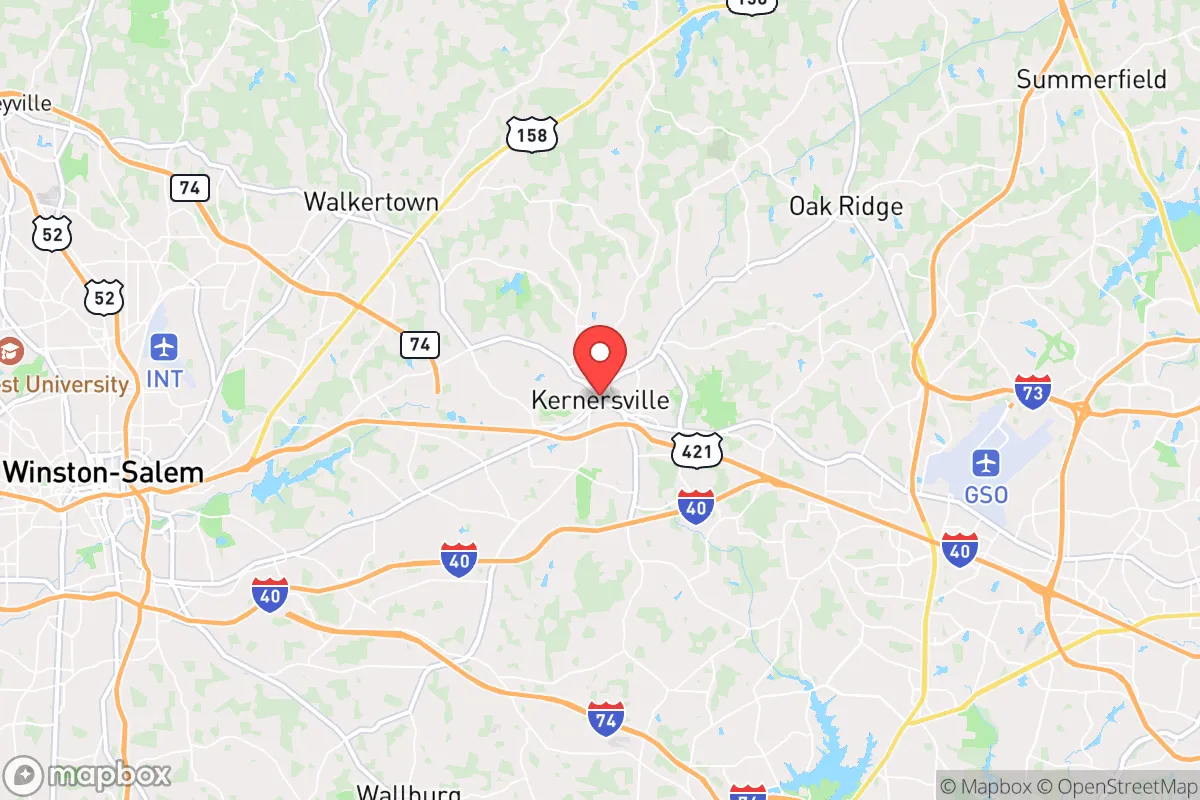
Photo: Wikipedia
Demographics of Kernersville, NC
Affluence Level in Kernersville, NC
A middle-class area roughly in line with national averages across income, home values, education, and employment.
People of Kernersville, NC
The people of Kernersville, NC today number 27,439, forming a community that is 67.0% White, 17.1% Black, 11.1% Hispanic, and 1.8% East/Southeast Asian, with a small Indian-subcontinent population of 0.3% and a foreign-born share of just 3.8%. This is a predominantly native-born, family-oriented Piedmont Triad suburb where 36.2% of adults hold a college degree, and the population identity is shaped more by its role as a bedroom community for Winston-Salem and Greensboro than by any single ethnic or historical narrative. The city’s character is quietly middle-class, with a noticeable military and manufacturing heritage, and its neighborhoods reflect distinct settlement waves rather than a single melting pot.
How the city was settled and grew
Kernersville’s human history begins not with colonial-era land grants but with a single crossroads tavern. The area was originally part of the Saura and Keyauwee hunting grounds, but European settlement accelerated after the 1750s when German and Scots-Irish farmers moved south along the Great Wagon Road. The town itself was formally founded in 1817 by Joseph Kerner, a German-descended tavern keeper, at the intersection of the Bethania-to-Salem and the Salisbury-to-Guilford roads. The original population cluster formed around Main Street and the present-day downtown, where Kerner’s tavern served travelers and local farmers. Through the 19th century, the population remained small and overwhelmingly White, with a handful of free Black families working as laborers. The arrival of the North Carolina Railroad in the 1850s brought a modest wave of Irish and German railroad workers, who settled in what is now the Old Town district, near the tracks. By 1900, Kernersville had roughly 500 residents, almost entirely native-born White Protestants, with a small Black community concentrated in the Piney Grove area south of the railroad. The early 20th century saw slow growth tied to tobacco farming and textile mills; the Harmony Grove neighborhood, originally a mill village, housed many of the White mill workers who arrived from rural Stokes and Forsyth counties between 1910 and 1940.
Modern era (post-1965)
The post-1965 era transformed Kernersville from a rural crossroads into a suburban bedroom community. The 1965 Hart-Cellar Act had minimal direct effect here—the foreign-born population remains only 3.8%—but the interstate highway system was decisive. The completion of I-40 in the 1970s and the later construction of the Winston-Salem Northern Beltway made Kernersville a commuter hub. Domestic in-migration surged after 1980, driven by White families leaving Winston-Salem and Greensboro for newer, larger homes on larger lots. The Kernersville Crossing subdivision, developed in the 1990s, became the primary landing zone for these relocating families, many of whom were college-educated professionals working at Wake Forest Baptist Medical Center or the Greensboro-Randolph Megasite. Black families, who had historically lived in the Piney Grove and Reynolds Park areas, began moving into subdivisions like Brookstone and Hunter’s Ridge during the 2000s, reflecting a broader suburbanization of the Black middle class. The Hispanic population, which now stands at 11.1%, grew rapidly after 2000, driven by construction and service-sector jobs. Most Hispanic residents settled in the South Main Street corridor and the Piney Grove area, where lower housing costs and proximity to landscaping and warehouse jobs created a natural concentration. The East/Southeast Asian population (1.8%) is small but visible, with families primarily in the Kernersville Crossing and Brookstone subdivisions, many employed in engineering and healthcare. The Indian-subcontinent population (0.3%) is negligible, with no distinct neighborhood concentration.
The future
The population of Kernersville is heading toward modest diversification, but the pace is slow. The White share has declined from roughly 80% in 2000 to 67.0% today, while the Hispanic share has grown from under 5% to 11.1%. The Black share has remained stable at 17-18% since 2010, suggesting that Black in-migration is roughly matching out-migration. The foreign-born share, at 3.8%, is well below the national average of 13.7%, indicating that Kernersville is not a primary destination for new immigrants. The next 10-20 years will likely see the Hispanic share continue to rise, possibly to 15-18%, as second-generation families remain in the area and new arrivals are drawn by construction and logistics jobs tied to the Triad’s warehouse boom. The East/Southeast Asian share may grow modestly as the nearby Greensboro-Randolph Megasite attracts Toyota and semiconductor-related suppliers, but the Indian-subcontinent population is unlikely to exceed 1% without a major corporate relocation. The city is not tribalizing into distinct ethnic enclaves; rather, it is slowly homogenizing into a lower-density, car-dependent suburb where income and housing type matter more than ethnicity. For a conservative-leaning family moving in now, Kernersville offers a stable, majority-White, family-oriented environment with a growing Hispanic minority and a small but established Black middle class—a place where demographic change is gradual enough to avoid the friction seen in faster-growing Sun Belt suburbs.
Kernersville is becoming a quieter, more suburban version of its former self—less a distinct town and more a residential node within the Piedmont Triad. For someone moving in now, the key takeaway is that this is a place where the population is stable, native-born, and politically moderate-to-conservative, with a slow but steady Hispanic influx and no signs of rapid ethnic turnover. The neighborhoods that matter most—Kernersville Crossing for newer families, Piney Grove for long-standing Black and Hispanic communities, and Old Town for historic character—offer distinct choices within a single, unpretentious city.

* Values derived from national, state, county, city and local statistics and may differ in a specific area. Last updated: 2026-05-03T20:26:06.000Z
Narrative content on this page is AI-generated and may contain mistakes. Verify any details that matter before acting on them.
ReloMaps may earn a commission from affiliate links at no extra cost to you.

