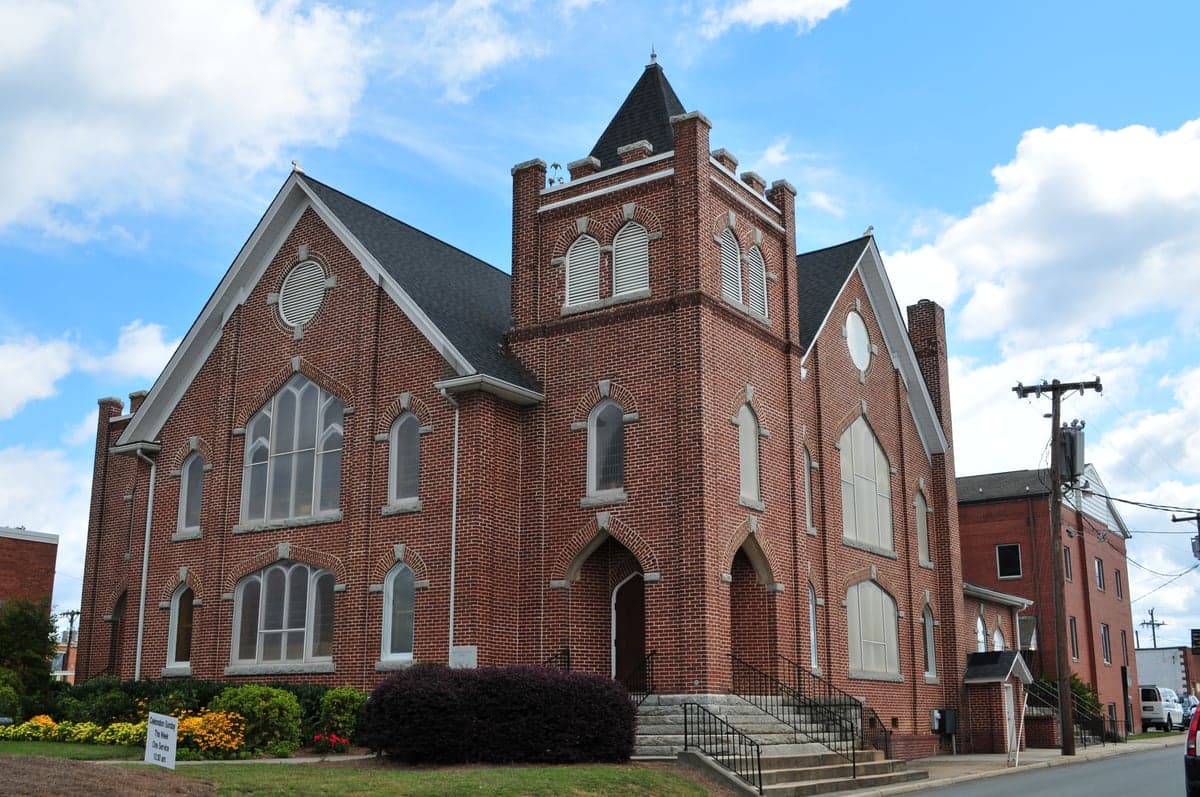
Photo: Wikipedia
Political ClimatePolitical Climate in Kernersville, NC
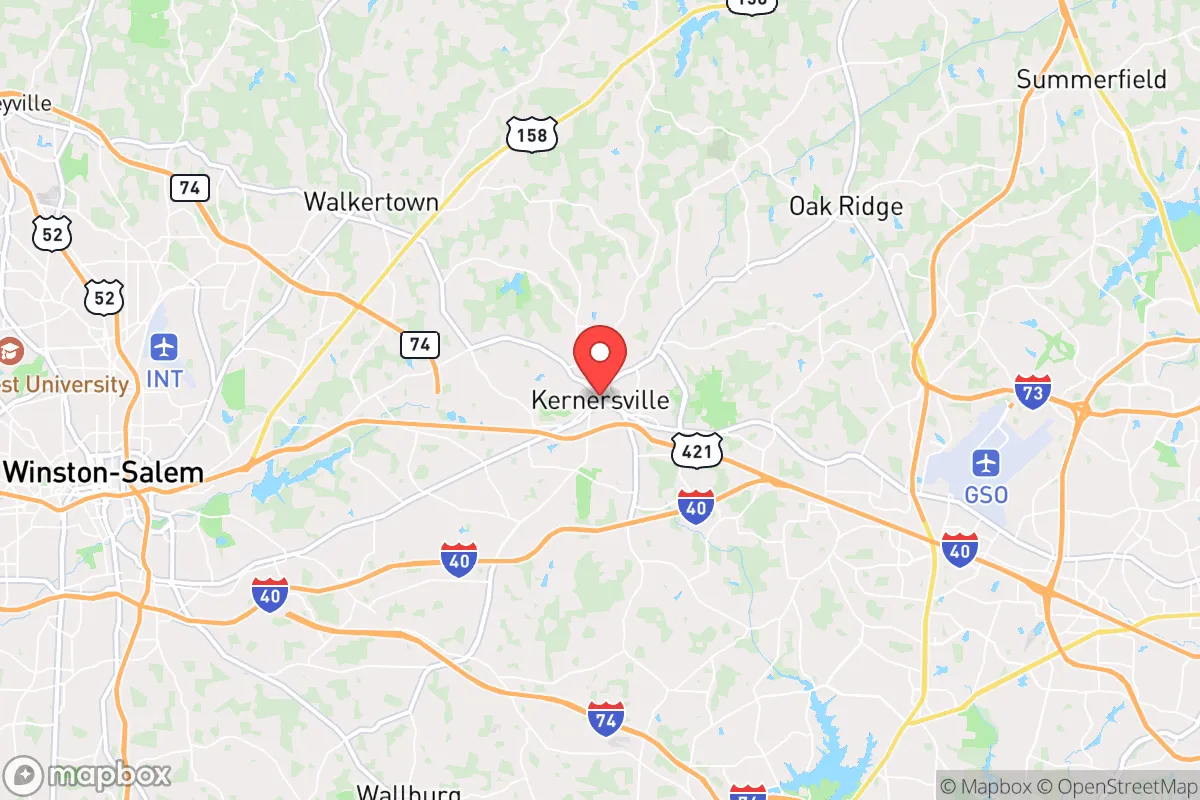
District shown is the primary district for this city’s centroid. Cities may span multiple districts.
Local Political AnalysisPolitical Analysis of Kernersville, NC
Kernersville leans solidly conservative, with a Cook PVI of R+9 that reflects a community where traditional values and limited-government principles still hold strong. This isn't a purple suburb hedging its bets; it's a place where most folks expect the government to stay out of their lives, their businesses, and their kids' education. Over the past decade, the political trajectory has been a slow, steady pull rightward, even as neighboring Greensboro and Winston-Salem have drifted left. The real story, though, is how that conservative foundation is being tested by outside pressures and a changing population.
How it compares
Drive ten minutes east to Greensboro (Cook PVI D+14) and you're in a different world — a city where city council debates often center on expanding social programs and rethinking public safety. Head west to Winston-Salem (Cook PVI D+7) and you'll find a similar progressive tilt, especially in the downtown core. Kernersville sits squarely between these two blue bubbles, and that geographic reality shapes its politics. Locals here see what's happening in those cities — higher taxes, zoning fights over density, school board battles over curriculum — and they want no part of it. The contrast is stark: while Greensboro was debating defunding police in 2020, Kernersville's town council quietly approved a budget that increased officer pay. That's the kind of decision that keeps this community stable while its neighbors experiment.
What this means for residents
For someone moving here, the practical effect of this conservative lean is a lighter touch from local government. Property taxes in Forsyth County are reasonable compared to Guilford County, and there's no city-level income tax eating into your paycheck. The town council has consistently resisted overreach on issues like mask mandates and business closures — during the pandemic, Kernersville was one of the first in the region to push back against state-level restrictions, letting restaurants and gyms stay open while nearby cities locked down. That pattern holds on other fronts: zoning rules are straightforward, permitting is fast, and there's little appetite for the kind of "visioning" exercises that lead to bike lanes and density targets in more progressive towns. The downside? If you're hoping for robust public transit or aggressive affordable housing programs, you'll be disappointed. But for most residents, that trade-off is exactly the point.
There's a cultural distinction worth noting: Kernersville has a strong strain of "live and let live" conservatism that's less about culture war and more about practical independence. You won't see the same level of church-based political organizing you'd find in, say, High Point. Instead, the politics here are driven by small business owners, tradespeople, and families who just want to be left alone. The biggest concern among long-time residents isn't a sudden leftward shift — it's the slow creep of suburbanization bringing Greensboro-style politics with it. New developments are attracting younger families from the cities, and some worry that as the population grows, so will pressure for the kind of government expansion they moved here to escape. For now, though, Kernersville remains a place where a conservative worldview isn't just tolerated — it's the baseline. If that changes, it won't be because the locals voted for it.

State Political ClimatePolitical Climate in North Carolina
State Political AnalysisPolitical Environment in the State
North Carolina has long been considered a quintessential swing state, but over the past decade, it has settled into a reliably red-leaning posture, particularly in statewide and legislative races. The state voted for Donald Trump in both 2016 and 2024, and while the margins have been close—often within 1-3 points—the underlying structure favors conservatives, thanks to a deep rural base and growing exurban populations. The dominant coalition is a mix of traditional small-government conservatives, military veterans, and a rising tide of fiscally conservative transplants from the Northeast and Midwest. Over the last 10-20 years, the state has shifted from a purple battleground to a state where Republicans hold supermajorities in the General Assembly, a conservative-leaning Supreme Court, and the governorship has flipped back and forth but remains constrained by veto-proof legislative power.
Urban vs. rural divide
The political map of North Carolina is a textbook study in the urban-rural chasm. The major metros—Charlotte (Mecklenburg County) and Raleigh-Durham (Wake and Durham Counties)—are deep blue strongholds, driven by banking, tech, and university populations. Mecklenburg County gave Biden 65% in 2020, and Wake County gave him 62%. These two counties alone produce nearly a third of the state’s total votes, but they are surrounded by a sea of red. The rural east—places like Greenville (Pitt County) and Fayetteville (Cumberland County)—are more mixed, with military bases and agricultural communities leaning conservative. The real engine of Republican dominance is the exurban and small-town belt: Mooresville (Iredell County), Hickory (Catawba County), and Wilmington (New Hanover County) have all trended redder as transplants and retirees move in. The Piedmont Triad—Greensboro, Winston-Salem, and High Point—is a true battleground within a battleground, with Guilford County often flipping between parties. The rural west, including Asheville (Buncombe County), is an island of blue in a sea of red, but the surrounding mountain counties are deeply conservative.
Policy environment
North Carolina’s policy environment is a mixed bag for conservatives, but the trend is positive. The state has a flat income tax rate of 4.5%, which is being phased down to 3.99% by 2027, making it one of the more competitive tax climates in the Southeast. There is no state tax on Social Security benefits, and the standard deduction is generous. The regulatory posture is business-friendly, with right-to-work laws and a tort reform system that caps non-economic damages in medical malpractice cases. Education policy is a flashpoint: the state has a robust school choice program, including Opportunity Scholarships (vouchers) that now serve over 50,000 students, and charter schools are expanding rapidly. However, the state also has a powerful teachers’ union and a Democratic governor who has vetoed several parental rights bills. On healthcare, North Carolina expanded Medicaid in 2023 under a bipartisan deal, which was a win for the left but also brought federal dollars to rural hospitals. Election laws are a bright spot: the state requires voter ID, has strict absentee ballot rules, and conducts regular purges of voter rolls. The General Assembly has also passed laws limiting the governor’s emergency powers, a direct response to COVID-era overreach.
Trajectory & freedom
On the freedom front, North Carolina is moving in the right direction, but the fight is ongoing. The state passed a constitutional amendment in 2018 requiring voter ID, which withstood court challenges. In 2023, the legislature passed a 12-week abortion ban, overriding the governor’s veto, which was a significant win for pro-life advocates. Gun rights are strong: the state has permitless carry for concealed handguns (effective 2023), and there are no red flag laws. Parental rights were bolstered by the Parents’ Bill of Rights (2023), which requires schools to notify parents of curriculum changes and prohibits instruction on gender identity and sexuality in K-4 classrooms. However, the state still has a state income tax, and property taxes are locally controlled but can be high in blue counties like Orange and Durham. Medical freedom took a hit during COVID with mask and vaccine mandates in some cities, but the legislature has since banned vaccine passports and limited future emergency mandates. The biggest concern is the growing influence of the Research Triangle—Raleigh, Durham, and Chapel Hill—which is importing progressive voters from California and New York, slowly shifting the state’s demographics.
Civil unrest & political movements
North Carolina has seen its share of political flashpoints, but they are localized and manageable. The 2020 protests in Charlotte and Raleigh over George Floyd’s death were large but mostly peaceful, though there were isolated incidents of property damage. The state has a strong Second Amendment movement, with regular gun rights rallies at the state capitol. Immigration politics are relatively calm: the state is not a sanctuary state, and several counties, including Wake and Mecklenburg, have pushed back against ICE cooperation, but the legislature has passed laws banning sanctuary policies. The most visible political movement is the Moms for Liberty chapter activity in suburban counties like Union and Cabarrus, which has successfully pushed for school board reforms and book challenges. Election integrity remains a hot topic: the 2020 and 2024 elections were closely contested, and the state’s bipartisan election board has been a source of tension, with Republicans accusing it of partisan bias. There have been no serious secession or nullification movements, but the state’s rural-urban divide is sharp enough that some rural counties have discussed forming a new state (the "State of Jefferson" idea has been floated in the west).
Projection
Over the next 5-10 years, North Carolina is likely to remain a red-leaning state, but the margin will narrow. The in-migration from blue states—particularly to the Charlotte metro and the Triangle—is accelerating. Wake County alone is adding 50-60 people per day, many from New York, California, and Illinois. These newcomers tend to be moderate to liberal on social issues but fiscally conservative, which could push the state toward a more libertarian or centrist posture. The rural population is aging and shrinking, which will erode the Republican base over time. However, the exurban growth in places like Johnston County (south of Raleigh) and Brunswick County (south of Wilmington) is adding conservative-leaning families. The biggest wildcard is the state’s gerrymandered legislative maps, which are likely to be challenged again in court. If Democrats ever win control of the state Supreme Court, they could force fairer maps, which would flip the General Assembly. For now, the trajectory is slow but steady toward purple, but the state’s conservative DNA—military, agriculture, manufacturing, and faith—is resilient. A new resident moving in now should expect a state that is broadly free and business-friendly, but with growing cultural battles in the suburbs over education and parental rights.
For someone choosing North Carolina today, the bottom line is this: you get a low-tax, gun-friendly, school-choice state with a strong economy and beautiful geography, but you need to pick your county carefully. If you want a conservative bubble, look at Union County (south of Charlotte) or Johnston County (east of Raleigh). If you want a more mixed environment, the Triad offers a balance. Avoid the Triangle and Asheville if progressive politics bother you. The state is still a net positive for freedom, but the culture war is real, and it’s playing out in school boards and county commissions. Come for the low taxes and the mountains, but stay engaged in local politics—because that’s where the future of the state will be decided.
* Values derived from national, state, county, city and local statistics and may differ in a specific area. Last updated: 2026-05-03T20:26:06.000Z
Narrative content on this page is AI-generated and may contain mistakes. Verify any details that matter before acting on them.
ReloMaps may earn a commission from affiliate links at no extra cost to you.

