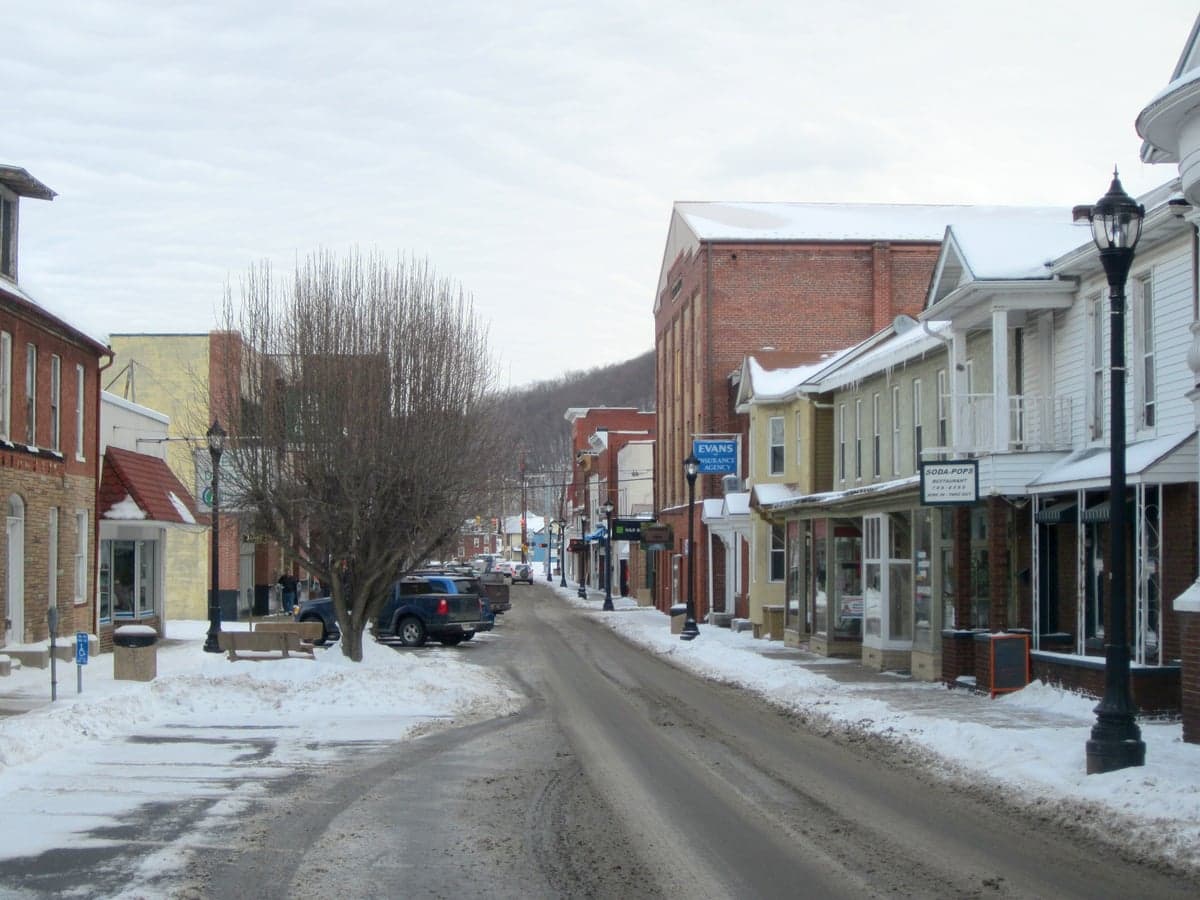
Photo: Wikipedia
Demographics of Keyser, WV
Affluence Level in Keyser, WV
A below-average socioeconomic profile. Incomes, home values, and educational attainment trail the U.S., with higher poverty and unemployment.
People of Keyser, WV
The people of Keyser, West Virginia, today number 4,870, forming a predominantly white (89.1%) and native-born (99.9% U.S.-born) community with a strong working-class character rooted in the city's railroad and industrial past. With only 21.1% holding a college degree, the population skews practical and family-oriented, centered around a compact downtown and a handful of distinct neighborhoods that trace their origins to specific waves of settlement. The city's identity is one of deep local roots and slow demographic change, shaped more by out-migration than by new arrivals.
How the city was settled and grew
Keyser's population history begins with the Potomac River valley's early European settlers, primarily of English, German, and Scots-Irish descent, who arrived in the mid-1700s as farmers and traders. The city's modern foundation was laid in the 1850s when the Baltimore and Ohio Railroad (B&O) established a major repair shop and rail yard here, drawing a wave of Irish and later Italian immigrant laborers to build and maintain the line. These workers settled in the South End neighborhood, near the rail yards, where modest frame houses and company-built row homes still stand. The railroad boom also attracted African American families, who formed a small but stable community concentrated in the West Side area along Mineral Street, near the former segregated school and churches. By 1900, the population had reached roughly 2,500, with the North End developing as a middle-class district of merchants and railroad supervisors, featuring larger Victorian homes on Church and Main Streets. The city's growth plateaued after World War II, as the railroad's workforce shrank and younger residents began leaving for larger cities.
Modern era (post-1965)
After the 1965 Immigration and Nationality Act, Keyser saw virtually no new foreign-born population—the current foreign-born share is just 0.1%, among the lowest in West Virginia. The city's demographic story since the 1970s has been one of domestic out-migration and gradual aging, rather than diversification. The Black population, which once made up roughly 8-10% of the city in the 1950s, has declined to 4.2% today, with many families moving to larger metro areas like Baltimore or Washington, D.C. The remaining Black residents are still largely concentrated in the West Side and along Armstrong Avenue, though the neighborhood has become more integrated as older white residents have moved out. The Hispanic share (0.7%) and East/Southeast Asian share (0.0%) are negligible, reflecting the city's lack of economic pull for immigrant communities. The Knobley Road area, a post-1970s suburban-style development of single-family homes on larger lots, has absorbed most of the city's modest growth, attracting families seeking lower housing costs and a rural feel within walking distance of downtown. The Potomac Park neighborhood, a small subdivision near the river, has seen some in-migration of retirees from the Washington, D.C. metro area, drawn by low property taxes and slower pace of life.
The future
Keyser's population is heading toward further homogenization and slow decline. The city lost roughly 5% of its population between 2010 and 2020, and projections suggest continued shrinkage as the remaining younger adults leave for college or jobs in Martinsburg, Winchester, or beyond. The foreign-born population is unlikely to grow significantly, as the city offers few entry-level jobs in manufacturing or services that attract immigrants, and the nearest refugee resettlement or immigrant gateway is over 100 miles away. The Black population may continue to decline slowly as older residents pass away and younger ones relocate. The South End and West Side are likely to see further depopulation and aging housing stock, while Knobley Road and Potomac Park may hold steady as enclaves for retirees and remote workers. No significant new immigrant or ethnic enclave is forming; the city is becoming more uniformly white and native-born, with a median age (around 45) that is higher than the national average.
For someone moving in now, Keyser offers a stable, low-diversity community where neighbors know each other and the pace of change is glacial. The population is aging and shrinking, but the city retains a strong sense of place rooted in its railroad heritage and Appalachian identity. New residents will find a place where the past is still present, and where the demographic future looks much like the present—only smaller and older.

* Values derived from national, state, county, city and local statistics and may differ in a specific area. Last updated: 2026-05-01T05:18:21.000Z
Narrative content on this page is AI-generated and may contain mistakes. Verify any details that matter before acting on them.
ReloMaps may earn a commission from affiliate links at no extra cost to you.

