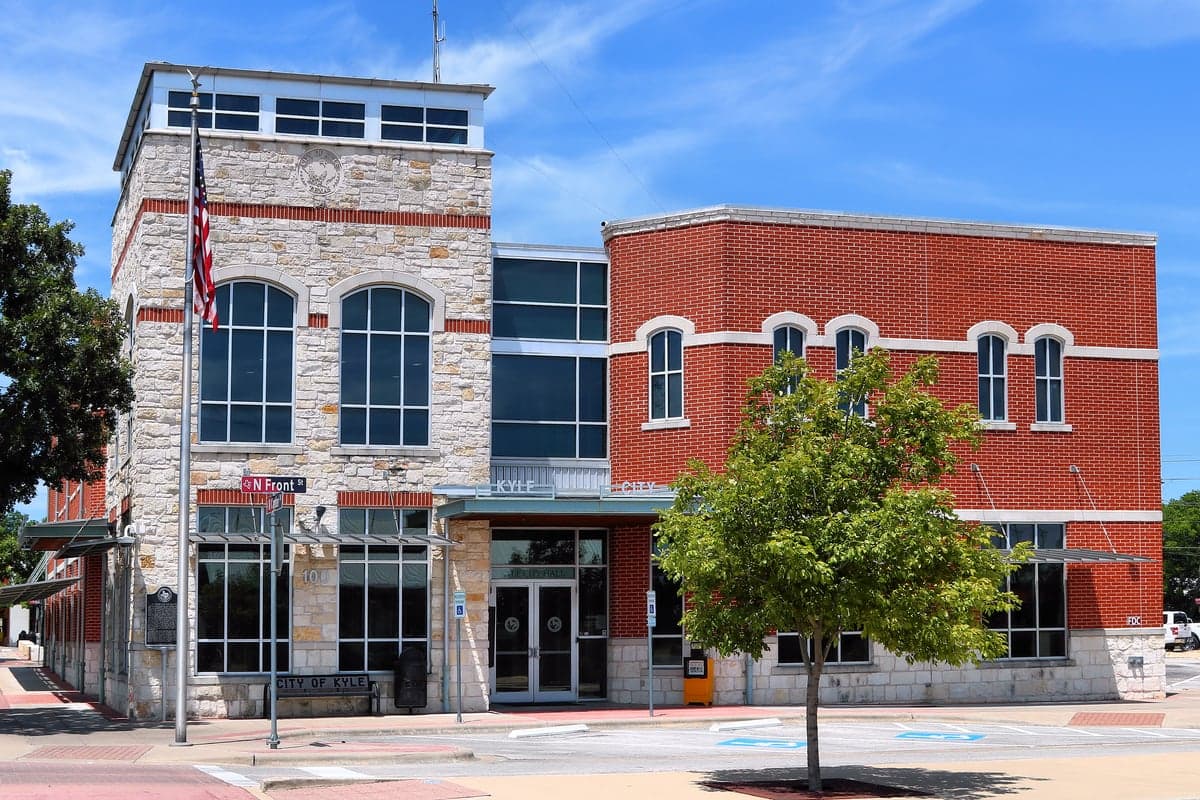
Photo: Wikipedia
Demographics of Kyle, TX
Affluence Level in Kyle, TX
A middle-class area roughly in line with national averages across income, home values, education, and employment.
People of Kyle, TX
The people of Kyle, Texas today form a rapidly growing, majority-Hispanic suburb of Austin, with a population of 52,439 that is 49.3% Hispanic, 41.1% white, 5.1% Black, and 0.9% East/Southeast Asian. The city is notably young and family-oriented, with a foreign-born share of just 4.7% — indicating most Hispanic residents are native-born, often multigenerational Texans. A moderate 32.4% of adults hold a college degree, reflecting a mix of blue-collar roots and white-collar commuters drawn by lower housing costs. The city’s identity blends a historic ranching and railroad past with the fast-paced, master-planned suburban growth that now defines its landscape.
How the city was settled and grew
Kyle was founded in 1880 as a stop on the International-Great Northern Railroad, named after a railroad official. The original population consisted of German and Czech farmers who took up land grants in the surrounding blackland prairie, along with a smaller number of Anglo ranchers. By the early 1900s, Mexican-American laborers arrived to work on the railroad and in cotton fields, settling in what is now the historic downtown district around Center Street and the adjacent Bunton Creek area. These early Hispanic families formed the core of Kyle’s working class, while white landowners dominated the agricultural economy. The town remained tiny — fewer than 1,000 residents — through the mid-20th century, with little new construction outside the original grid of streets near the railroad tracks.
Modern era (post-1965)
The post-1965 immigration reforms had minimal direct effect on Kyle, as the city’s foreign-born population remains low. Instead, the modern population boom came from domestic in-migration, beginning in the 1990s when Austin’s housing costs pushed families south along Interstate 35. The first major master-planned community, Plum Creek, opened in the late 1990s and attracted a mix of white and Hispanic families seeking new schools and larger lots. Meanwhile, older neighborhoods like Kyle Crossing and Bunton Creek absorbed many Hispanic families moving from rural Hays County and the Rio Grande Valley. The 2000s and 2010s saw the addition of Waterleaf and Sunfield, which drew a slightly more diverse population, including Black and East/Southeast Asian professionals. By 2020, Kyle had shifted from a majority-white town to a Hispanic-plurality city, with white residents dropping to 41.1% and Hispanic residents rising to 49.3%. The Black share grew to 5.1%, concentrated in newer subdivisions, while the East/Southeast Asian community (0.9%) remains small but visible in the tech-commuter segment.
The future
Kyle’s population is projected to exceed 80,000 by 2035, driven by continued suburban expansion and annexation. The city is not tribalizing into distinct ethnic enclaves; rather, newer master-planned communities like Sunfield and Waterleaf are economically integrated, though older neighborhoods like Bunton Creek retain a stronger Hispanic character. The immigrant community is not growing significantly — the foreign-born share has plateaued near 5% — meaning the Hispanic population is increasingly native-born and English-dominant, accelerating assimilation. The white share is likely to stabilize as Austin spillover continues, while Black and Asian shares may rise modestly. Over the next 10–20 years, Kyle will likely become a more homogeneous suburban middle-class city in terms of income and lifestyle, even as its ethnic diversity remains above the Texas average.
Kyle is becoming a classic Sun Belt suburb: family-centric, politically moderate-to-conservative, and defined by rapid growth rather than deep historical roots. For someone moving in now, the city offers a lower-cost alternative to Austin with a strong sense of community in its older Hispanic neighborhoods and newer planned developments alike. The key trade-off is between affordability and the growing pains of traffic, school crowding, and infrastructure catch-up that come with a city that has quintupled in size since 2000.

* Values derived from national, state, county, city and local statistics and may differ in a specific area. Last updated: 2026-05-14T18:36:39.000Z
Narrative content on this page is AI-generated and may contain mistakes. Verify any details that matter before acting on them.
ReloMaps may earn a commission from affiliate links at no extra cost to you.

