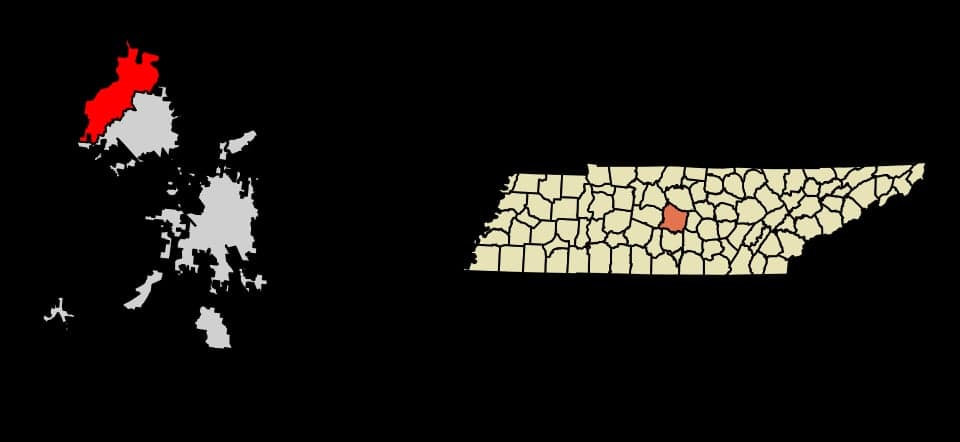
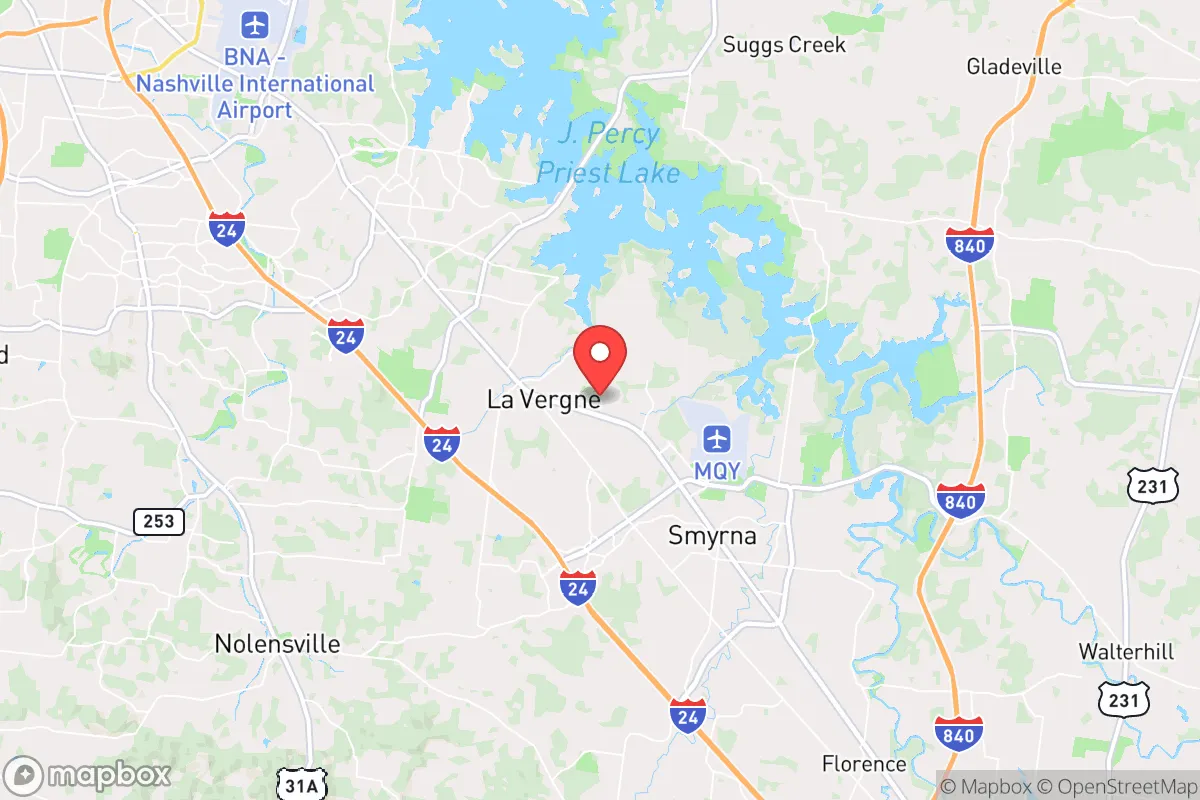
Photo: Wikipedia
Demographics of La Vergne, TN
Affluence Level in La Vergne, TN
A middle-class area roughly in line with national averages across income, home values, education, and employment.
People of La Vergne, TN
La Vergne, Tennessee, is a rapidly diversifying suburban city of 38,944 residents, where no single racial or ethnic group holds a majority. The city is characterized by a dense, working-to-middle-class population, a high foreign-born share (12.1%), and a distinctive identity as a landing pad for both domestic migrants from other states and immigrants from Latin America and Southeast Asia. It is a place where a historic white and Black Southern population is being reshaped by a significant Hispanic community (23.5%) and a growing East/Southeast Asian presence (3.0%), creating a multiethnic, blue-collar suburb of Nashville.
How the city was settled and grew
La Vergne’s human history begins not with colonial settlement but with the railroad. Founded in the 1850s as a stop on the Nashville and Chattanooga Railroad, the city was named after the French word for “green” by a railroad executive. The original population was a mix of white farmers and merchants, with a small number of enslaved Black laborers who worked the surrounding plantations. After the Civil War, freedmen established a community in what is now the Rock Springs neighborhood, a historically Black area near the railroad tracks that remained the city’s African American anchor for generations. Through the early 20th century, La Vergne remained a tiny, rural hamlet—its population barely topped 1,000 by 1950. The first major growth wave came with the post-World War II expansion of Nashville’s industrial base. The arrival of the Nissan North America headquarters and a major Whirlpool plant in the 1980s drew white and Black workers from rural Middle Tennessee and Appalachia, who settled in subdivisions like Paddock Club and Lake Forest. These neighborhoods, built on former farmland, became the backbone of the city’s modern, suburban identity.
Modern era (post-1965)
The 1965 Hart-Cellar Act opened immigration from outside Europe, but La Vergne’s modern demographic transformation began in earnest in the 1990s and 2000s. The city’s affordable housing stock and proximity to Nashville’s logistics and manufacturing jobs—especially at the massive Amazon Fulfillment Center and Ingram Content Group—attracted a new wave of domestic and international migrants. Hispanic immigrants, primarily from Mexico and Central America, began settling in the Waldron’s Creek and Smith Springs areas, drawn by construction and service-sector work. Today, the Hispanic share stands at 23.5%, making La Vergne one of the most Hispanic cities in Middle Tennessee. The Black population, at 26.8%, is a mix of long-standing families from the Rock Springs area and newer arrivals from other Southern states and the Rust Belt. The East/Southeast Asian community (3.0%) is concentrated in the Chancellor’s Ridge and newer subdivisions near I-24, with many families working in healthcare and tech. The Indian subcontinent population (0.1%) is negligible. The white population, now 43.8%, has declined from a near-majority in 2000, as older residents have aged out and been replaced by younger, more diverse families. The college-educated share (23.7%) is below the national average, reflecting the city’s blue-collar, trade-oriented workforce.
The future
La Vergne’s population is heading toward further diversification, but not necessarily toward homogenization. The Hispanic community is growing steadily, driven by both immigration and higher birth rates, and is likely to approach or exceed 30% within a decade. The Black population is stable, while the white share is slowly declining. The East/Southeast Asian community is small but growing, particularly among Vietnamese and Filipino families. The city is not tribalizing into rigid enclaves—most neighborhoods are mixed—but there is a visible concentration of Hispanic families in the Waldron’s Creek area and of Black families in the older Rock Springs and Lake Forest sections. The next 10-20 years will likely see La Vergne become a majority-minority city, with a Hispanic plurality. The key question is whether the city’s schools and local government can integrate these groups into a shared civic identity, or whether economic stratification will create separate communities within the same suburb.
For someone moving in now, La Vergne is becoming a genuinely multiethnic, working-class suburb—a place where a white family from rural Tennessee, a Black family from Chicago, and a Hispanic family from Guatemala can all live on the same street. It is not an affluent or highly educated city, but it offers affordable housing, good highway access, and a growing diversity that is reshaping its character. The bottom line: La Vergne is a city in demographic transition, and the next decade will determine whether it becomes a model of integration or a collection of separate communities sharing a zip code.

* Values derived from national, state, county, city and local statistics and may differ in a specific area. Last updated: 2026-04-23T02:16:07.000Z
Narrative content on this page is AI-generated and may contain mistakes. Verify any details that matter before acting on them.
ReloMaps may earn a commission from affiliate links at no extra cost to you.

