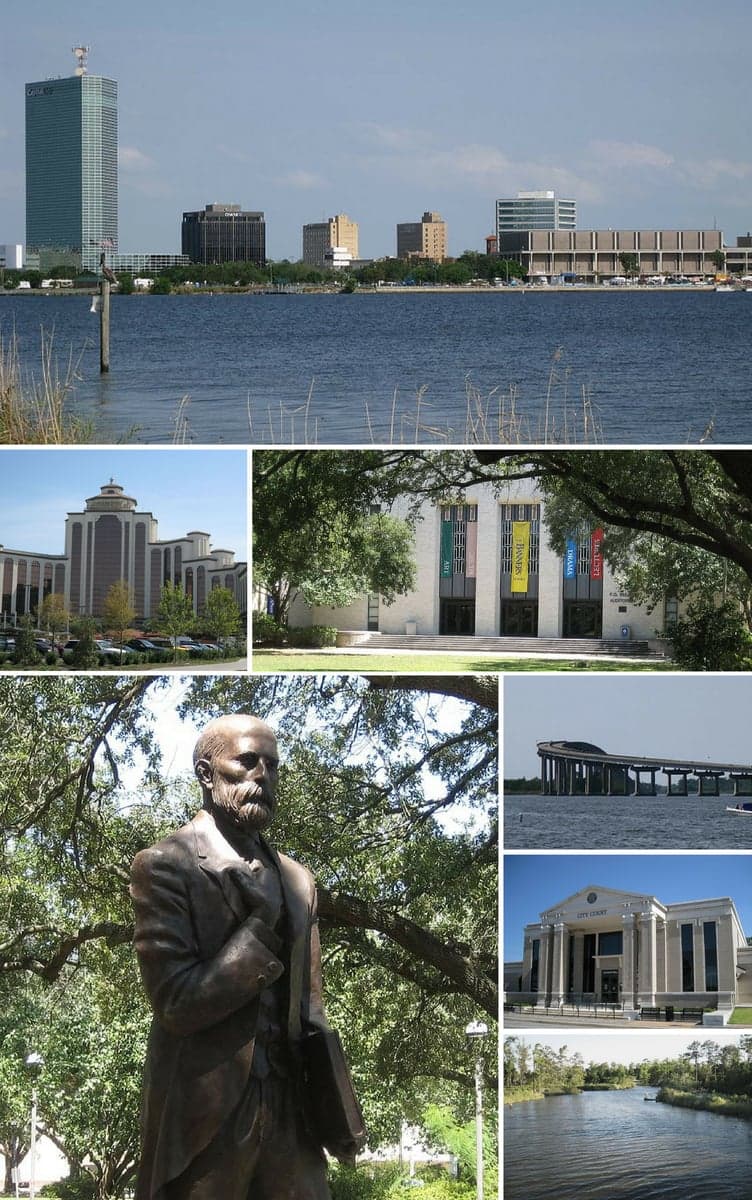
Photo: Wikipedia
Personal Sovereignty in Lake Charles, LA
Strong independent fundamentals that actively favor personal liberty and low regulation.
What does Personal Sovereignty tell us?
Personal Sovereignty measures your capacity for self-reliance and independence with minimal government friction. Higher scores mean fewer barriers between you and the way you want to live... but it assumes you have the space you need and good neighbors.
What does this tell us?
Personal Sovereignty measures your capacity for self-reliance and independence with minimal government friction. Higher scores mean fewer barriers between you and the way you want to live... but it assumes you have the space you need and good neighbors.
State Policy
Energy independence: Net exporter (280% of energy produced in-state)
Personal Liberty
Homesteading

Personal Liberty Analysis
For the individual or family prioritizing personal sovereignty—meaning maximum control over your own life, property, and decisions—Lake Charles, Louisiana, offers a legal and cultural environment that is markedly more permissive than much of the coastal or Midwestern United States. The state’s deep-rooted tradition of individual liberty, combined with a relatively light regulatory touch and a tax code that doesn’t punish productivity, creates a baseline for autonomy that is hard to find elsewhere. While no place is a libertarian utopia, Lake Charles sits in a state that consistently ranks among the most free in the nation for those who want to be left alone to live, work, and defend themselves as they see fit.
Tax burden and regulatory posture: how much the state takes and how much it interferes
Louisiana’s tax structure is a significant draw for anyone focused on keeping more of what they earn. The state levies a flat income tax rate of 3% on all individual income, a rate that is both simple and low compared to the progressive brackets found in states like California (up to 13.3%) or New York (up to 10.9%). There is no state-level property tax on vehicles or business inventory, and the average effective property tax rate in Calcasieu Parish, where Lake Charles sits, is around 0.55% of assessed home value—roughly half the national average. For a $250,000 home, that means annual property taxes of about $1,375, versus $2,500 or more in many other regions. Sales tax is higher, with a combined state and local rate near 10%, but this is a consumption tax you can partially control by buying used or out of state. From a regulatory standpoint, Louisiana is a "right-to-work" state, meaning you cannot be forced to join a union as a condition of employment, and it has a relatively low number of occupational licensing requirements compared to the national median. The state’s business climate is consistently ranked in the top 10 by the Tax Foundation, which translates to fewer bureaucratic hurdles for anyone starting a side hustle, a home-based business, or a trade operation. The regulatory posture here is one of general non-interference, especially compared to states that aggressively enforce zoning, environmental, or labor mandates.
Self-defense and gun law specifics: what you can own, carry, and where
For the prepper or survivalist, Louisiana’s gun laws are a major pillar of personal sovereignty. The state is a constitutional carry jurisdiction, meaning any law-abiding adult 18 or older can carry a concealed handgun without a permit. This went into effect in 2021, and it has not been rolled back. There is no state-level registry for firearms, no waiting periods for purchases from private sellers, and no "assault weapon" ban or magazine capacity limit. You can legally own suppressors, short-barreled rifles, and machine guns with the proper federal tax stamps, and the state does not impose additional restrictions beyond federal law. Stand-your-ground laws are in full effect: you have no duty to retreat before using deadly force if you are lawfully present and reasonably believe it is necessary to prevent death, great bodily harm, or a forcible felony. Castle doctrine protections extend to your home, vehicle, and workplace. Importantly, Louisiana law explicitly preempts local governments from passing their own gun ordinances, so you won’t find the patchwork of city-level bans that plague states like Colorado or Washington. For the individual who views firearms as a non-negotiable right and a practical tool for self-reliance, Lake Charles offers one of the most permissive legal environments in the country.
Self-reliance and homesteading viability: lot sizes, zoning, and off-grid feasibility
Lake Charles and its surrounding rural areas in Calcasieu Parish offer genuine opportunities for a self-reliant lifestyle, though the city itself is more suburban. Inside the city limits, standard residential lots are typically one-quarter to one-half acre, and zoning is generally permissive for backyard gardens, small livestock like chickens, and even beekeeping, though you should check specific subdivision covenants. The real potential lies just outside town. In unincorporated areas of the parish, you can find 1-to-5-acre parcels for under $20,000 per acre, and zoning restrictions are minimal. Raising goats, pigs, or a family milk cow is entirely feasible on a few acres, and there are no state-level bans on rainwater collection—in fact, Louisiana encourages it with tax credits for cisterns. Off-grid living is legally possible, but with caveats. The state building code applies to new construction, but enforcement is lax in rural areas. Solar panels are allowed, and net metering is available through local utilities, though the rates are not as favorable as in some western states. Septic systems are regulated by the parish health unit, but the permitting process is straightforward. The biggest practical hurdle is the climate: high humidity and frequent hurricanes mean you need robust infrastructure for water storage, power backup, and storm hardening. But for someone willing to put in the work, the legal and economic barriers to a semi-self-sufficient homestead are low.
Personal liberties: parental rights, medical autonomy, speech, and property
Louisiana has a strong track record on several fronts of personal liberty that matter to conservative and libertarian-leaning individuals. Parental rights are explicitly protected in state law, with a 2024 statute affirming that parents have the fundamental right to direct the upbringing, education, and healthcare of their minor children. This includes the right to opt out of any school curriculum or activity without penalty, and to access all educational and medical records. The state does not have a vaccine mandate for school attendance beyond the standard childhood immunizations, and religious and philosophical exemptions are available. On medical autonomy, Louisiana has not imposed broad mask or vaccine mandates since 2021, and the state legislature has passed laws prohibiting discrimination based on vaccination status. There is no state-level "right to die" law, but there is also no forced treatment order for adults who refuse care, outside of extreme mental health commitments. Free speech is robust; there are no state-level hate speech laws that criminalize expression, and the state has a strong anti-SLAPP statute to protect against frivolous lawsuits meant to silence criticism. Property rights are protected by a constitutional amendment requiring just compensation for any regulatory taking, and the state has a relatively low rate of eminent domain abuse. For the individual who values the ability to speak freely, raise their children without state interference, and make their own medical choices, Louisiana’s legal framework is a clear positive.
In the broader landscape of American personal sovereignty, Lake Charles offers a combination that is increasingly rare: low taxes, minimal gun control, permissive zoning for self-reliance, and strong protections for parental and medical autonomy. It is not a perfect haven—the sales tax is high, hurricane risk is real, and the local economy is tied to the volatile oil and gas industry. But compared to the regulatory overreach and cultural hostility to traditional independence found in states like California, New York, or Illinois, southwest Louisiana represents a genuine refuge. For the strategic relocator who prioritizes being left alone to live, work, defend, and provide for their own, Lake Charles is a serious contender that deserves a hard look.

* Values derived from national, state, county, city and local statistics and may differ in a specific area. Last updated: 2026-04-23T05:00:08.000Z
Narrative content on this page is AI-generated and may contain mistakes. Verify any details that matter before acting on them.
ReloMaps may earn a commission from affiliate links at no extra cost to you.

