Photo: Wikipedia
Demographics of Lander, WY
Affluence Level in Lander, WY
A middle-class area roughly in line with national averages across income, home values, education, and employment.
People of Lander, WY
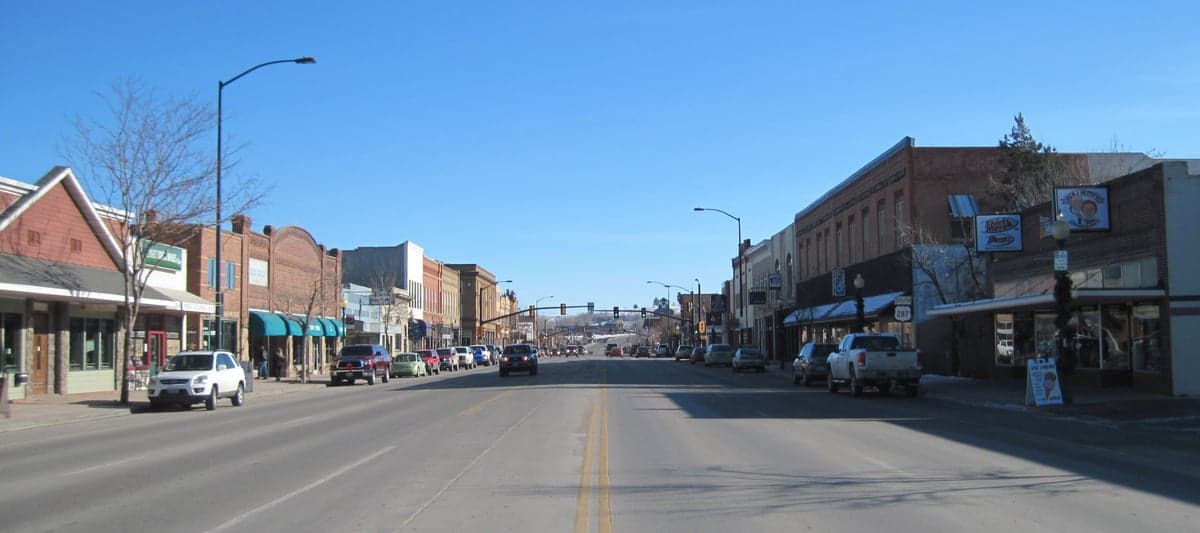
The people of Lander, Wyoming today number 7,565, forming a predominantly white (80.7%) community with a notably small foreign-born population (0.7%) and a college-educated rate of 42.7%—well above the national average. The city’s character is defined by a blend of outdoor-recreation professionals, ranching families, and a growing cohort of remote workers drawn to the Wind River Range. Lander’s identity remains distinctly Western and independent, with a population density of roughly 1,100 people per square mile that fosters a tight-knit, low-crime atmosphere.
How the city was settled and grew
Lander was founded in 1884 as a railroad town on the Chicago and North Western Railway, named after Civil War General Frederick W. Lander. The original settlers were a mix of railroad workers, cattle ranchers, and miners drawn by the 1870s gold rush in the nearby South Pass area. The town’s early population was overwhelmingly of Northern European descent—English, Irish, German, and Scandinavian—who built the first homes in what is now the Historic Downtown District, centered around Main Street. By 1900, Lander had grown to about 1,000 residents, with a second wave arriving in the 1910s-1920s as homesteaders claimed land under the Enlarged Homestead Act of 1909. These homesteaders settled the North Lander area, where small farms and ranches dotted the landscape. The Great Depression slowed growth, but a third wave came during World War II, when the U.S. Army established the Lander Army Air Base (now the Lander Valley Airport), bringing military personnel and support workers who later settled in the South Lander neighborhood near the base. By 1950, the population had reached 2,500, with the economy anchored by ranching, timber, and the newly established Wyoming State Training School (now the Wyoming Life Resource Center).
Modern era (post-1965)
After the 1965 Hart-Cellar Act, Lander saw minimal immigration-driven change—its foreign-born population remains just 0.7% today. Instead, the modern era has been shaped by domestic in-migration. The 1970s and 1980s brought a wave of back-to-the-land homesteaders and environmental activists, many of whom settled in the Bald Mountain area, a semi-rural enclave west of town known for its large lots and mountain views. This group, often college-educated and politically liberal, created a cultural counterpoint to the ranching families of the East Lander neighborhood, where multi-generational Wyomingites live on larger parcels near the Popo Agie River. The 1990s and 2000s saw a surge of retirees and second-home buyers, drawn by Lander’s outdoor recreation (rock climbing at Sinks Canyon, hiking in the Wind River Range). These newcomers concentrated in the West Lander subdivision, a newer development of single-family homes built between 1995 and 2010. Hispanic residents, now 6.2% of the population, arrived primarily in the 2000s as agricultural and construction workers, settling in the Southwest Lander area near the industrial park. Black (0.9%) and East/Southeast Asian (0.1%) populations remain negligible, with no significant enclaves. The Indian subcontinent population is 0.0%.
The future
Lander’s population is projected to grow modestly—perhaps 1-2% annually—driven by remote workers and retirees, not immigration. The city is not homogenizing into a single culture; rather, it is tribalizing into distinct enclaves: the Historic Downtown District remains a hub for small business owners and artists; Bald Mountain attracts environmentalists and outdoor professionals; East Lander holds the ranching families; and West Lander draws newcomers. The Hispanic community, while small, is likely to plateau as agricultural work declines, with younger generations assimilating into the broader white-majority culture. The college-educated rate (42.7%) will likely rise as remote workers continue to arrive, but the population will remain overwhelmingly white and native-born. No significant growth in Black, East/Southeast Asian, or Indian populations is expected given the lack of economic pull factors.
For someone moving in now, Lander is becoming a bifurcated community: a stable, white-majority, college-educated town with a strong outdoor-recreation economy, but with clear cultural divisions between long-time ranching families and newer, more liberal transplants. The low crime rate, high educational attainment, and small-town feel are draws, but the lack of racial or ethnic diversity means newcomers should expect a culturally homogeneous environment. The city’s future is one of slow, steady growth—not transformation.

* Values derived from national, state, county, city and local statistics and may differ in a specific area. Last updated: 2026-04-21T11:30:41.000Z
Narrative content on this page is AI-generated and may contain mistakes. Verify any details that matter before acting on them.
ReloMaps may earn a commission from affiliate links at no extra cost to you.

