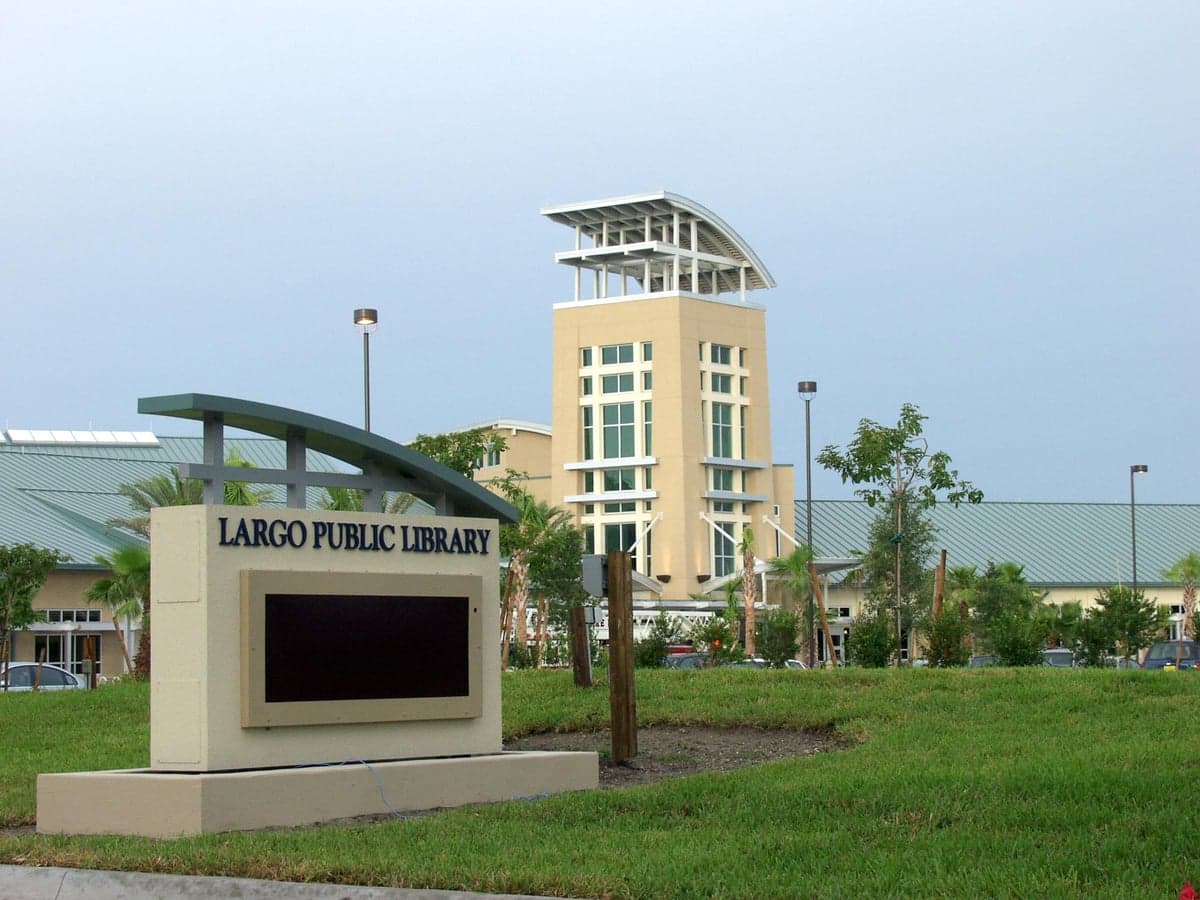
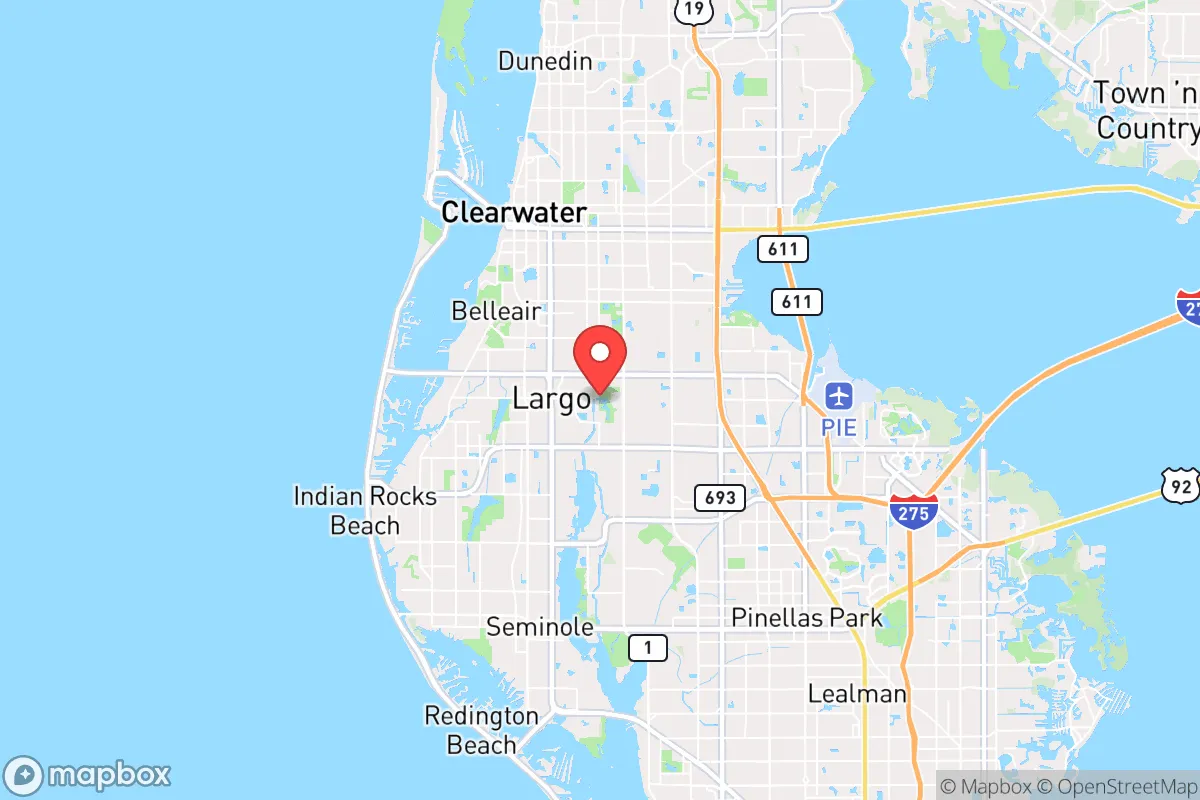
Photo: Wikipedia
Demographics of Largo, FL
Affluence Level in Largo, FL
A middle-class area roughly in line with national averages across income, home values, education, and employment.
People of Largo, FL
Largo, Florida, is a mid-sized city of 82,506 residents that feels more like a stable, middle-class suburb than a beach-adjacent boomtown. The population is predominantly white (69.0%), with a significant Hispanic minority (14.4%) and a smaller Black community (8.5%), while the foreign-born share sits at a modest 5.2% — well below the national average. What distinguishes Largo today is its settled, family-oriented character: a place where multi-generational Floridians live alongside Midwestern transplants, and where the pace of change has been gradual rather than disruptive.
How the city was settled and grew
Largo was founded in the 1880s as a farming and citrus community, long after Florida's colonial period had ended. The original settlers were mostly white Protestants from Georgia, Alabama, and the Carolinas who were drawn by cheap land and the promise of a mild winter growing season. They established the Largo Central area around what is now West Bay Drive and Missouri Avenue, building small frame houses and packing sheds for the citrus crop. A second wave arrived in the 1910s and 1920s, when the railroad extension brought Greek and Italian immigrants who worked as fishermen and sponge divers along the Gulf coast; many of these families settled in the Largo Bayside neighborhood near the Intracoastal Waterway. The city incorporated in 1905 with fewer than 300 residents, and remained a quiet agricultural hub through the 1940s. The post-World War II era brought the first major suburban influx: returning veterans and their young families, many from the Northeast and Midwest, who built ranch-style homes in Ridgecrest and Largo Highlands — neighborhoods that still retain their mid-century character of wide lots and mature oaks.
Modern era (post-1965)
The 1965 Immigration and Nationality Act had a limited direct effect on Largo compared to Miami or Tampa, but it reshaped the city indirectly through secondary migration. The most notable post-1965 change was the growth of the Hispanic population, which now stands at 14.4%. This community is primarily of Puerto Rican and Mexican descent, with many families arriving in the 1980s and 1990s from the Tampa area or directly from the Caribbean. They concentrated in the Belleair Bluffs border area and along the East Bay Drive corridor, where older apartment complexes and duplexes offered affordable entry points. The Black population (8.5%) is largely composed of families who moved from the rural South during the Great Migration's later stages, settling in the Largo Heights and Southern Pines neighborhoods. East and Southeast Asian communities (2.9%) — primarily Filipino and Vietnamese — arrived in the 1990s and 2000s, often drawn by healthcare jobs at Largo Medical Center and Morton Plant Hospital; they are scattered rather than concentrated in a single ethnic enclave. The Indian subcontinent population (0.8%) is a very recent addition, mostly professionals in tech and medicine who arrived after 2010. Domestic in-migration has been the dominant demographic force throughout this period: retirees and remote workers from the Midwest and Northeast, who continue to buy single-family homes in established neighborhoods like Largo Central and Ridgecrest.
The future
Largo's population is aging and slowly diversifying, but the pace of change is moderate. The white share has declined from roughly 80% in 2000 to 69% today, while the Hispanic share has risen steadily. The foreign-born population (5.2%) is unlikely to spike dramatically because Largo lacks the dense ethnic networks and entry-level job base that drive rapid immigration in larger cities. Instead, the city is experiencing a gradual homogenization of its older, established neighborhoods as long-time residents age in place, while newer subdivisions on the city's eastern edge attract a slightly younger and more diverse mix of families. The Indian and East/Southeast Asian communities are small and dispersed, and are likely to remain so unless a major employer relocates to the area. The most significant trend is the continued inflow of domestic migrants from higher-cost states — a pattern that reinforces Largo's character as a stable, middle-class suburb rather than transforming it into a truly multicultural hub.
For someone moving to Largo now, the city offers a predictable, family-oriented environment with a modest degree of demographic change. It is not a place of rapid ethnic turnover or cultural friction, but rather a community where the population is slowly becoming more Hispanic and slightly more diverse, while retaining its fundamentally suburban, white-majority character. The neighborhoods that defined Largo's past — Largo Central, Ridgecrest, Largo Heights — remain the anchors of its present, and the city's future looks more like a continuation of that pattern than a break from it.

* Values derived from national, state, county, city and local statistics and may differ in a specific area. Last updated: 2026-04-22T21:33:04.000Z
Narrative content on this page is AI-generated and may contain mistakes. Verify any details that matter before acting on them.
ReloMaps may earn a commission from affiliate links at no extra cost to you.

