Photo: Wikipedia
Demographics of Layton, UT
Affluence Level in Layton, UT
An upper-middle-class area. Household wealth, education levels, and homeownership run ahead of national benchmarks.
People of Layton, UT
Layton, Utah, is a predominantly white, family-oriented city of 82,512 residents, where 77.2% of the population identifies as white alone. The city is characterized by a strong Latter-day Saint cultural influence, a low foreign-born rate of just 3.0%, and a growing Hispanic community that now makes up 15.0% of the population. With 36.0% of adults holding a college degree, Layton is an educated, middle-to-upper-middle-class suburb that blends its agricultural pioneer roots with modern military and aerospace employment.
How the city was settled and grew
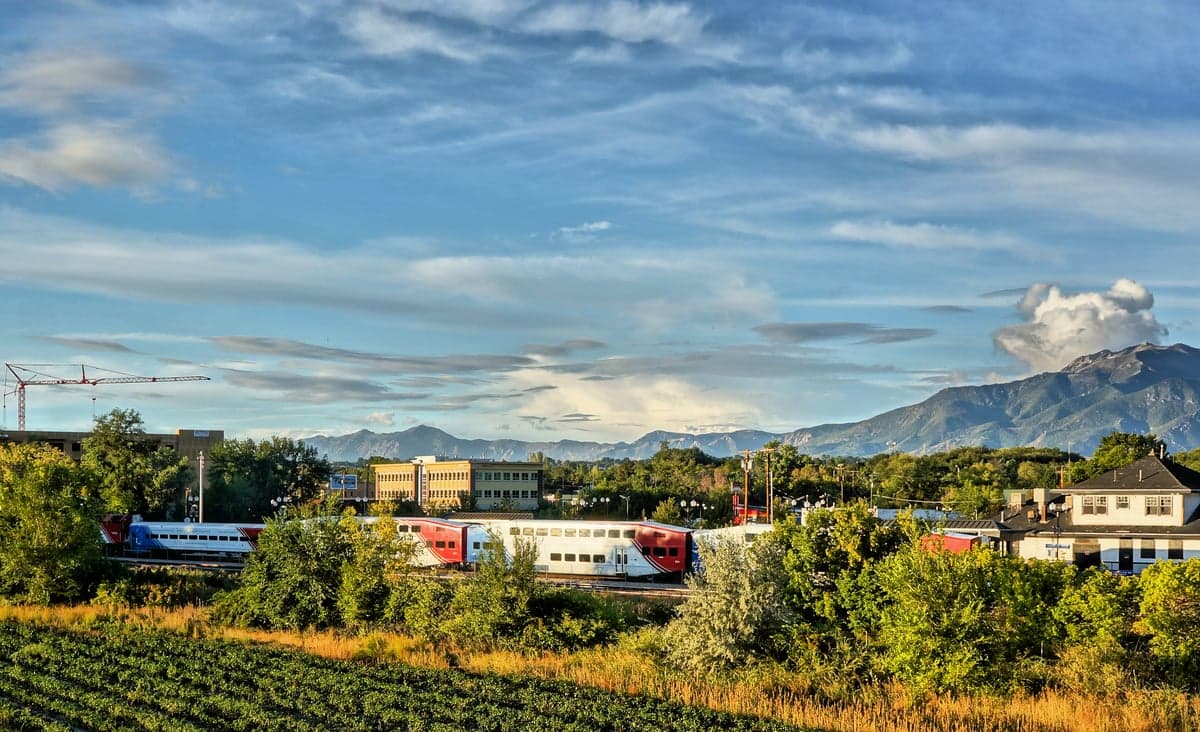
Layton’s human history begins with Mormon pioneers dispatched by Brigham Young in the 1850s to settle the fertile benchlands of Davis County. The area was originally known as Kaysville’s “West Ward” before being incorporated as Layton in 1902, named after Mormon apostle Christopher Layton. The first settlers were predominantly Anglo-Saxon converts to the LDS Church from the British Isles and Scandinavia, who built farms and irrigation canals. The historic East Layton neighborhood, centered around the original Layton Elementary and the Layton Utah Temple, was the heart of this pioneer settlement, with many original pioneer homes still standing. The arrival of the railroad in the 1870s spurred a second wave of farmers and merchants, who clustered in Layton’s downtown core along Gentile Street, establishing the city’s first commercial district. By 1950, Layton remained a small agricultural town of roughly 3,000 residents, almost entirely white and LDS.
Modern era (post-1965)
The post-1965 transformation of Layton was driven not by immigration reform but by the expansion of Hill Air Force Base, located just south of the city. The base’s growth during the Vietnam War and Cold War brought a wave of domestic in-migration—military personnel, defense contractors, and civilian engineers—who settled in new subdivisions. The Surrey Downs neighborhood, built in the 1970s and 1980s, absorbed many of these incoming families, creating a more diverse (though still overwhelmingly white) suburban enclave. The 1990s and 2000s saw Layton’s population explode from 40,000 to over 70,000, driven by Utah’s high birth rate and continued in-migration from other Western states. The East Gate and Heritage Park neighborhoods, developed in the 2000s, attracted younger families and professionals, while the West Layton area near I-15 became a hub for retail and apartment complexes. The Hispanic population, which was negligible in 1980, grew steadily through labor migration to construction, service, and agricultural jobs, now reaching 15.0%. These families have concentrated in the West Layton and Layton Meadows areas, where more affordable housing and rental options exist. East/Southeast Asian communities (1.9%) are largely tied to Hill Air Force Base and the tech sector, living in Surrey Downs and East Gate. The Black population (1.3%) and Indian subcontinent population (0.1%) remain very small, with no distinct ethnic enclaves.
The future
Layton’s population is projected to continue growing, driven by natural increase and domestic in-migration, but the city is not homogenizing into a single monoculture. Instead, it is tribalizing along geographic and economic lines. The East Layton and Heritage Park neighborhoods remain overwhelmingly white, LDS, and affluent, while West Layton is becoming more ethnically diverse and economically mixed, with a growing Hispanic presence. The Hispanic community is growing steadily but not explosively—its share has risen from roughly 10% in 2010 to 15% today—and is assimilating into the broader culture while maintaining distinct community institutions, such as Spanish-language services at local Catholic parishes. The East/Southeast Asian population is likely to plateau as military rotations stabilize. The foreign-born rate of 3.0% is far below the national average of 13.7%, and Layton is not a destination for new immigrant waves. Over the next 10-20 years, Layton will likely become a more stratified suburb: a wealthy, white, LDS east side and a more diverse, working-class west side, with the city’s overall character remaining conservative, family-focused, and culturally Mormon.
For a conservative-leaning individual or family moving to Layton today, the city offers a stable, safe, and growing community where traditional values and military-family culture predominate. The east side neighborhoods provide the highest concentration of like-minded, college-educated neighbors, while the west side offers more affordable entry points and increasing diversity. The city’s future is one of managed growth and gradual demographic change, not rapid transformation.

* Values derived from national, state, county, city and local statistics and may differ in a specific area. Last updated: 2026-05-03T20:34:27.000Z
Narrative content on this page is AI-generated and may contain mistakes. Verify any details that matter before acting on them.
ReloMaps may earn a commission from affiliate links at no extra cost to you.

