Photo: Wikipedia
Demographics of Leadville, CO
Affluence Level in Leadville, CO
An upper-middle-class area. Household wealth, education levels, and homeownership run ahead of national benchmarks.
People of Leadville, CO
Leadville, Colorado, is a small, high-altitude city of 2,634 residents with a distinctly working-class character rooted in its mining past. The population is predominantly White (64.4%) with a significant Hispanic minority (28.7%), a very small East/Southeast Asian community (0.5%), and virtually no Black or Indian subcontinent residents. The city is notably well-educated—61.9% hold a college degree—but retains a rugged, independent identity shaped by boom-and-bust cycles and a remote mountain setting at 10,200 feet.
How the city was settled and grew
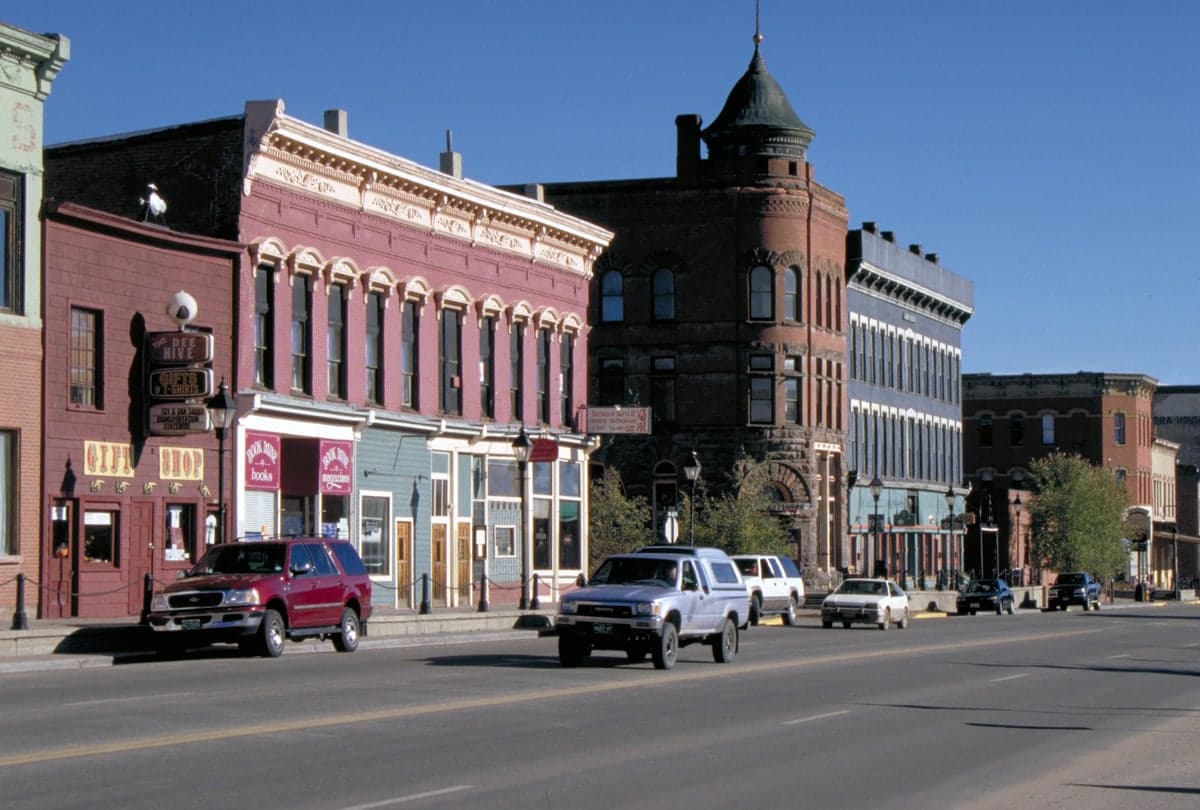
Leadville’s human history began with the 1860 discovery of gold in California Gulch, but the real population surge came with the 1877 silver boom. Prospectors, miners, and entrepreneurs flooded in from across the United States and Europe, transforming a barren valley into a rowdy mining camp of over 30,000 people by 1880. The original Anglo-American settlers, many from the Midwest and Appalachia, built the Central Business District along Harrison Avenue, while Irish and Cornish miners clustered in St. Vincent’s Hill and Carbonate Hill, establishing ethnic boarding houses and churches. A smaller wave of Chinese laborers arrived in the 1870s to work in the mines and laundries, settling in a segregated enclave near East 3rd Street, though most were expelled by the 1880s. The collapse of silver in 1893 triggered a sharp population decline, but lead and zinc mining sustained a smaller, more stable workforce through the mid-20th century, with families concentrated in West Leadville and the Lake County neighborhoods near the Climax Molybdenum Mine.
Modern era (post-1965)
After the 1965 Immigration and Nationality Act, Leadville saw minimal foreign-born influx—today only 1.1% of residents are foreign-born—but experienced significant domestic in-migration. The closure of the Climax Mine in the 1980s led to a population drop, but a revival began in the 1990s as tourism, outdoor recreation, and second-home buyers discovered the area. The Hispanic population grew steadily from the 1970s onward, driven by Mexican-American families moving from southern Colorado and New Mexico for mining and service jobs. These families settled primarily in East Leadville and the California Gulch corridor, where affordable housing and proximity to the ski areas of Summit County attracted a mix of Latino and Anglo residents. The White population, meanwhile, shifted toward higher-income newcomers—remote workers, retirees, and outdoor enthusiasts—who bought historic homes in the National Historic District around Harrison Avenue. The Black population remains at 0.0%, and East/Southeast Asian communities are negligible at 0.5%, reflecting the city’s limited economic diversity and remote location.
The future
Leadville’s population is slowly stabilizing after decades of decline, but it is not homogenizing. The Hispanic share (28.7%) is likely to grow modestly as families expand and service-sector jobs in tourism and healthcare attract younger Latino workers, while the White share (64.4%) may shrink slightly as older Anglo residents age out or sell to newcomers. The city is not tribalizing into distinct enclaves—neighborhoods like West Leadville and East Leadville remain mixed, with no single group dominating any area. The college-educated share (61.9%) is high for a small mountain town, driven by remote workers and professionals, but this could plateau as housing costs rise and limit in-migration. The foreign-born population is unlikely to increase significantly given the lack of industrial jobs and the high cost of living. Over the next 10–20 years, Leadville will likely remain a predominantly White and Hispanic community with a stable, educated workforce, but it faces pressure from Summit County’s housing market pushing lower-income residents out.
For someone moving in now, Leadville is becoming a quieter, more residential version of its mining-era self—less transient, more family-oriented, and increasingly split between long-time locals and newcomers with remote incomes. The city’s demographic stability and high education level make it a safe bet for conservative-leaning families seeking a tight-knit, outdoor-focused community, but the limited ethnic diversity and high altitude are real trade-offs. The population is not growing fast, but it is solidifying around a core of working-class Hispanics and educated Anglos, with little room for major demographic shifts.

* Values derived from national, state, county, city and local statistics and may differ in a specific area. Last updated: 2026-04-29T00:32:22.000Z
Narrative content on this page is AI-generated and may contain mistakes. Verify any details that matter before acting on them.
ReloMaps may earn a commission from affiliate links at no extra cost to you.

