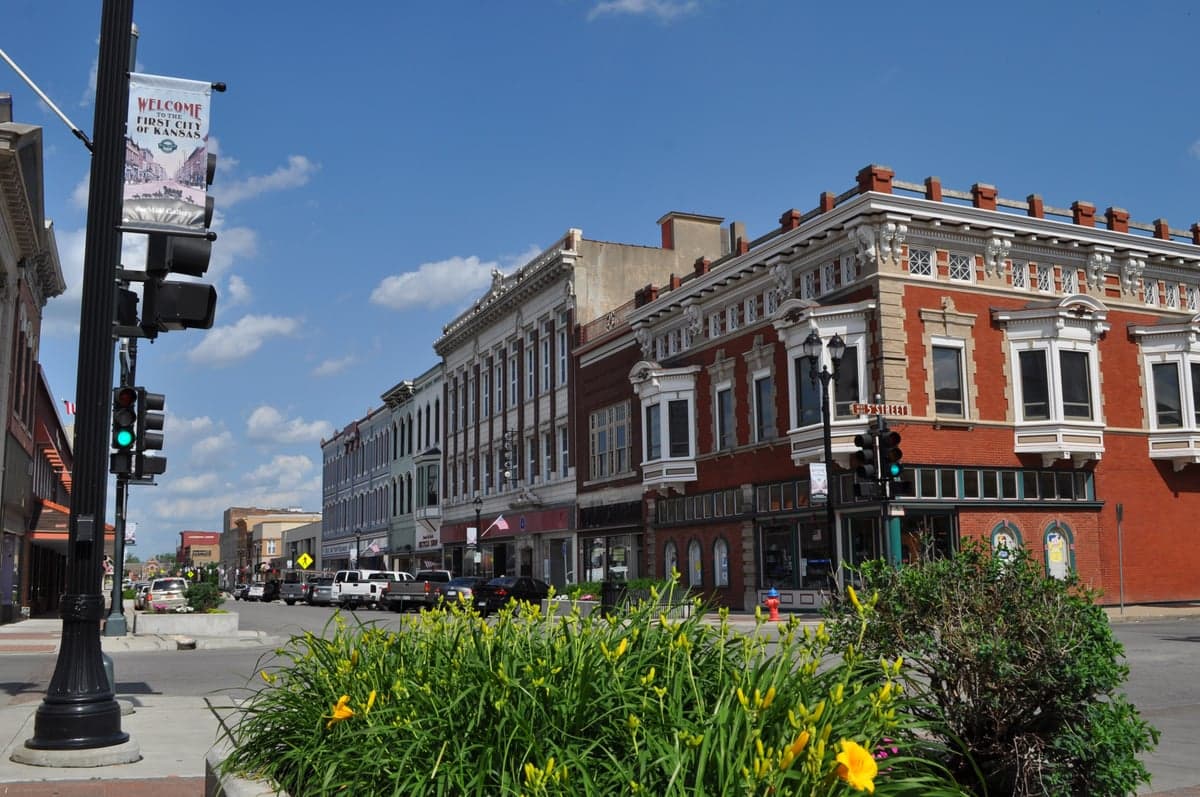
Photo: Wikipedia
Demographics of Leavenworth, KS
Affluence Level in Leavenworth, KS
A middle-class area roughly in line with national averages across income, home values, education, and employment.
People of Leavenworth, KS
The people of Leavenworth, Kansas today number 37,176, forming a community that is 70.8% white, 11.3% Black, 8.7% Hispanic, and 1.8% East/Southeast Asian, with a notably low foreign-born share of just 2.0%. The city carries a distinctive identity as a historic military and federal anchor, shaped by Fort Leavenworth and the United States Penitentiary, which have drawn successive waves of soldiers, corrections staff, and their families. With 33.5% of adults holding a college degree—a figure slightly above the national average—the population is more educated than many comparable Midwestern towns, reflecting the professional workforce tied to the military and federal institutions. Leavenworth remains a predominantly native-born, family-oriented city where generational roots run deep, particularly in older neighborhoods like the North Side and South Park.
How the city was settled and grew
Leavenworth was founded in 1854 as one of the first incorporated cities in Kansas Territory, its location on the Missouri River making it a natural gateway for westward expansion. The original population was overwhelmingly white, drawn by the promise of trade, land speculation, and the establishment of Fort Leavenworth in 1827, which predated the city itself. The fort brought soldiers, merchants, and laborers, while the federal prison, opened in 1903, added a steady stream of corrections employees. The city’s early growth was fueled by the railroad and river commerce, with distinct neighborhoods emerging along class and occupational lines. The North Side, near the river and the prison, became home to working-class families, including many German and Irish immigrants who arrived in the 1860s and 1870s. South Park, developed in the late 19th century, attracted wealthier merchants and professionals, with its large Victorian homes reflecting the city’s early prosperity. A smaller but significant Black population began arriving after the Civil War, settling primarily in the Northeast neighborhood, near the industrial corridor, where they found work in the railroad yards and as domestic laborers. By 1900, Leavenworth was a bustling river town of roughly 20,000, its population overwhelmingly white and native-born, with a small but established Black community concentrated in the northeast quadrant.
Modern era (post-1965)
The post-1965 period brought gradual demographic shifts, though Leavenworth remained far less diverse than many other Kansas cities. The 1965 Immigration and Nationality Act had a muted effect here: the foreign-born share today is just 2.0%, compared to roughly 7% nationally. The white share declined from over 90% in 1970 to 70.8% today, driven primarily by an increase in the Black population, which grew from about 8% in 1970 to 11.3% now. This growth came largely from domestic in-migration—military families assigned to Fort Leavenworth and corrections staff moving from other federal facilities. The Hispanic population, now 8.7%, began rising in the 1990s, with families settling in the West End and South Leavenworth areas, drawn by affordable housing and service-sector jobs. The East/Southeast Asian population, at 1.8%, is almost entirely tied to the military community, with many families living on or near the fort in the Fort Leavenworth housing areas and the adjacent Sherman Heights neighborhood. The Indian subcontinent population remains negligible at 0.1%, reflecting the absence of a tech or medical sector that typically attracts that group. Suburbanization has been limited: unlike Johnson County to the east, Leavenworth has not experienced explosive sprawl, and its neighborhoods remain relatively stable, with the North Side and Northeast retaining their historic working-class and Black populations, while South Park and the West End have seen modest white flight to newer subdivisions on the city’s southern edge.
The future
The population of Leavenworth is projected to remain stable or grow slowly, with the city’s character as a military and federal hub likely to persist. The white share is expected to continue a gradual decline, falling toward 65-68% by 2040, as the Hispanic and Black populations increase modestly through natural growth and continued military assignments. The Hispanic population, now 8.7%, is the fastest-growing segment, with families in the West End and South Leavenworth driving a slow but steady expansion. The East/Southeast Asian population will likely plateau around 2%, tied to the fort’s officer corps, while the Indian subcontinent share will remain negligible. The city is not tribalizing into distinct ethnic enclaves—neighborhoods remain largely mixed, with the Northeast being the most predominantly Black area and the West End the most Hispanic. The biggest wildcard is Fort Leavenworth: any major base realignment could sharply alter the population’s composition and size. For now, Leavenworth is becoming slightly more diverse, but it remains a predominantly white, native-born community where federal employment and family roots create a stable, conservative-leaning social fabric.
For someone moving in now, Leavenworth offers a low-immigration, family-oriented environment where the population is slowly diversifying but remains anchored by its historic military and corrections identity. The city is not experiencing rapid demographic change or suburban sprawl, making it a predictable choice for those seeking a stable, small-city lifestyle with a strong sense of place. New residents will find a community where neighborhoods like South Park and the North Side retain distinct characters, and where the biggest demographic story is the gradual growth of the Hispanic population in the West End—a shift that is happening at a pace unlikely to unsettle the city’s established rhythms.

* Values derived from national, state, county, city and local statistics and may differ in a specific area. Last updated: 2026-04-30T01:44:47.000Z
Narrative content on this page is AI-generated and may contain mistakes. Verify any details that matter before acting on them.
ReloMaps may earn a commission from affiliate links at no extra cost to you.

