Photo: Wikipedia
Demographics of Lewisburg, WV
Affluence Level in Lewisburg, WV
A middle-class area roughly in line with national averages across income, home values, education, and employment.
People of Lewisburg, WV
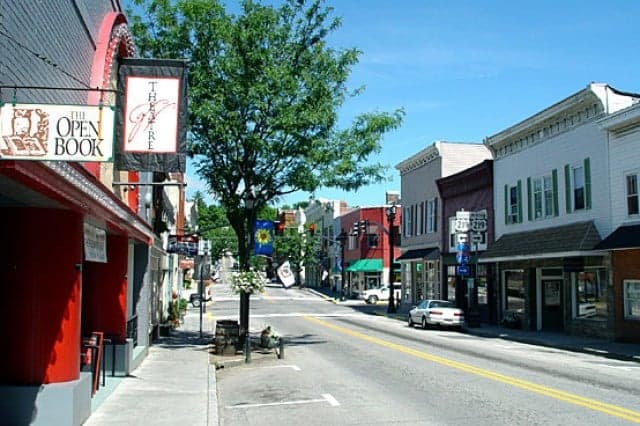
Lewisburg, West Virginia, is a small city of 3,871 residents with a distinctly educated and culturally engaged character, where 59.5% of adults hold a college degree — a figure more than double the national average for a town its size. The population is overwhelmingly white (90.8%), with the largest minority groups being Hispanic (3.6%) and East/Southeast Asian (2.6%), while the foreign-born share sits at just 2.1%. This is not a city of rapid demographic change; rather, it is a place where long-standing Appalachian roots meet a steady trickle of retirees, remote workers, and second-home owners drawn by the historic downtown and the Greenbrier Valley’s amenities. The dominant identity is one of preservation — of architecture, of small-town civility, and of a pace of life that feels deliberately removed from the pressures of larger metros.
How the city was settled and grew
Lewisburg’s human history begins with European settlement in the mid-18th century, when Scotch-Irish and German pioneers pushed west from Virginia’s Tidewater region into the Greenbrier Valley. The town was officially laid out in 1782 and named after Andrew Lewis, a colonial militia officer, and its early economy rested on agriculture, livestock, and the stagecoach trade along the Midland Trail. The original settlers clustered around what is now Historic Downtown Lewisburg, building the stone and brick structures — many still standing — that housed taverns, courthouses, and mercantile stores. A second wave arrived after the Civil War, when the Chesapeake and Ohio Railway reached nearby White Sulphur Springs, turning Lewisburg into a supply hub for the region’s timber and coal industries. This era saw the development of the Monroe Avenue corridor, where working-class families — many of them freedmen and their descendants — established homes and small businesses. By 1900, the population had stabilized around 1,500, and the city’s character as a quiet county seat was firmly set. The mid-20th century brought little new in-migration; Lewisburg remained a predominantly white, native-born community with a small Black population centered in the South Church Street area, a neighborhood that had grown out of post-Reconstruction settlement patterns.
Modern era (post-1965)
The post-1965 period in Lewisburg was not defined by the immigration waves that reshaped larger American cities, but by domestic in-migration of a specific kind. The 1970s and 1980s saw the first significant influx of outsiders since the railroad era: retirees and second-home buyers drawn by the Greenbrier Resort’s prestige and the area’s rural charm. These newcomers — predominantly white, affluent, and often from the Washington, D.C., and Northern Virginia suburbs — settled in the Greenbrier Avenue and Church Street historic districts, renovating antebellum homes and fueling a preservation movement that would define the city’s modern identity. The 1990s and 2000s brought a second domestic wave: remote workers and small-business owners seeking a lower cost of living and a slower pace. This group concentrated in the Dry Creek Road area and newer subdivisions like Stonegate, where larger lots and mountain views appealed to those fleeing suburban sprawl. The city’s Hispanic population, now 3.6%, began to grow in the 2000s, largely through labor migration tied to the region’s hospitality and construction sectors; these families settled primarily in the Fairview Road corridor, where rental housing is more available. The East/Southeast Asian community (2.6%) is a more recent arrival, composed mostly of professionals employed at the Greenbrier Resort or at nearby medical facilities, and they are dispersed rather than concentrated in a single neighborhood. The Indian-subcontinent population (0.6%) is similarly small and scattered, with no distinct ethnic enclave. The Black population, once more visible in the South Church Street area, has declined to 1.3% as younger generations have left for larger cities with more economic opportunity.
The future
Lewisburg’s demographic trajectory points toward slow, selective growth rather than rapid diversification. The city’s population has remained essentially flat — hovering around 3,800 to 3,900 for two decades — and the foreign-born share (2.1%) is unlikely to rise significantly given the lack of large employers or immigrant-service infrastructure. The Hispanic and East/Southeast Asian communities are small and stable, with no signs of rapid expansion or enclave formation; they are more likely to assimilate into the broader white-majority culture than to create distinct ethnic neighborhoods. The most notable trend is the continued in-migration of educated, relatively affluent domestic migrants — retirees and remote workers — who are drawn by the same factors that attracted the 1980s wave: historic charm, outdoor recreation, and proximity to the Greenbrier. This group is homogenizing the city further, as new arrivals tend to be white and college-educated, reinforcing the existing demographic profile. The Historic Downtown and Greenbrier Avenue areas will likely remain the most desirable and expensive, while Fairview Road and Dry Creek Road may see modest infill development as housing prices push some newcomers to the periphery. The city is not tribalizing into distinct enclaves; rather, it is becoming a more uniformly white, affluent, and culturally homogeneous place, with the small minority populations either assimilating or aging in place.
For someone moving to Lewisburg now, the city offers a stable, predictable community where the population is not growing rapidly but is becoming more selective — wealthier, older, and more educated. The trade-off is clear: you gain a preserved historic setting and a civically engaged populace, but you join a place where demographic change is slow and where the minority communities that do exist are small and dispersed. This is not a city of ethnic neighborhoods or immigrant dynamism; it is a city of careful preservation, where the people who arrive tend to look and think much like the people who were already there.

* Values derived from national, state, county, city and local statistics and may differ in a specific area. Last updated: 2026-04-19T13:09:00.000Z
Narrative content on this page is AI-generated and may contain mistakes. Verify any details that matter before acting on them.
ReloMaps may earn a commission from affiliate links at no extra cost to you.

