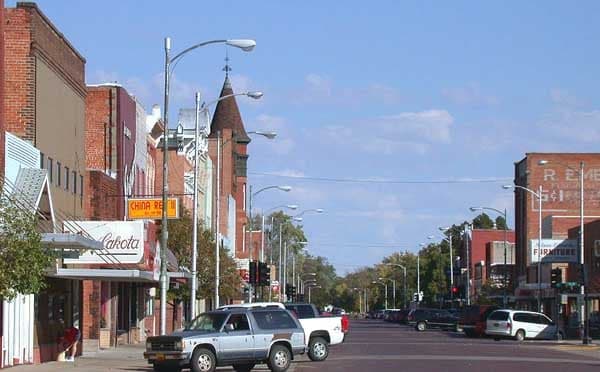
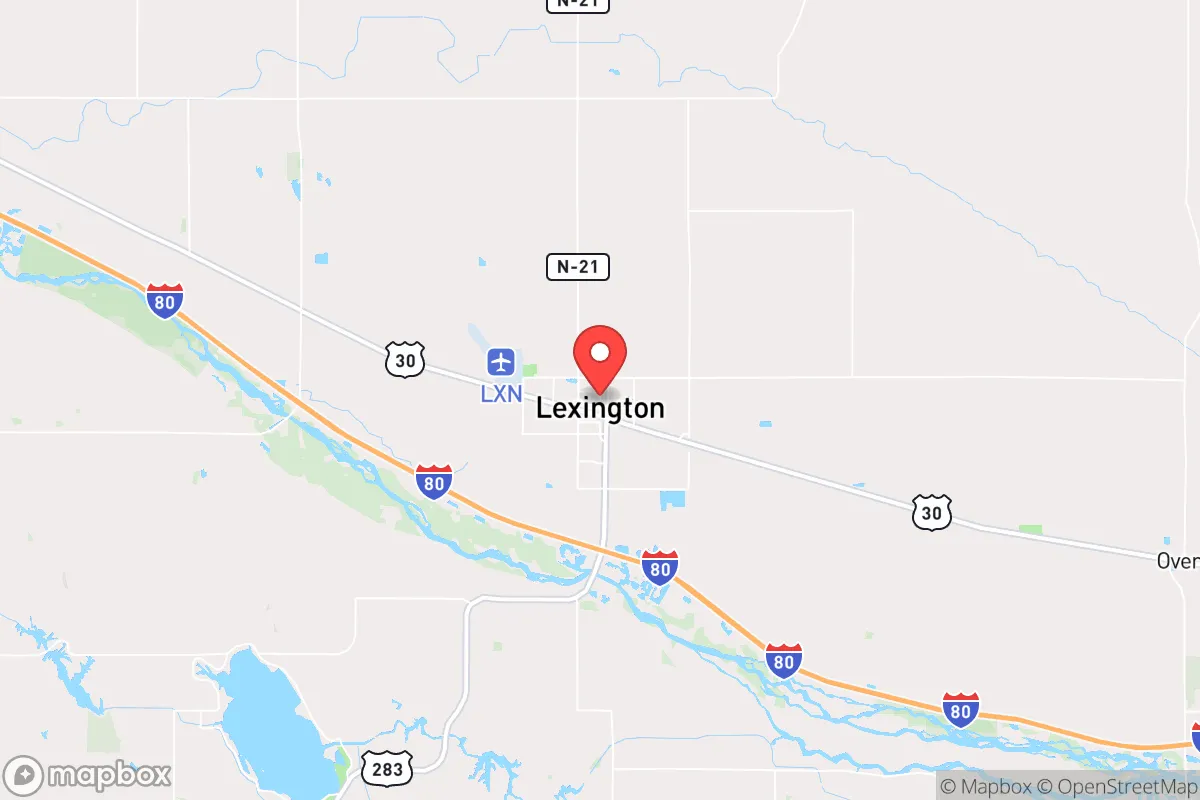
Photo: Wikipedia
Demographics of Lexington, NE
Affluence Level in Lexington, NE
A below-average socioeconomic profile. Incomes, home values, and educational attainment trail the U.S., with higher poverty and unemployment.
People of Lexington, NE
The people of Lexington, Nebraska, today form a notably diverse and working-class community of roughly 10,700 residents, characterized by a large Hispanic majority (65.0%) and significant Black (13.3%) and White (18.6%) populations. The city’s identity is shaped by its role as a regional meatpacking and agricultural hub, with a foreign-born share of 21.2% that is among the highest in the state. This is a place where newcomers and long-standing families coexist in distinct neighborhoods, creating a demographic landscape that is both dynamic and, at times, segmented by origin and income.
How the city was settled and grew
Lexington was founded in the 1870s as a railroad town along the Union Pacific line, drawing its earliest settlers from European immigrant groups, primarily Germans, Czechs, and Swedes, who were attracted by the promise of homesteading land and work on the expanding transcontinental railway. These original families built the core of what is now Downtown Lexington, centered around the courthouse square, and established the city’s agricultural economy. By the early 20th century, the town’s population remained overwhelmingly White and native-born, with a small but established Mexican-American community that had arrived to work on the railroads and in the sugar beet fields. The historic South Central neighborhood, near the old rail yards, became the first enclave for these early Hispanic laborers, a pattern that would repeat with later waves.
Modern era (post-1965)
The modern demographic transformation of Lexington began in earnest after the 1965 Hart-Cellar Act and accelerated dramatically in the 1990s and 2000s with the expansion of the IBP (now Tyson Foods) beef processing plant. This single employer drew thousands of new residents, first from Mexico and Central America, and later from Somalia, Sudan, and other East African nations. The Hispanic population surged from a modest minority to the majority, while the Black population—now 13.3%—is overwhelmingly composed of Somali and other East African refugees and their descendants. These groups settled in distinct areas: the Westside neighborhood, near the plant and along Highway 30, became the primary hub for Somali families, while the Eastside and North Lexington areas saw heavy Hispanic concentration, with many families living in mobile home parks and older single-family homes. The White population, now just 18.6%, has largely shifted to the South Lexington and Lakeview subdivisions, creating a pattern of de facto residential sorting by ethnicity and income. The East/Southeast Asian community remains very small at 0.8%, and there is no measurable Indian-subcontinent population.
The future
Lexington’s population is likely to continue its trend toward a Hispanic majority, with the Black community stabilizing or growing slowly through secondary migration from other meatpacking towns. The White population is aging and declining, as younger White residents often leave for college or urban jobs and are not replaced. The city is not homogenizing; rather, it is tribalizing into distinct enclaves, with limited social mixing between the Hispanic, Somali, and White communities. The foreign-born share (21.2%) may plateau as second-generation children assimilate linguistically, but the city’s low college attainment rate (14.0%) suggests that economic mobility remains a challenge. New housing developments on the south edge of town are attracting some White and Hispanic families seeking newer homes, but the core neighborhoods remain ethnically defined.
For someone moving to Lexington now, the city offers a low cost of living and steady employment in meatpacking and agriculture, but it is a place where community life is largely organized by ethnic background. New residents should expect to find strong, culturally specific networks—whether in the Hispanic-majority Eastside, the Somali-focused Westside, or the predominantly White South Lexington—rather than a single, integrated civic identity. The city’s future is one of continued diversity, but also of persistent economic and social segmentation.

* Values derived from national, state, county, city and local statistics and may differ in a specific area. Last updated: 2026-05-03T20:30:32.000Z
Narrative content on this page is AI-generated and may contain mistakes. Verify any details that matter before acting on them.
ReloMaps may earn a commission from affiliate links at no extra cost to you.

