Photo: Wikipedia
Demographics of Liberty, MO
Affluence Level in Liberty, MO
A middle-class area roughly in line with national averages across income, home values, education, and employment.
People of Liberty, MO
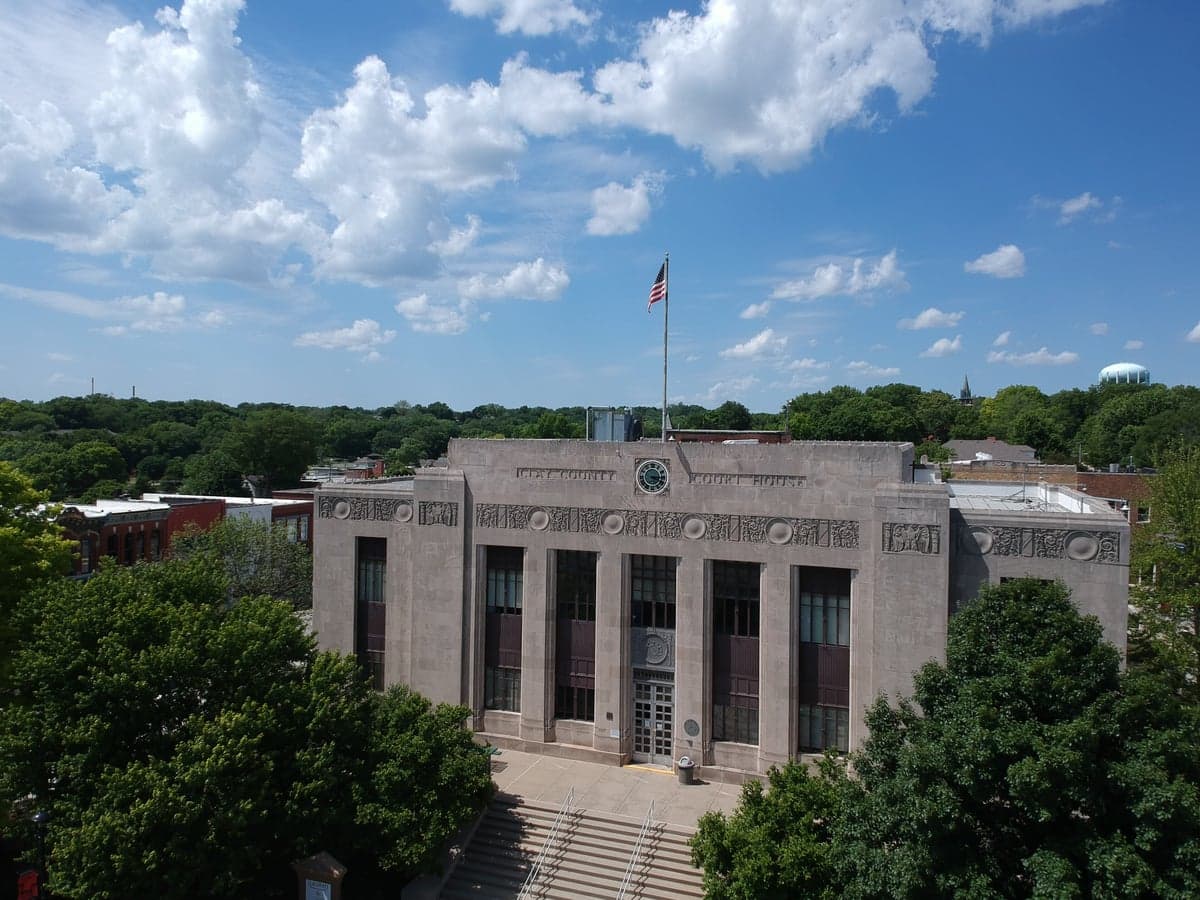
The people of Liberty, Missouri, today number roughly 30,446, forming a community that is predominantly white (83.8%) with a notably small foreign-born population of just 1.1%. The city’s character is shaped by its role as the Clay County seat and a historic college town, anchored by William Jewell College, giving it a blend of professional, educated residents—39.9% hold a bachelor’s degree or higher—and a strong sense of local tradition. Distinctively, Liberty feels more like a self-contained small city than a mere Kansas City suburb, with its own historic square, established neighborhoods, and a population that is both stable and slowly diversifying, primarily through domestic in-migration rather than international immigration.
How the city was settled and grew
Liberty was founded in 1822 as the county seat of Clay County, drawing its earliest settlers from the Upper South—primarily Kentucky, Tennessee, and Virginia—who were attracted by fertile land and the promise of river access via the nearby Missouri River. These original families, often slaveholding farmers, established the town’s grid around the historic Liberty Square, which remains the civic and commercial heart. The arrival of William Jewell College in 1849 brought a second wave of residents: educators, ministers, and their families, who settled in the College Hill neighborhood surrounding the campus. The post-Civil War era saw modest growth from German and Irish immigrants who worked as tradesmen and laborers, with many settling in the Westside Historic District, an area of Victorian homes built by these working-class families. Through the early 20th century, Liberty remained a quiet agricultural and educational hub, with its population growing slowly as the children of these founding families stayed put.
Modern era (post-1965)
The 1965 Hart-Cellar Act had minimal direct impact on Liberty, as the city’s foreign-born population remains tiny at 1.1%. Instead, the modern era has been defined by domestic suburbanization. Beginning in the 1970s and accelerating through the 1990s, Liberty absorbed white, middle-class families moving north from Kansas City proper, seeking larger lots and lower crime rates. This wave filled new subdivisions like Lakeside at Liberty and Briarcliff Village (the latter straddling the Kansas City line), which attracted professionals commuting to downtown Kansas City. The 2000s brought a smaller but notable influx of Hispanic families (now 5.2% of the population), who concentrated in the South Liberty area near the intersection of Missouri 152 and I-35, drawn by construction and service jobs. The Black population (4.6%) has grown modestly, with families settling in established neighborhoods like Kensington and newer subdivisions near Liberty High School. East/Southeast Asian residents (1.5%) and Indian-subcontinent residents (0.2%) are scattered but visible in the college and medical sectors, often living near the William Jewell College campus or in the North Liberty area near Liberty Hospital. The city’s overall racial composition has shifted only gradually: the white share dropped from roughly 93% in 2000 to 83.8% today, driven almost entirely by domestic Hispanic and Black in-migration, not international arrivals.
The future
Liberty’s population is heading toward slow, steady growth—projected to reach 35,000–38,000 by 2040—but it is not homogenizing into a single enclave. Instead, the city is tribalizing along geographic and economic lines. The College Hill and Westside Historic District areas are becoming denser with young professionals and empty-nesters, while the Lakeside and Briarcliff subdivisions remain overwhelmingly white and family-oriented. The Hispanic community in South Liberty is growing but plateauing, as second-generation families assimilate into broader suburban patterns. The Black and Asian populations are likely to increase slowly, driven by Kansas City’s expanding professional class seeking affordable housing, but no single immigrant group is poised to transform the city’s character. The foreign-born share will likely remain below 3% for the foreseeable future, as Liberty lacks the industrial or service-sector magnets that attract large immigrant populations.
For someone moving in now, Liberty is becoming a more diverse but still predominantly white, college-educated suburb with a strong local identity. The city offers a stable, family-oriented environment where neighborhood choice largely determines social experience—from the historic walkability of College Hill to the car-dependent sprawl of Lakeside. The population is not fragmenting into conflict, but it is sorting into distinct lifestyle zones, making it important for newcomers to choose a neighborhood that aligns with their priorities.

* Values derived from national, state, county, city and local statistics and may differ in a specific area. Last updated: 2026-04-30T02:22:09.000Z
Narrative content on this page is AI-generated and may contain mistakes. Verify any details that matter before acting on them.
ReloMaps may earn a commission from affiliate links at no extra cost to you.

