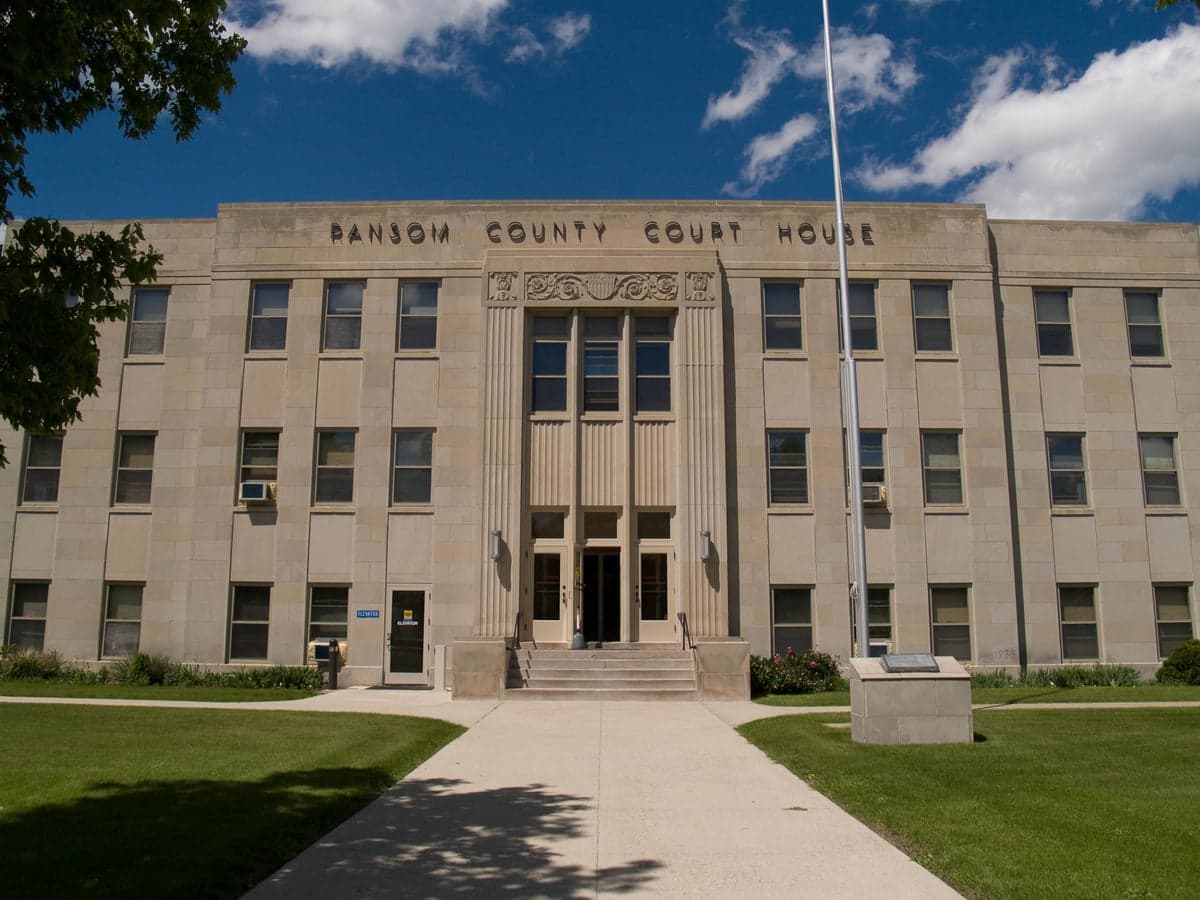
Photo: Wikipedia
Demographics of Lisbon, ND
Affluence Level in Lisbon, ND
A below-average socioeconomic profile. Incomes, home values, and educational attainment trail the U.S., with higher poverty and unemployment.
People of Lisbon, ND
The people of Lisbon, North Dakota today number 2,262, forming a tight-knit, predominantly white community with a strong agricultural and manufacturing heritage. The city is notably homogeneous, with 91.9% of residents identifying as white, a foreign-born population of just 0.7%, and a small but present Hispanic (1.4%) and Black (1.7%) community. The population is older and less college-educated than the national average, with 20.1% holding a bachelor's degree or higher, reflecting a community rooted in hands-on trades and family-run farms rather than a knowledge economy.
How the city was settled and grew
Lisbon was founded in 1880 as a railroad town on the Sheyenne River, named after the capital of Portugal by a railroad official. The original settlers were predominantly Scandinavian and German immigrants drawn by the promise of cheap land under the Homestead Act and the jobs created by the Northern Pacific Railway. The first wave built their homes in the Original Townsite along Main Street, where the grain elevators and depot anchored daily life. A second wave of German-Russian immigrants, fleeing conscription and land shortages in the Russian Empire, arrived in the 1890s and 1900s, settling in the North Side neighborhood near the railroad tracks, where they established St. Aloysius Catholic Church as a cultural anchor. By 1910, the population had reached 1,200, and the city's economy diversified with the opening of a brick plant and a creamery, drawing a small number of Irish and Czech laborers who clustered in the South End along the river. The city's growth plateaued after World War II, as younger generations left for larger cities, but the core Scandinavian and German character remained intact through the mid-20th century.
Modern era (post-1965)
After the 1965 Hart-Cellar Act, Lisbon saw virtually no new immigration, unlike larger North Dakota cities. The foreign-born share has never risen above 1%, and the city's demographic story since 1965 is one of domestic stability and slow decline. The West Hill neighborhood, developed in the 1970s and 1980s, attracted a small number of families moving from rural farms into town, but the overall population fell from a peak of roughly 2,400 in 1960 to 2,262 today. The small Hispanic population (1.4%) is largely concentrated in the East Side near the ag processing plants, where seasonal workers from Texas and Mexico have settled permanently. The Black population (1.7%) is a recent arrival, primarily families connected to the state's oil boom or military service at the nearby Fargo Air National Guard Base, and they are scattered across the Downtown rental stock rather than forming a distinct enclave. The East/Southeast Asian community (0.7%) is almost entirely Hmong families who moved from the Twin Cities in the 2000s for lower housing costs, settling in the Riverside area. The Indian subcontinent population is effectively zero, reflecting the city's lack of tech or medical sectors that typically attract that group.
The future
Lisbon's population is projected to remain flat or decline slightly over the next decade, as the aging white population (median age 45) is not being replaced by younger families. The city is not tribalizing into distinct ethnic enclaves; instead, the small minority populations are assimilating into the broader community, with intermarriage rates high among the Hispanic and Black residents. The Hmong community is the most cohesive, maintaining a small cultural center in the Riverside neighborhood, but their numbers are too small to sustain growth. The biggest demographic shift is likely to be continued out-migration of young adults to Fargo (45 miles east) for jobs and education, leaving an even older, whiter population behind. No new immigrant waves are expected, as Lisbon lacks the employers—no major university, no refugee resettlement agency, no large meatpacking plant—that drive diversity in other rural towns.
For someone moving in now, Lisbon is becoming a quieter, more homogeneous place than it already was—a stable, low-diversity community where the few non-white residents are integrated but isolated by sheer numbers. The city offers a safe, predictable environment for conservative-leaning families who value tradition and low crime, but it offers little ethnic or cultural variety, and the population trend suggests that character will only deepen over the next 20 years.

* Values derived from national, state, county, city and local statistics and may differ in a specific area. Last updated: 2026-04-19T08:56:51.000Z
Narrative content on this page is AI-generated and may contain mistakes. Verify any details that matter before acting on them.
ReloMaps may earn a commission from affiliate links at no extra cost to you.

